
嗅觉感觉神经元切除后嗅球中间神经元的细胞类型和层特异性可塑性。
Cell type- and layer-specific plasticity of olfactory bulb interneurons following olfactory sensory neuron ablation.
作者信息
Kunkhyen Tenzin, Brechbill Taryn R, Berg Sarah P R, Pothuri Pranitha, Rangel Alexander N, Gupta Ashna, Cheetham Claire E J
机构信息
Department of Neurobiology, University of Pittsburgh, Pittsburgh, PA, 15213, USA.
出版信息
Sci Rep. 2024 Aug 1;14(1):17771. doi: 10.1038/s41598-024-68649-4.
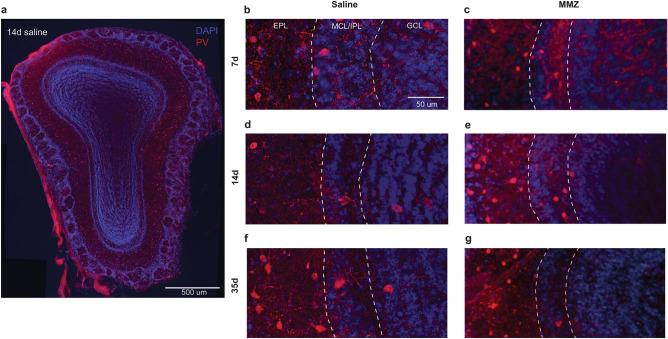
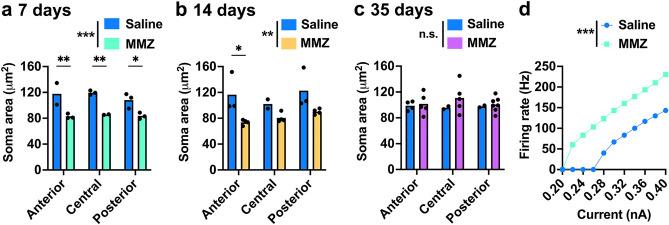
Lifelong neurogenesis endows the mouse olfactory system with a capacity for regeneration that is unique in the mammalian nervous system. Throughout life, olfactory sensory neurons (OSNs) are generated from olfactory epithelium (OE) stem cells in the nose, while the subventricular zone generates neuroblasts that migrate to the olfactory bulb (OB) and differentiate into multiple populations of inhibitory interneurons. Methimazole (MMZ) selectively ablates OSNs, but OE neurogenesis enables OSN repopulation and gradual recovery of OSN input to the OB within 6 weeks. However, it is not known how OB interneurons are affected by this loss and subsequent regeneration of OSN input following MMZ treatment. We found that dopaminergic neuron density was significantly reduced 7-14 days post-MMZ but recovered substantially at 35 days. The density of parvalbumin-expressing interneurons was unaffected by MMZ; however, their soma size was significantly reduced at 7-14 days post-MMZ, recovering by 35 days. Surprisingly, we found a transient increase in the density of calretinin-expressing neurons in the glomerular and external plexiform layers, but not the granule cell layer, 7 days post-MMZ. This could not be accounted for by increased neurogenesis but may result from increased calretinin expression. Together, our data demonstrate cell type- and layer-specific changes in OB interneuron density and morphology after MMZ treatment, providing new insight into the range of plasticity mechanisms employed by OB circuits during loss and regeneration of sensory input.
终身神经发生赋予小鼠嗅觉系统一种再生能力,这在哺乳动物神经系统中是独一无二的。在整个生命过程中,嗅觉感觉神经元(OSN)由鼻腔中的嗅觉上皮(OE)干细胞产生,而脑室下区产生神经母细胞,这些神经母细胞迁移到嗅球(OB)并分化为多种抑制性中间神经元群体。甲巯咪唑(MMZ)可选择性地消除OSN,但OE神经发生可使OSN重新填充,并在6周内使OSN向OB的输入逐渐恢复。然而,尚不清楚MMZ治疗后这种OSN输入的丧失和随后的再生如何影响OB中间神经元。我们发现,MMZ治疗后7 - 14天,多巴胺能神经元密度显著降低,但在35天时大幅恢复。表达小白蛋白的中间神经元密度不受MMZ影响;然而,在MMZ治疗后7 - 14天,它们的胞体大小显著减小,到35天时恢复。令人惊讶的是,我们发现在MMZ治疗后7天,肾小球层和外丛状层中表达钙视网膜蛋白的神经元密度短暂增加,但颗粒细胞层中没有增加。这不能用神经发生增加来解释,可能是由于钙视网膜蛋白表达增加所致。总之,我们的数据表明MMZ治疗后OB中间神经元密度和形态存在细胞类型和层特异性变化,为OB回路在感觉输入丧失和再生过程中所采用的可塑性机制范围提供了新的见解。





 Zotero 插件