Faculté de Gestion des Ressources Naturelles Renouvelables, Université de Kisangani, Kisangani, Democratic Republic of the Congo.
Evolutionary Biology and Ecology Unit CP 160/12, Faculté des Sciences, Université Libre de Bruxelles, Brussels, Belgium.
Heredity (Edinb). 2024 Oct;133(4):238-248. doi: 10.1038/s41437-024-00709-x. Epub 2024 Aug 1.
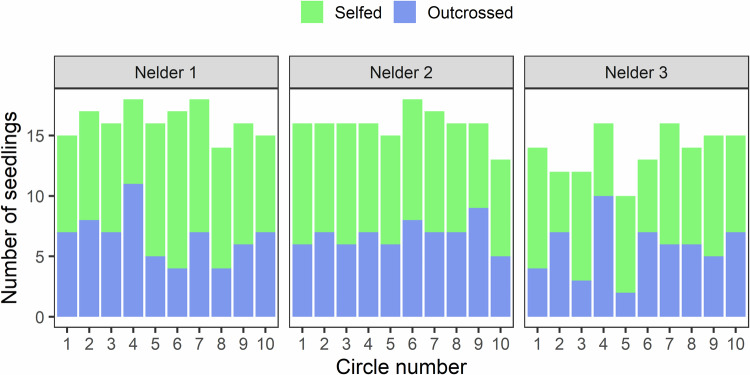
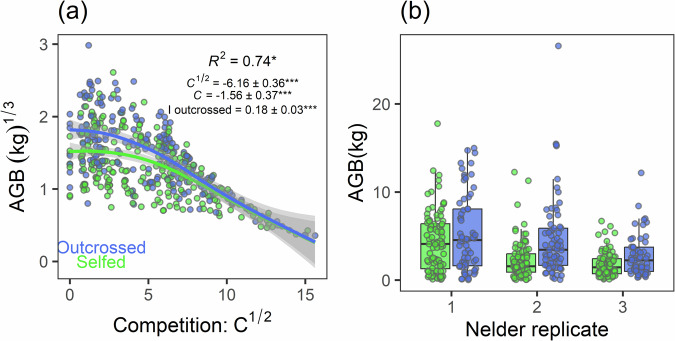
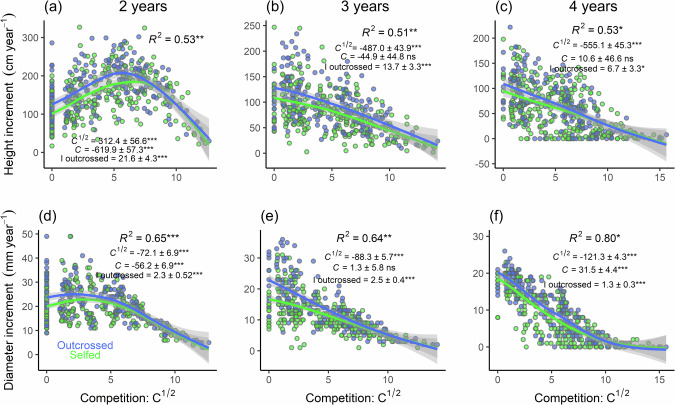
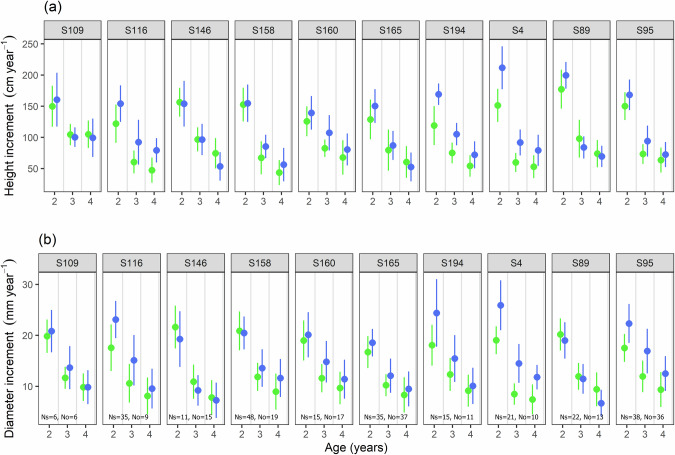
Selfing or mating between related individuals can lead to inbreeding depression (ID), which can influence the survival, growth and evolution of populations of tree species. As selective logging involves a decrease in the density of congeneric partners, it could lead to increasing biparental inbreeding or self-fertilization, exposing the population to higher ID. We assessed the influence of inbreeding on the growth of a commercial timber species, Pericopsis elata (Fabaceae), which produced about 54% of self-fertilized seedlings in a natural population of the Congo basin. We followed the survival and growth of 540 plants raised in a plantation along a gradient of plant density (0.07-15.9 plants per m). Parentage analysis allowed us distinguishing selfed and outcrossed seedlings. The annual growth was higher for outcrossed than selfed plants, on average by 10.8% for diameter and 12.9% for height growth. Based on the difference in above ground biomass between selfed and outcrossed seedlings after 41 months, we estimated the level of ID at δ = 0.33, while a lifetime estimate of ID based on the proportions of selfed plants at seedling and adult stages led to δ = 0.7. The level of ID on growth rate did not change significantly with age but tended to vanish under high competition. Pericopsis elata is a particularly interesting model because inbreeding depression is partial, with about 26% of reproducing adults resulting from selfing, contrary to most tropical tree species where selfed individuals usually die before reaching adulthood. Hence, the risks of ID must be considered in the management and conservation of the species.
自交或近亲交配可能导致近交衰退(ID),从而影响树种种群的存活、生长和进化。由于选择性采伐会降低同属伙伴的密度,这可能导致双亲亲本的近交或自交增加,使种群面临更高的 ID 风险。我们评估了近交对商业木材树种——Pericopsis elata(豆科)生长的影响,该树种在刚果盆地的一个自然种群中产生了约 54%的自交种子。我们沿着种植密度梯度(每平方米 0.07-15.9 株)对种植园中 540 株植物的存活和生长进行了跟踪。通过亲代分析,我们可以区分自交和异交的幼苗。异交苗的年生长速度高于自交苗,平均直径生长速度高出 10.8%,高度生长速度高出 12.9%。根据 41 个月后自交和异交幼苗地上生物量的差异,我们估计 ID 水平为 δ=0.33,而基于幼苗和成年阶段自交植物比例的终生 ID 估计值导致 δ=0.7。ID 对生长速度的影响随年龄变化不大,但在竞争激烈时趋于消失。Pericopsis elata 是一个特别有趣的模型,因为近交衰退是部分的,大约 26%的繁殖成体是自交的,与大多数热带树种不同,自交个体通常在成年前死亡。因此,在管理和保护该物种时,必须考虑 ID 的风险。