Department of Respiratory and Critical Care Medicine, The First Affiliated Hospital, Chongqing Medical University, Chongqing, 400016, People's Republic of China.
Department of Respiratory and Critical Care Medicine, Affiliated University Town Hospital of Chongqing Medical University, Chongqing, 401331, People's Republic of China.
BMC Infect Dis. 2024 Aug 1;24(1):767. doi: 10.1186/s12879-024-09482-y.
In this study, we aim to explore the efficacy of paxlovid on reducing mortality of COVID-19 patients in clinical setting, especially whether paxlovid modifies the risk of death in these severe and critical patients.
Our retrospective cohort study was conducted on the medical records of patients, consecutively admitted for COVID-19 to five hospitals in Chongqing, China from Dec 8, 2022 to Jan 20, 2023. Based on whether patients received paxlovid during their hospitalization, patients were grouped as paxlovid group and non-paxlovid group. We used 1:1 ratio propensity score matching (PSM) in our study to adjust for confounding factors and differences between groups. Statistical analysis were performed by SPSS 23.0. The differences in 28-day mortality between these two groups and its influencing factors were the main results we focused on.
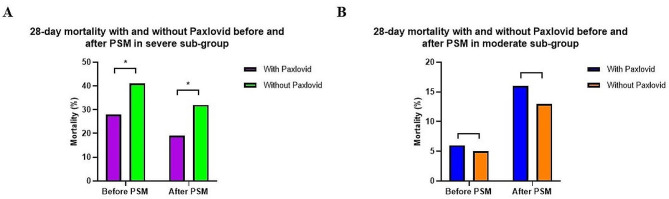
There were 1018 patients included in our study cohort. With 1:1 ratio PSM, each of the paxlovid group and non-paxlovid group included 237 patients. The results showed that patients using paxlovid have a lower 28-day mortality in overall population either before PSM (OR 0.594, 95% CI 0.385-0.917, p = 0.019) or after PSM (OR 0.458, 95% CI 0.272-0.774, p = 0.003) with multivariable adjusted logistic regression models. Meanwhile, in severe subgroup, it showed similar findings.With paxlovid treatment, it showed a significantly lower 28-day mortality in severe subgroup both before PSM (28% vs.41%, p = 0.008) and after PSM (19% vs.32%, p = 0.007).
Paxlovid can significantly reduce the risk of 28-day mortality in overall population and severe subgroup patients.This study distinguished the severe subgroup patients with COVID-19 who benefit more from paxlovid treatment.
本研究旨在探讨帕罗韦德在临床环境下降低 COVID-19 患者死亡率的疗效,特别是帕罗韦德是否改变这些重症和危重症患者的死亡风险。
我们的回顾性队列研究纳入了 2022 年 12 月 8 日至 2023 年 1 月 20 日期间连续收治于中国重庆五家医院的 COVID-19 患者的病历。根据患者住院期间是否使用帕罗韦德,将患者分为帕罗韦德组和非帕罗韦德组。我们在研究中使用 1:1 比例倾向评分匹配(PSM)来调整混杂因素和组间差异。统计分析采用 SPSS 23.0 进行。我们主要关注两组患者 28 天死亡率的差异及其影响因素。
本研究队列共纳入 1018 例患者。经过 1:1 比例 PSM,帕罗韦德组和非帕罗韦德组各纳入 237 例患者。结果显示,总体人群中使用帕罗韦德的患者 28 天死亡率较低,无论在 PSM 前(OR 0.594,95%CI 0.385-0.917,p=0.019)还是 PSM 后(OR 0.458,95%CI 0.272-0.774,p=0.003),多变量调整后的逻辑回归模型均显示出这一结果。同时,在重症亚组中也得出了类似的发现。在重症亚组中,使用帕罗韦德治疗的患者 28 天死亡率明显较低,无论在 PSM 前(28%比 41%,p=0.008)还是 PSM 后(19%比 32%,p=0.007)。
帕罗韦德可显著降低总体人群和重症亚组患者 28 天死亡率。本研究区分了 COVID-19 重症亚组患者,这些患者从帕罗韦德治疗中获益更多。