Epidemic Intelligence Service, U.S. Centers for Disease Control and Prevention, 1600 Clifton Rd, Atlanta, GA, 30333, USA.
PATH PAMO Plus, Lusaka, Zambia.
Malar J. 2024 Aug 1;23(1):226. doi: 10.1186/s12936-024-05047-1.
Malaria community case management (CCM) can improve timely access to healthcare, and CCM programmes in sub-Saharan Africa are expanding from serving children under 5 years (CU5) only to all ages. This report characterizes malaria case management in the setting of an age-expanded CCM programme in Chadiza District, Zambia.
Thirty-three households in each of 73 eligible communities were randomly selected to participate in a household survey preceding a trial of proactive CCM (NCT04839900). All household members were asked about fever in the prior two weeks and received a malaria rapid diagnostic test (RDT); those reporting fever were asked about healthcare received. Weighted population estimates were calculated and mixed effects regression was used to assess factors associated with malaria care seeking.
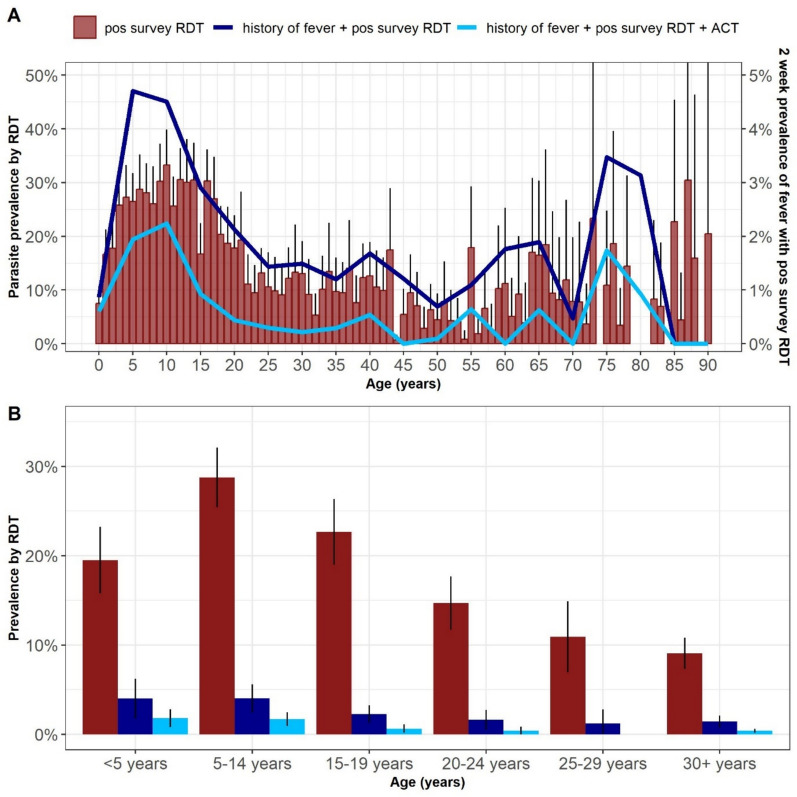
Among 11,030 (98.6%) participants with RDT results (2,357 households), parasite prevalence was 19.1% by RDT; school-aged children (SAC, 5-14 years) had the highest prevalence (28.8%). Prior fever was reported by 12.4% of CU5, 7.5% of SAC, and 7.2% of individuals ≥ 15 years. Among those with prior fever, 34.0% of CU5, 56.0% of SAC, and 22.6% of individuals ≥ 15 years had a positive survey RDT and 73.7% of CU5, 66.5% of SAC, and 56.3% of individuals ≥ 15 years reported seeking treatment; 76.7% across all ages visited a CHW as part of care. Nearly 90% (87.8%) of people who visited a CHW reported a blood test compared with 73.5% seen only at a health facility and/or pharmacy (p < 0.001). Reported malaria treatment was similar by provider, and 85.9% of those with a reported positive malaria test reported getting malaria treatment; 66.9% of the subset with prior fever and a positive survey RDT reported malaria treatment. Age under 5 years, monthly or more frequent CHW home visits, and greater wealth were associated with increased odds of receiving healthcare.
Chadiza District had high CHW coverage among individuals who sought care for fever. Further interventions are needed to increase the proportion of febrile individuals who receive healthcare. Strategies to decrease barriers to healthcare, such as CHW home visits, particularly targeting those of all ages in lower wealth strata, could maximize the benefits of CHW programmes.
疟疾社区病例管理(CCM)可以改善及时获得医疗保健的机会,撒哈拉以南非洲的 CCM 计划正在从仅为 5 岁以下儿童(CU5)扩大到所有年龄段。本报告描述了赞比亚恰迪扎区在扩大年龄的 CCM 计划背景下的疟疾病例管理情况。
在主动 CCM 试验(NCT04839900)之前,从每个符合条件的 73 个社区中随机选择 33 个家庭参与家庭调查。所有家庭都被问到在过去两周内是否发烧,并接受了疟疾快速诊断检测(RDT);报告发烧的人被问到接受了何种医疗服务。计算了加权人口估计数,并使用混合效应回归来评估与寻求医疗保健相关的因素。
在有 RDT 结果的 11030 名(98.6%)参与者中(2357 户),RDT 检测寄生虫患病率为 19.1%;学龄儿童(SAC,5-14 岁)患病率最高(28.8%)。有 12.4%的 CU5、7.5%的 SAC 和 7.2%的≥15 岁的人报告有发热前症状。在有发热前症状的人中,有 34.0%的 CU5、56.0%的 SAC 和 22.6%的≥15 岁的人 RDT 检测呈阳性,有 73.7%的 CU5、66.5%的 SAC 和 56.3%的≥15 岁的人报告接受了治疗;所有年龄段中有 76.7%的人都曾去 CHW 就诊。几乎 90%(87.8%)去 CHW 就诊的人报告进行了血液检查,而只有 73.5%的人去了卫生机构和/或药店(p<0.001)。就诊提供者报告的疟疾治疗情况相似,有报告的疟疾病例检测呈阳性的人中,有 85.9%接受了疟疾治疗;在有发热前症状和 RDT 检测呈阳性的亚组中,有 66.9%的人接受了疟疾治疗。年龄在 5 岁以下、每月或更频繁的 CHW 家访以及更高的财富与获得医疗保健的机会增加有关。
恰迪扎区有大量的 CHW 为发热患者提供服务。需要进一步干预措施来增加获得医疗保健的发热人数比例。减少医疗保健障碍的策略,如 CHW 家访,特别是针对所有年龄段和较低财富阶层的人,可以最大限度地发挥 CHW 计划的效益。