Department of Neuromedicine and Movement Science, Faculty of Medicine and Health Sciences, Norwegian University of Science and Technology (NTNU), Trondheim, 7491, Norway.
Department of Physiotherapy, Kathmandu University School of Medical Sciences, Dhulikhel, Kavre, Nepal.
BMC Health Serv Res. 2024 Aug 1;24(1):876. doi: 10.1186/s12913-024-11272-w.
Physiotherapy provides non-invasive and non-pharmaceutical intervention for curative, rehabilitation and preventative purposes. Physiotherapy is also a central provider of health promotion. As the global burden of non-communicable diseases and chronic health conditions is rising, the importance of physiotherapy services increases. Unfortunately, physiotherapy services in low- and middle-income countries (LMICs) are generally unsatisfactory. In Nepal, the earthquake in 2015 and the COVID pandemic have clearly illuminated the importance of physiotherapy.
This qualitative study aimed to identify barriers and facilitators at different system levels for strengthening physiotherapy services in Nepal.
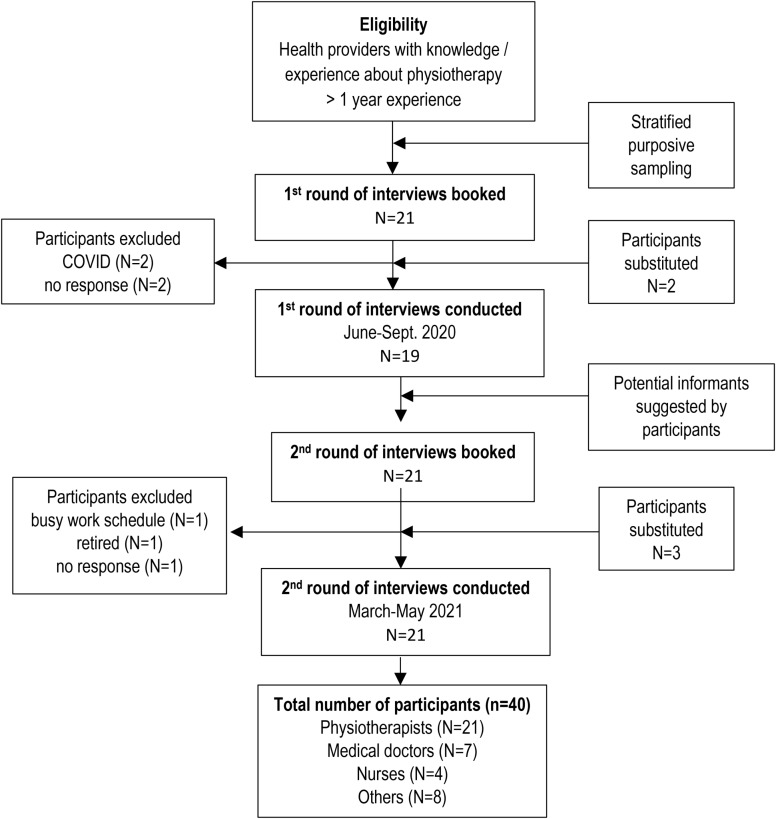
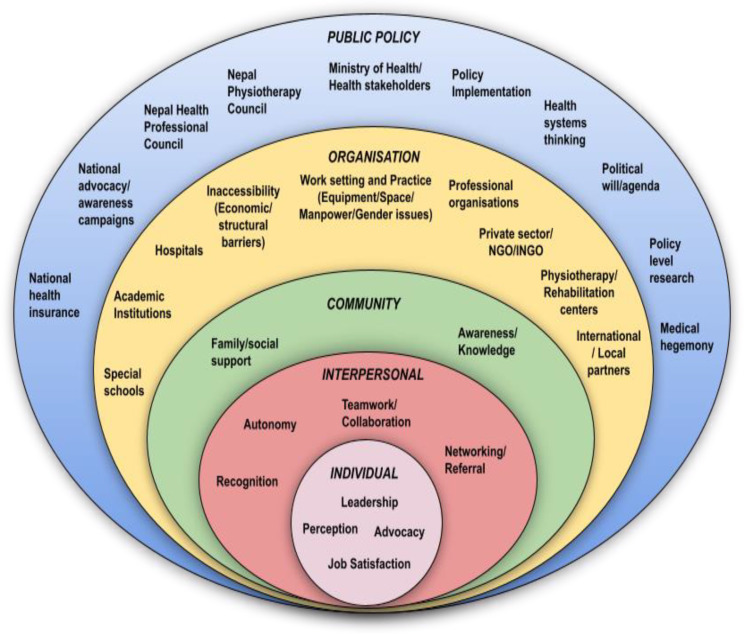
Forty semi-structured individual interviews were performed with different health providers. Transcribed interviews were assessed with thematic analysis. A five-level socioecological framework conceptualised multilevel determinants of barriers and facilitators.
The study revealed various factors that were potential barriers and facilitators across five different levels, namely individual (taking the lead, need for advocacy), interpersonal (lack of recognition and autonomy, networking for referrals and coordination), community (lack of knowledge and awareness, social and family support), organisational (accessibility, workplace and clinical practice, educational opportunities, role of organisations and rehabilitation centres), and public policy level (planning and implementation of policies and programs, medical hegemony, priorities). Government officials, local leaders, and clinicians, half of whom were physiotherapists, agreed on many of the same issues, where a lack of awareness of what physiotherapy is and knowledge about what physiotherapists do was central.
The results provide information for the development of physiotherapy by pointing out key elements that need attention. Our broad and structured investigation strategy is applicable to others for a comprehensive analysis of barriers and facilitators for physiotherapy services.
物理治疗为治疗、康复和预防目的提供非侵入性和非药物干预。物理治疗也是促进健康的主要提供者。随着非传染性疾病和慢性健康状况的全球负担不断增加,物理治疗服务的重要性也在增加。不幸的是,中低收入国家(LMICs)的物理治疗服务普遍不尽如人意。在尼泊尔,2015 年的地震和 COVID 大流行清楚地说明了物理治疗的重要性。
本定性研究旨在确定不同系统层面加强尼泊尔物理治疗服务的障碍和促进因素。
对不同的卫生提供者进行了 40 次半结构式个人访谈。对转录访谈进行了主题分析评估。一个五级社会生态框架概念化了多水平障碍和促进因素的决定因素。
研究揭示了五个不同层次的各种潜在障碍和促进因素,包括个人(带头、倡导需求)、人际(缺乏认可和自主权、转诊和协调网络)、社区(缺乏知识和意识、社会和家庭支持)、组织(可及性、工作场所和临床实践、教育机会、组织和康复中心的作用)和公共政策层面(政策和计划的规划和实施、医学霸权、优先事项)。政府官员、地方领导人和临床医生(其中一半是物理治疗师)对许多相同的问题达成了一致,他们对物理治疗是什么缺乏认识,对物理治疗师的工作内容知之甚少。
研究结果为物理治疗的发展提供了信息,指出了需要关注的关键要素。我们广泛而结构化的调查策略适用于其他人,以全面分析物理治疗服务的障碍和促进因素。