Shandong University Cancer Center, Shandong University, Jinan, Shandong, China.
Department of Radiation Oncology, Shandong Cancer Hospital and Institute, Shandong First Medical University, and Shandong Academy of Medical Sciences, Jinan, Shandong, China.
Cancer Immunol Immunother. 2024 Aug 2;73(10):189. doi: 10.1007/s00262-024-03762-x.
The interplay between regulatory T cells (Tregs) and neighboring cells, which is pivotal for anti-tumor immunity and closely linked to patient prognosis, remains to be fully elucidated.
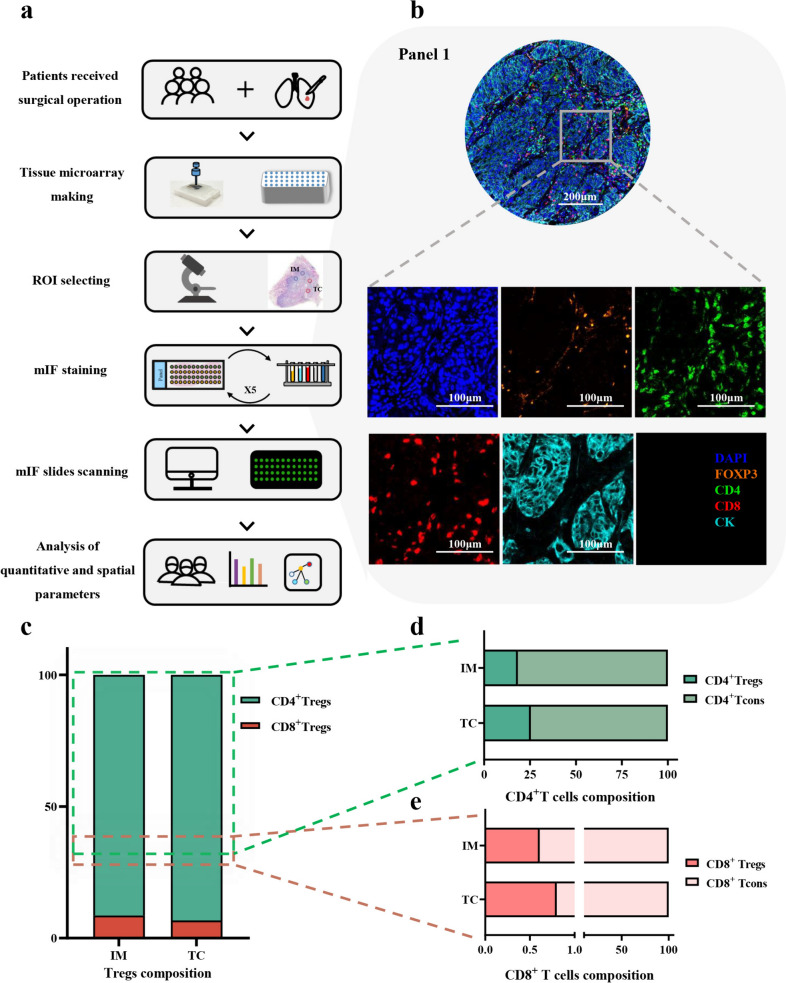
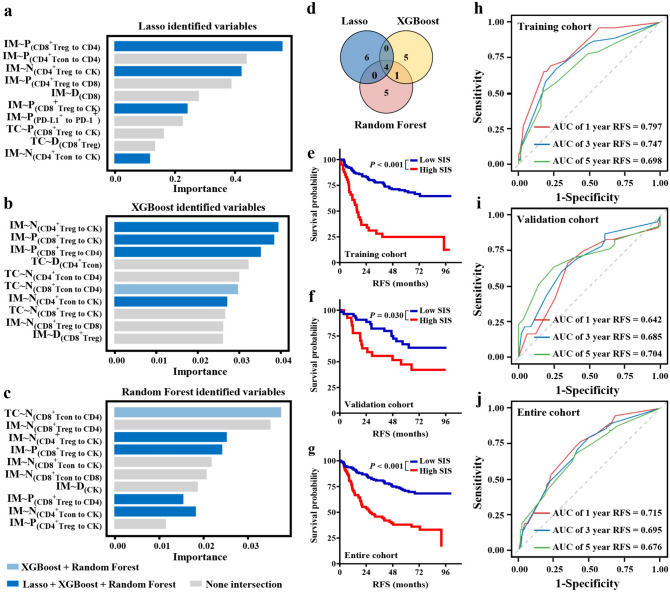
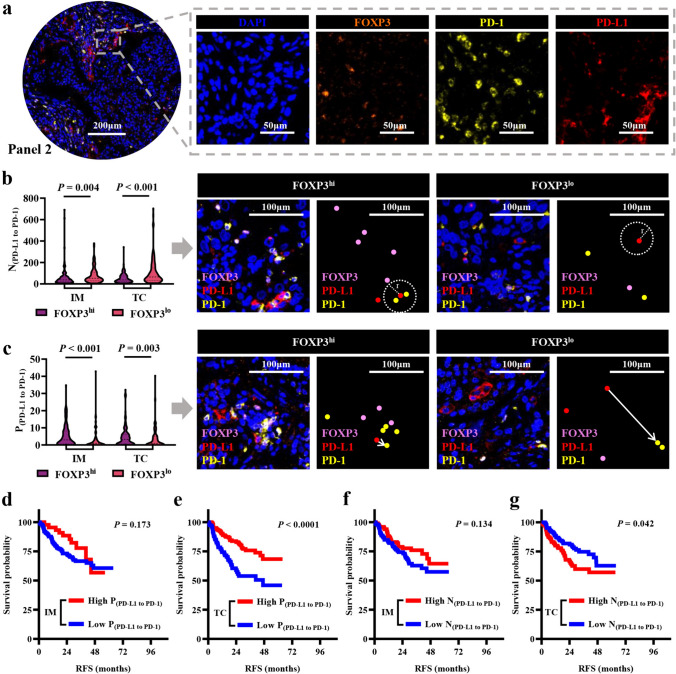
Tissue microarrays of 261 operable NSCLC patients were stained by multiplex immunofluorescence (mIF) assay, and the interaction between Tregs and neighboring cells in the tumor microenvironment (TME) was evaluated. Employing various machine learning algorithms, we developed a spatial immune signature to predict the prognosis of NSCLC patients. Additionally, we explored the interplay between programmed death-1/programmed death ligand-1 (PD-1/PD-L1) interactions and their relationship with Tregs.
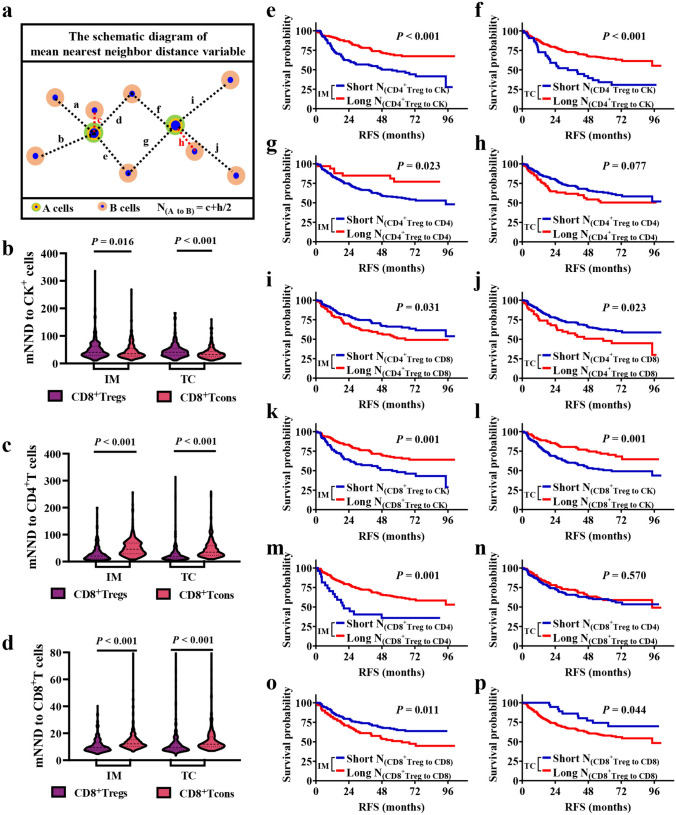
Survival analysis indicated that the interplay between Tregs and neighboring cells in the invasive margin (IM) and tumor center was associated with recurrence in NSCLC patients. We integrated the intersection of the three algorithms to identify four crucial spatial immune features [P in IM, P in IM, N in IM, N in IM] and employed these characteristics to establish SIS, an independent prognosticator of recurrence in NSCLC patients [HR = 2.34, 95% CI (1.53, 3.58), P < 0.001]. Furthermore, analysis of cell interactions demonstrated that a higher number of Tregs contributed to higher PD-L1 cells surrounded by PD-1 cells (P < 0.001) with shorter distances (P = 0.004).
We dissected the cell interplay network within the TME, uncovering the spatial architecture and intricate interactions between Tregs and neighboring cells, along with their impact on the prognosis of NSCLC patients.
调节性 T 细胞(Tregs)与相邻细胞之间的相互作用对于抗肿瘤免疫至关重要,并且与患者的预后密切相关,但目前仍未完全阐明。
对 261 例可手术的非小细胞肺癌(NSCLC)患者的组织微阵列进行多重免疫荧光(mIF)检测,并评估肿瘤微环境(TME)中 Tregs 与相邻细胞之间的相互作用。我们采用各种机器学习算法,开发了一种空间免疫特征来预测 NSCLC 患者的预后。此外,我们还探讨了程序性死亡受体-1/程序性死亡配体-1(PD-1/PD-L1)相互作用与其与 Tregs 之间的关系。
生存分析表明,Tregs 与侵袭边缘(IM)和肿瘤中心的相邻细胞之间的相互作用与 NSCLC 患者的复发有关。我们整合了三种算法的交点,鉴定出四个关键的空间免疫特征[IM 中的 P、IM 中的 P、IM 中的 N、IM 中的 N],并利用这些特征建立了 SIS,这是非小细胞肺癌患者复发的独立预后指标[HR=2.34,95%CI(1.53,3.58),P<0.001]。此外,细胞相互作用分析表明,Tregs 数量的增加与 PD-1 细胞周围 PD-L1 细胞(P<0.001)和距离较短(P=0.004)有关。
我们剖析了 TME 中的细胞相互作用网络,揭示了 Tregs 与相邻细胞之间的空间结构和复杂相互作用,以及它们对 NSCLC 患者预后的影响。