Key Laboratory of Animal Physiology & Biochemistry, College of Veterinary Medicine, Nanjing Agricultural University, Nanjing 210095, P. R. China.
Institute of Animal Science, Jiangsu Academy of Agricultural Sciences, Nanjing 210014, China.
Poult Sci. 2024 Oct;103(10):104075. doi: 10.1016/j.psj.2024.104075. Epub 2024 Jul 8.
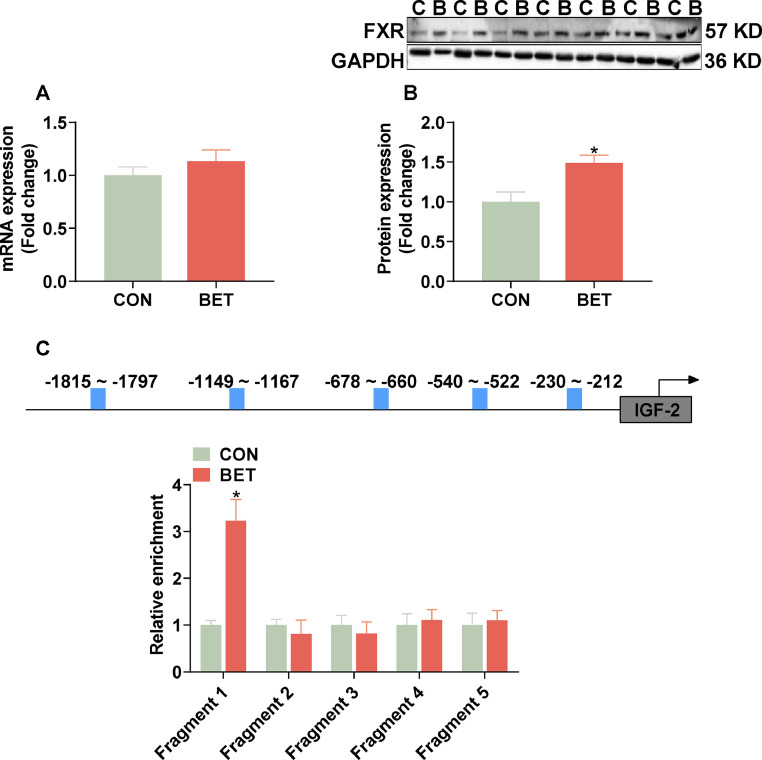
Betaine has been shown to enhance growth performance and increase breast muscle yield in ducks and broilers through various mechanisms, including the modification of DNA methylation. However, the impact of in ovo betaine injection on muscle growth in newly hatched goslings remains unclear. In this study, fifty eggs were injected with saline or betaine at 7.5 mg/egg prior to incubation, and the subsequent effects on breast muscle growth in the newly hatched goslings were investigated. Betaine significantly increased (P < 0.05) the hatch weight, breast muscle weight, and breast muscle index, accompanied by an augmentation in muscle bundle cross-sectional area. Concurrently, betaine significantly upregulated (P < 0.05) the expression levels of myogenic regulatory factors, including myogenin (MyoG) and paired box 7 (Pax7) both mRNA and protein, while downregulating (P < 0.05) the mRNA and protein levels of myostatin (MSTN). Histological analysis revealed a higher abundance of proliferating cell nuclear antigen (PCNA) and Pax7 immune-positive cells in the breast muscle of the betaine group, consistent with elevated PCNA and Pax7 mRNA and protein levels. Additionally, significantly increased (P < 0.05) contents of insulin-like growth factor 1 (IGF-1) and insulin-like growth factor 2 (IGF-2) were observed in the breast muscle of the betaine group, so was mRNA expression of IGF-1, IGF-2, and insulin-like growth factor 1 receptor (IGF-1R). Betaine also significantly in8creased (P < 0.05) global DNA methylation of the breast muscle, accompanied by enhanced mRNA and protein levels of methionine cycle and DNA methylation-related enzymes, Interestingly, the promoter regions of IGF-1, IGF-2, and IGF-1R genes were significantly hypomethylated (P < 0.05). Moreover, in ovo betaine injection significantly upregulated (P < 0.05) the protein level of farnesoid X receptor (FXR) in breast muscle and FXR binding to the promoter of IGF-2 gene. These findings suggest that in ovo betaine injection promotes breast muscle growth during embryonic development in goslings through the FXR-mediated IGF-2 pathway, ultimately improving hatch weight and breast muscle weight.
甜菜碱已被证明通过多种机制,包括 DNA 甲基化的修饰,可提高鸭和肉鸡的生长性能和增加胸肌产量。然而,在孵化后的小鹅中,胚内注射甜菜碱对肌肉生长的影响尚不清楚。本研究在孵化前,用生理盐水或 7.5mg/ 枚的甜菜碱对 50 枚鸡蛋进行注射,随后研究了其对孵化后小鹅胸肌生长的影响。结果表明,甜菜碱显著增加(P<0.05)了孵化重、胸肌重和胸肌指数,同时增加了肌束横截面积。同时,甜菜碱显著上调了(P<0.05)肌生成调节因子(包括 MyoG 和 Pax7 的 mRNA 和蛋白)的表达水平,同时下调了(P<0.05)肌肉生长抑制素(MSTN)的 mRNA 和蛋白水平。组织学分析显示,甜菜碱组胸肌中增殖细胞核抗原(PCNA)和 Pax7 免疫阳性细胞较多,与 PCNA 和 Pax7 mRNA 和蛋白水平升高一致。此外,甜菜碱组胸肌中胰岛素样生长因子 1(IGF-1)和胰岛素样生长因子 2(IGF-2)的含量也显著增加(P<0.05),IGF-1、IGF-2 和胰岛素样生长因子 1 受体(IGF-1R)的 mRNA 表达也增加。甜菜碱还显著增加(P<0.05)了胸肌的整体 DNA 甲基化水平,同时增强了蛋氨酸循环和 DNA 甲基化相关酶的 mRNA 和蛋白水平。有趣的是,IGF-1、IGF-2 和 IGF-1R 基因的启动子区域明显低甲基化(P<0.05)。此外,胚内注射甜菜碱显著上调了(P<0.05)胸肌中的法尼醇 X 受体(FXR)蛋白水平,以及 FXR 与 IGF-2 基因启动子的结合。这些结果表明,在孵化后的小鹅中,胚内注射甜菜碱通过 FXR 介导的 IGF-2 途径促进了胚胎发育过程中的胸肌生长,最终提高了孵化重和胸肌重。