Chen Liang, Zhang Zhizhong, Deng Wei, Jiang Guitao, Xie Deming, Cao Aizhi
Institute of Animal and Aquatic Sciences, Huaihua Academy of Agricultural Sciences, Huaihua 418000, PR China; Livestock and Poultry Breeding Innovation Center, Yuelushan Laboratory, Changsha 410000, PR China.
Institute of Animal and Aquatic Sciences, Huaihua Academy of Agricultural Sciences, Huaihua 418000, PR China.
Poult Sci. 2025 May 19;104(8):105319. doi: 10.1016/j.psj.2025.105319.
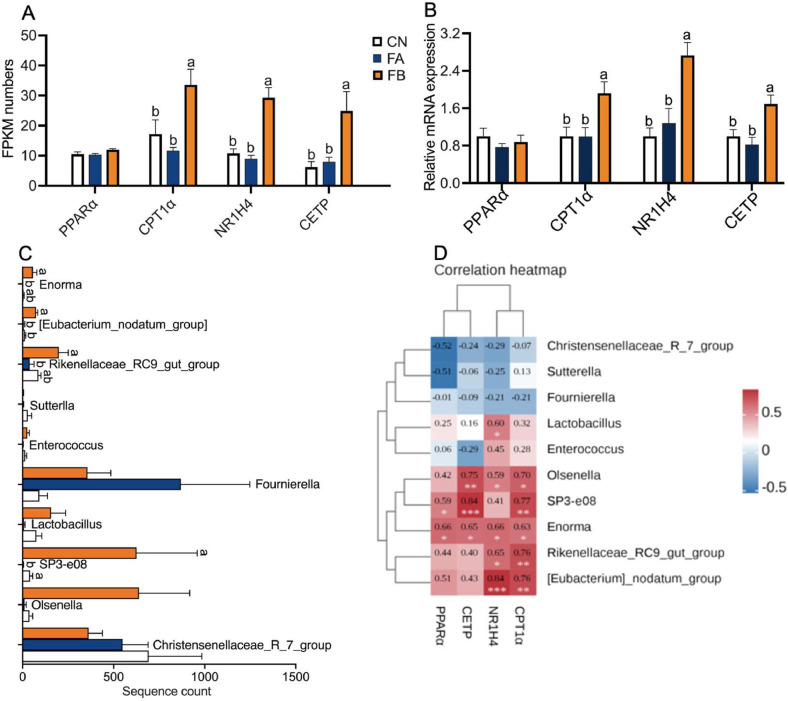
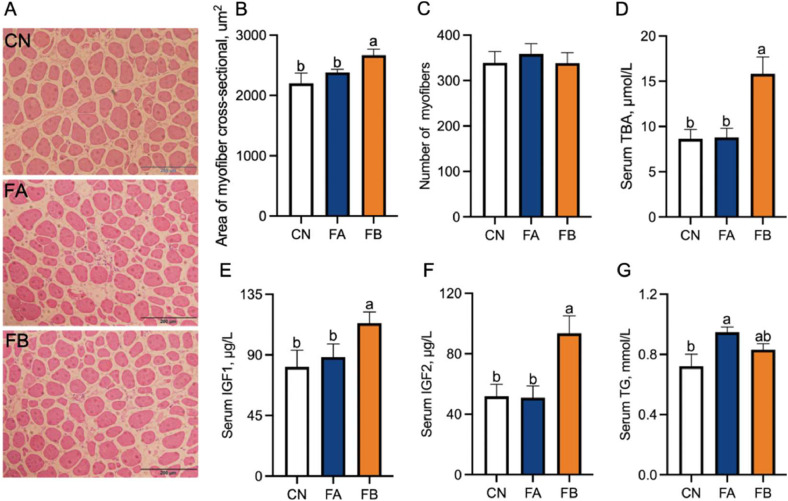
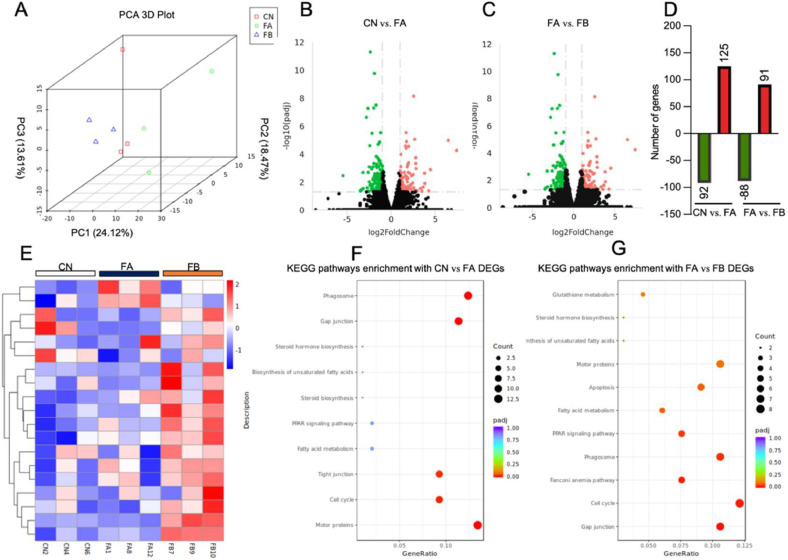
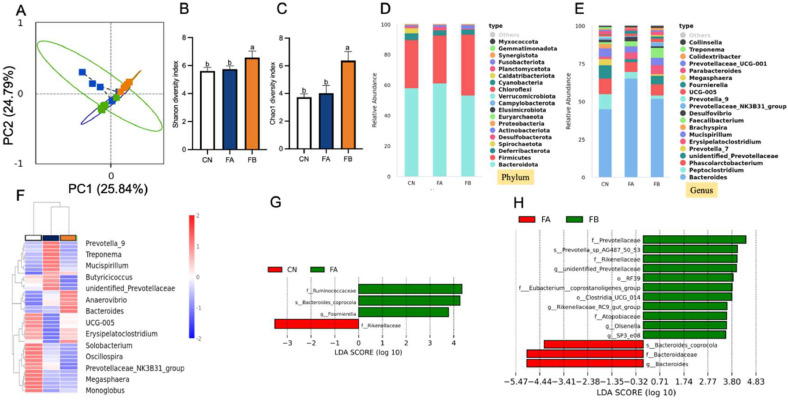
To optimize livestock production of integrated farms, dietary crude fat levels are often increased, making efficient fat utilization crucial. Bile acids are known to improve fat utilization, but their impact on growth performance and breast muscle development in Zhijiang ducks remains unclear. In this study, a total of 360 twenty-day-old Zhijiang ducks with similar body weights were divided into three groups: the control group (CN) received a basal diet; the high-fat group (FA) received the basal diet plus 1.25 % rapeseed oil; and the high-fat plus bile acids compound (BA) group (FB) received the FA diet supplemented with 250 mg/kg BA for 30 days. Results indicated that the addition of rapeseed oil and BA significantly increased (P < 0.05) average daily gain (ADG) and reduced (P < 0.05) feed conversion ratio (FCR). Slaughter data showed that BA significantly enhanced (P < 0.05) breast muscle weight and percentage while decreasing (P < 0.05) abdominal fat weight. Additionally, BA increased (P < 0.05) the cross-sectional area of breast muscle fibers, total bile acid content, and levels of insulin-like growth factors 1/2 (IGF1/2). Transcriptomic analysis further revealed that BA significantly upregulated (P < 0.05) the levels of PPARα, CPT1α, NR1H4, and CETP in breast muscle. 16S rRNA analysis showed a significant increase (P < 0.05) in the relative abundances of genera Enorma, [Eubacterium nodatum group], Rikenellaceae RC9 gut group, and SP3-e08. Additionally, the Spearman correlation suggested a positive correlation between the genera Olsenella, SP3-e08, Enorma, Rikenellaceae_RC9_gut_group, and [Eubacterium_nodatum_group] with PPARα, CETP, NR1H4, and CPT1α. In contrast, the genera Christensenellaceae_R_7_group and Sutterella exhibited negative correlations with PPARα. These findings provide new insights into the role of BA in promoting growth performance and skeletal muscle development in Zhijiang ducks fed a high-fat diet, with this effect potentially linked to changes in the gut microbiota.
为优化综合养殖场的家畜生产,通常会提高日粮中的粗脂肪水平,因此高效利用脂肪至关重要。已知胆汁酸可改善脂肪利用,但其对浙江鸭生长性能和胸肌发育的影响尚不清楚。在本研究中,将360只体重相近的20日龄浙江鸭分为三组:对照组(CN)饲喂基础日粮;高脂组(FA)饲喂基础日粮加1.25%菜籽油;高脂加胆汁酸复合组(BA)(FB)在FA日粮基础上添加250 mg/kg胆汁酸,持续30天。结果表明,添加菜籽油和胆汁酸显著提高了(P < 0.05)平均日增重(ADG),并降低了(P < 0.05)饲料转化率(FCR)。屠宰数据显示,胆汁酸显著提高了(P < 0.05)胸肌重量和百分比,同时降低了(P < 0.05)腹脂重量。此外,胆汁酸增加了(P < 0.05)胸肌纤维横截面积、总胆汁酸含量以及胰岛素样生长因子1/2(IGF1/2)水平。转录组分析进一步显示,胆汁酸显著上调了(P < 0.05)胸肌中PPARα、CPT1α、NR1H4和CETP的水平。16S rRNA分析表明,Enorma属、[结节真杆菌组]、理研菌科RC9肠道组和SP3-e08的相对丰度显著增加(P < 0.05)。此外,Spearman相关性分析表明,Olsenella属、SP3-e08、Enorma属、理研菌科_RC9_肠道组和[结节真杆菌组]与PPARα、CETP、NR1H4和CPT1α呈正相关。相反,Christensenellaceae_R_7_组和萨特氏菌属与PPARα呈负相关。这些发现为胆汁酸在高脂日粮饲喂的浙江鸭中促进生长性能和骨骼肌发育的作用提供了新的见解,这种作用可能与肠道微生物群的变化有关。