Warwick Clinical Trials Unit, Warwick Medical School, University of Warwick, Coventry, CV4 7AL, UK.
University Hospitals Coventry and Warwickshire, Clifford Bridge Road, Coventry, CV2 2DX, UK.
BMC Neurol. 2024 Aug 2;24(1):268. doi: 10.1186/s12883-024-03779-w.
Between 2015 and 2019 the Chronic Headache Education and Self-management Study (CHESS) developed and tested a supportive self-management approach that aimed to improve outcomes for people with chronic migraine or chronic tension type headache with/without episodic migraine. However, a paucity of qualitative research which explored the lived experiences of people with chronic headache was evidenced. In response, we undertook to explore the experiences of living with chronic headaches of people who participated in the CHESS study.
We adopted qualitative methodologies, inviting participants in the CHESS study to participate in semi-structured interviews. In phase 1 (feasibility study), a thematic analysis was conducted. In phase 2 (main CHESS trial), interviews were informed by topic guides developed from our learning from the phase 1 interviews. Pen portrait methodology and thematic analysis was employed allowing us to explore the data longitudinally.
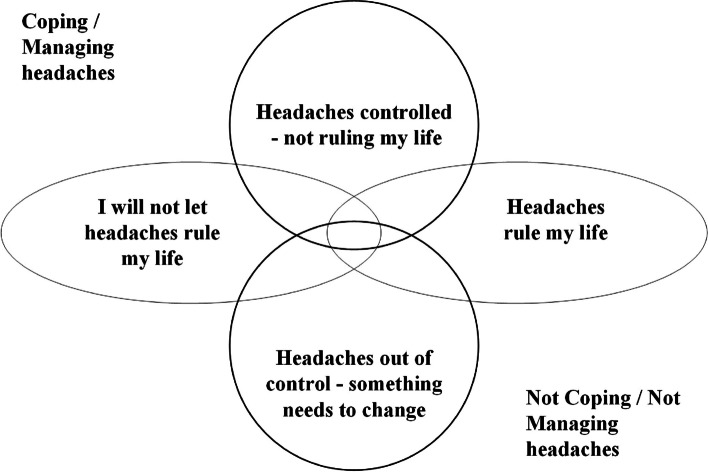
Phase 1, 15 interviews (10 female) age range 29 to 69 years (median 47 years) revealed the complexities of living with chronic headache. Six overarching themes were identified including the emotional impact and the nature of their headaches. Phase 2, included 66 interviews (26 participants; median age group 50s (range 20s-60s); 20 females. 14 were interviewed at three points in time (baseline, 4 and 12 months) Through an iterative process four overlapping categories of headache impact emerged from the data and were agreed: i) 'I will not let headaches rule my life'; ii) 'Headaches rule my life'; iii) 'Headaches out of control-something needs to change'; and iv) 'Headaches controlled-not ruling my life'. One of these categories was assigned to each pen portrait at each timepoint. The remaining 12 participants were interviewed at two time points during a year; pen portraits were again produced. Analysis revealed that the headache impact categories developed above held true in this sample also providing some validation of the categories.
These data give an insight into the complexities of living with chronic headache. Chronic headache is unpredictable, permeating all aspects of an individual's life; even when an individual feels that their headache is controlled and not interfering, this situation can rapidly change. It shows us that more work needs to be done both medically and societally to help people living with this often-hidden condition.
ISRCTN79708100.
在 2015 年至 2019 年期间,慢性头痛教育和自我管理研究(CHESS)开发并测试了一种支持性的自我管理方法,旨在改善慢性偏头痛或慢性紧张型头痛伴/不伴发作性偏头痛患者的预后。然而,现有的定性研究证据表明,人们对慢性头痛患者的生活体验了解甚少。有鉴于此,我们着手探索参与 CHESS 研究的患者的慢性头痛生活体验。
我们采用定性方法,邀请 CHESS 研究的参与者参加半结构化访谈。在第 1 阶段(可行性研究),进行了主题分析。在第 2 阶段(主要 CHESS 试验),根据从第 1 阶段访谈中学习到的主题指南进行访谈。采用肖像画方法和主题分析,使我们能够进行纵向探索数据。
第 1 阶段,15 次访谈(10 名女性)年龄范围为 29 至 69 岁(中位数为 47 岁),揭示了慢性头痛患者生活的复杂性。确定了 6 个总体主题,包括情绪影响和头痛的性质。第 2 阶段,包括 66 次访谈(26 名参与者;年龄中位数在 50 多岁(20 多岁至 60 多岁);20 名女性。其中 14 名参与者在三个时间点(基线、4 个月和 12 个月)接受了访谈。通过迭代过程,从数据中出现了四个重叠的头痛影响类别,并达成一致:i)“我不会让头痛主宰我的生活”;ii)“头痛主宰我的生活”;iii)“头痛失控-需要改变”;iv)“头痛得到控制-不再主宰我的生活”。在每个时间点,每个肖像画都被分配到其中一个类别。其余 12 名参与者在一年内的两个时间点接受了访谈;再次制作了肖像画。分析结果表明,上述开发的头痛影响类别在本样本中也是成立的,为这些类别提供了一些验证。
这些数据深入了解了慢性头痛患者的生活复杂性。慢性头痛是不可预测的,渗透到个人生活的各个方面;即使当个人觉得他们的头痛得到了控制,不会干扰他们的生活,这种情况也会迅速改变。它表明,我们需要在医学和社会层面上做更多的工作,以帮助那些患有这种常常被忽视的疾病的人。
ISRCTN79708100。