Sato So, Sasabuchi Yusuke, Okada Akira, Yasunaga Hideo
Department of Clinical Epidemiology and Health Economics, Graduate School of Medicine, The University of Tokyo, 7-3-1, Hongo, Bunkyo, Tokyo, 1130033, Japan.
The Department of Real-World Evidence, Graduate School of Medicine, The University of Tokyo, Bunkyo, Japan.
Dysphagia. 2025 Apr;40(2):381-387. doi: 10.1007/s00455-024-10737-8. Epub 2024 Aug 3.
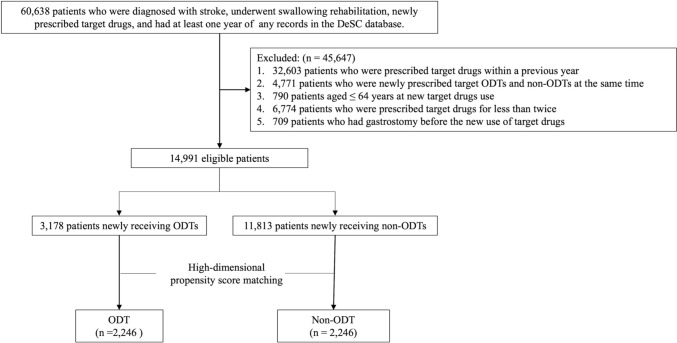
Orally disintegrating tablets (ODTs) dissolve rapidly in contact with saliva and have been reported to facilitate oral administration of medications in swallowing difficulties. However, their clinical benefits remain unclear because no previous studies have examined whether ODTs facilitate medication adherence and clinical outcomes in patients with post-stroke dysphagia. This study evaluated the association between ODT prescriptions and clinical benefits using high-dimensional propensity score (hd-PS) matching to adjust for confounding factors. Using a large Japanese commercial medical and dental claims database, we identified patients aged ≥ 65 years with post-stroke dysphagia between April 2014 and March 2021. To compare 1-year outcomes of medication adherence, cardiovascular events, and aspiration pneumonia between patients taking ODTs and non-ODTs, we performed hd-PS matching. We identified 11,813 patients without ODTs and 3178 patients with ODTs. After hd-PS matching, 2246 pairs were generated. Medication adherence for 1 year, based on the proportion of days covered, was not significantly different between the non-ODT and ODT groups before (0.887 vs. 0.900, P = 0.999) and after hd-PS matching (0.889 vs. 0.902, P = 0.977). The proportion of cardiovascular events (0.898 vs. 0.893, P = 0.591) and aspiration pneumonia (0.380 vs. 0.372, P = 0.558) were also not significantly different between the groups. This study found no significant differences in medication adherence, cardiovascular diseases, or aspiration pneumonia between the non-ODT and ODT groups in patients with post-stroke dysphagia. Both groups achieved a proportion of days covered exceeding 80%. Clinicians may consider prescribing ODTs or non-ODTs based on patient preferences rather than solely on post-stroke conditions.
口腔崩解片(ODT)与唾液接触后迅速溶解,据报道有助于吞咽困难患者口服药物。然而,其临床益处仍不明确,因为此前尚无研究探讨ODT是否有助于改善中风后吞咽困难患者的药物依从性和临床结局。本研究使用高维倾向评分(hd-PS)匹配来评估ODT处方与临床益处之间的关联,以调整混杂因素。利用一个大型日本商业医疗和牙科理赔数据库,我们确定了2014年4月至2021年3月期间年龄≥65岁的中风后吞咽困难患者。为了比较服用ODT和未服用ODT患者在药物依从性、心血管事件和吸入性肺炎方面的1年结局,我们进行了hd-PS匹配。我们确定了11813名未服用ODT的患者和3178名服用ODT的患者。经过hd-PS匹配后,生成了2246对。基于覆盖天数比例的1年药物依从性,在hd-PS匹配前非ODT组和ODT组之间无显著差异(0.887对0.900,P = 0.999),匹配后也无显著差异(0.889对0.902,P = 0.977)。两组之间心血管事件比例(0.898对0.893,P = 0.591)和吸入性肺炎比例(0.380对0.372,P = 0.558)也无显著差异。本研究发现,中风后吞咽困难患者中,非ODT组和ODT组在药物依从性、心血管疾病或吸入性肺炎方面无显著差异。两组的覆盖天数比例均超过80%。临床医生在开药时,可根据患者偏好而非仅依据中风后的情况来考虑开具ODT或非ODT。