School of Physics and Electronics, Hunan Normal University, Changsha 410081, China.
School of Physics and Electronics, Hunan Normal University, Changsha 410081, China.
Ultrason Sonochem. 2024 Oct;109:107005. doi: 10.1016/j.ultsonch.2024.107005. Epub 2024 Jul 30.
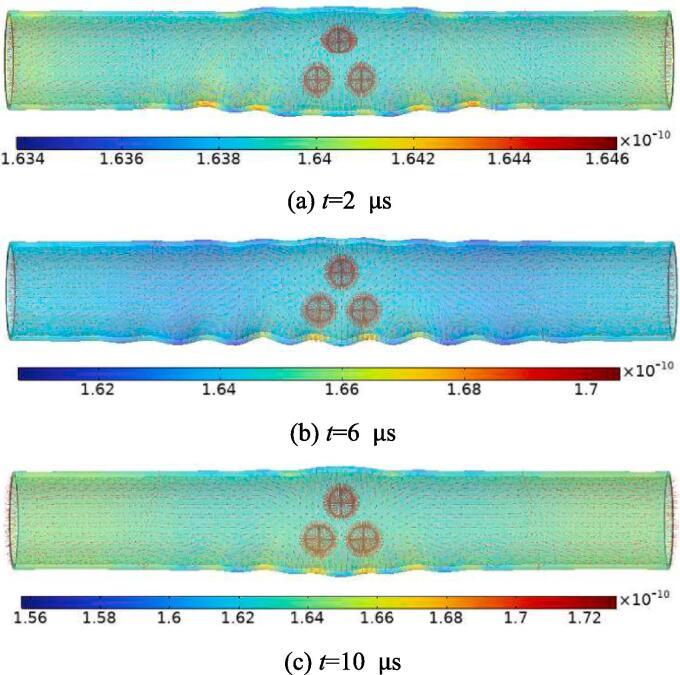
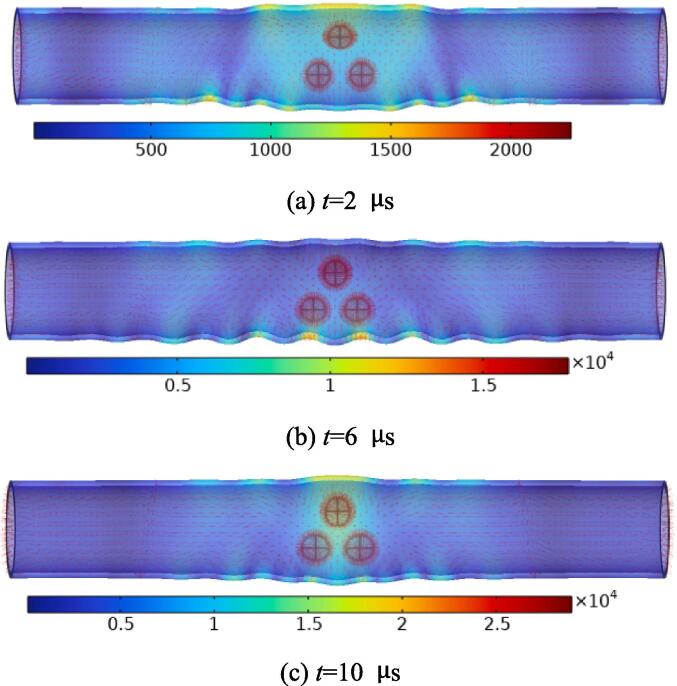
Experimental studies have shown that ultrasonic cavitation can reversibly open the blood-brain barrier (BBB) to assist drug delivery. Nevertheless, the majority of the present study focused on experimental aspects of BBB opening. In this study, we developed a three-bubble-liquid-solid model to investigate the dynamic behavior of multiple bubbles within the blood vessels, and elucidate the physical mechanism of drug molecules through endothelial cells under ultrasonic cavitation excitation. The results showed that the large bubbles have a significant inhibitory effect on the movement of small bubbles, and the vibration morphology of intravascular microbubbles was affected by the acoustic parameters, microbubble size, and the distance between the microbubbles. The ultrasonic cavitation can significantly enhance the unidirectional flux of drug molecules, and the unidirectional flux growth rate of the wall can reach more than 5 %. Microjets and shock waves emitted from microbubbles generate different stress distribution patterns on the vascular wall, which in turn affects the pore size of the vessel wall and the permeability of drug molecules. The vibration morphology of microbubbles is related to the concentration, arrangement and scale of microbubbles, and the drug permeation impact can be enhanced by optimizing bubble size and acoustic parameters. The results offer an extensive depiction of the factors influencing the blood-brain barrier opening through ultrasonic cavitation, and the model may provide a potential technique to actively regulate the penetration capacity of drugs through endothelial layer of the neurovascular system by regulating BBB opening.
实验研究表明,超声空化可以可逆地打开血脑屏障(BBB)以辅助药物递送。然而,目前大多数研究都集中在 BBB 开放的实验方面。在这项研究中,我们开发了一个三泡液固模型,以研究血管内多个气泡的动态行为,并在超声空化激励下阐明药物分子通过血管内皮细胞的物理机制。结果表明,大泡对小泡的运动有显著的抑制作用,血管内微泡的振动形态受声参数、微泡大小和微泡之间距离的影响。超声空化可以显著增强药物分子的单向通量,壁面的单向通量增长率可达到 5%以上。微泡发射的微射流和冲击波在血管壁上产生不同的应力分布模式,进而影响血管壁的孔径和药物分子的通透性。微泡的振动形态与微泡的浓度、排列和尺度有关,通过优化气泡大小和声参数可以增强药物渗透的影响。该结果广泛描述了超声空化对血脑屏障开放的影响因素,该模型可能通过调节 BBB 开放,为通过神经血管系统内皮层主动调节药物渗透能力提供一种潜在技术。