Endrikat Jan, Schmidt Gilda, Oak Bhagyashree, Shukla Viplav, Nangia Prakirti, Schleyer Nicolas, Crocker John, Pijnapppel Ruud
Radiology, Bayer AG, Berlin, Germany.
Department of Gynecology, Obstetrics and Reproductive Medicine, University Medical School of Saarland, Homburg, Saar, Germany.
Patient Prefer Adherence. 2024 Jul 31;18:1577-1588. doi: 10.2147/PPA.S466992. eCollection 2024.
Women with high breast density (HBD) carry an increased risk for breast cancer (BC). The aim of the study was to provide data on awareness and knowledge gaps among women with vs w/o HBD about BC risk factors (BCRFs), which is the basis for effective communication about screening.
This was a web-based survey of 3000 women aged ≥30 and ≤70 from six countries. It comprised of 45 questions. -tests and chi-square tests with False Discovery Rate adjustments were conducted as applicable, with significant differences reported at α=0.05.
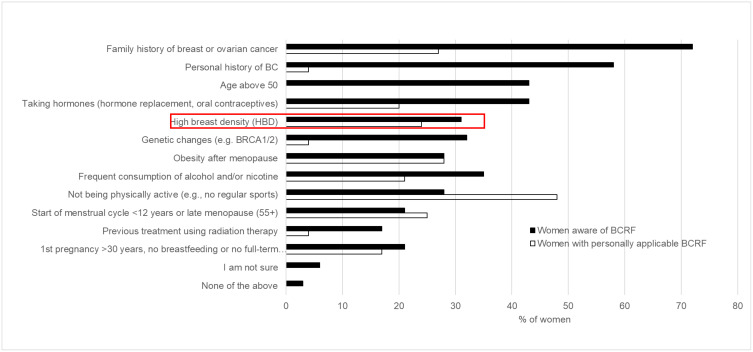
Three-thousand women were included in the analysis, 733 (24.4%) had HBD. Overall, 39% of women were familiar with the concept of HBD in the context of BC. Thirty-one percent of women were aware of HBD as BCRF and for 24% of women HBD was personally applicable. A significantly higher proportion of women with HBD were aware of almost all BCRFs compared to women w/o HBD (p ≤ 0.05). Similarly, a significantly higher proportion of women with HBD have undergone screening procedures compared to women w/o HBD (p ≤ 0.05). Women with HBD were significantly better aware of basic facts about BC (p ≤ 0.05). A total of 1617 women underwent mammography, 904 ultrasound and 150 MRI during their last screening. The most relevant source of information about BC was the health care professional, as reported by 63% of women.
Overall 39% of women were familiar with HBD as BCRF. Lack of BCRF awareness may contribute to delayed screenings, missed opportunities for early detection, and potentially poorer outcomes for individuals with dense breast tissue. Thus, this information should be communicated more widely.
乳腺密度高(HBD)的女性患乳腺癌(BC)的风险增加。本研究的目的是提供有关有或无HBD的女性对乳腺癌风险因素(BCRFs)的知晓情况和知识差距的数据,这是关于筛查的有效沟通的基础。
这是一项对来自六个国家的3000名年龄在30岁及以上、70岁及以下女性进行的基于网络的调查。调查包括45个问题。适用时进行t检验和经错误发现率调整的卡方检验,α=0.05时有显著差异则报告。
3000名女性纳入分析,其中733名(24.4%)有HBD。总体而言,39%的女性在乳腺癌背景下熟悉HBD的概念。31%的女性知晓HBD是BCRF,24%的女性认为HBD与自身相关。与无HBD的女性相比,有HBD的女性知晓几乎所有BCRF的比例显著更高(p≤0.05)。同样,与无HBD的女性相比,有HBD的女性接受筛查程序的比例显著更高(p≤0.05)。有HBD的女性对乳腺癌基本事实的知晓程度显著更高(p≤0.05)。在她们最近一次筛查期间,共有1617名女性进行了乳房X光检查,904名进行了超声检查,150名进行了核磁共振成像检查。63%的女性报告称,关于乳腺癌最相关的信息来源是医疗保健专业人员。
总体而言,39%的女性熟悉HBD作为BCRF。缺乏对BCRF的认识可能导致筛查延迟、错过早期发现的机会,并可能使乳腺组织致密的个体预后更差。因此,应更广泛地传播这些信息。