Haarbauer-Krupa Juliet, Wray Allison P, Lebrun-Harris Lydie A, Cree Robyn A, Womack Lindsay S
US Department of Health and Human Services, Centers for Disease Control and Prevention, National Center for Injury Prevention and Control, Division of Injury Prevention, Atlanta, GA.
Oak Ridge Institute for Science and Education, Oak Ridge, TN.
J Pediatr Clin Pract. 2024 May 22;14:200117. doi: 10.1016/j.jpedcp.2024.200117. eCollection 2024 Dec.
To (1) estimate the lifetime prevalence of suspected and diagnosed traumatic brain injury (TBI) based on parent report overall and select sociodemographic characteristics; and (2) describe differences in prevalence of health conditions and health-related risk factors by whether a child had a lifetime history of diagnosed TBI.
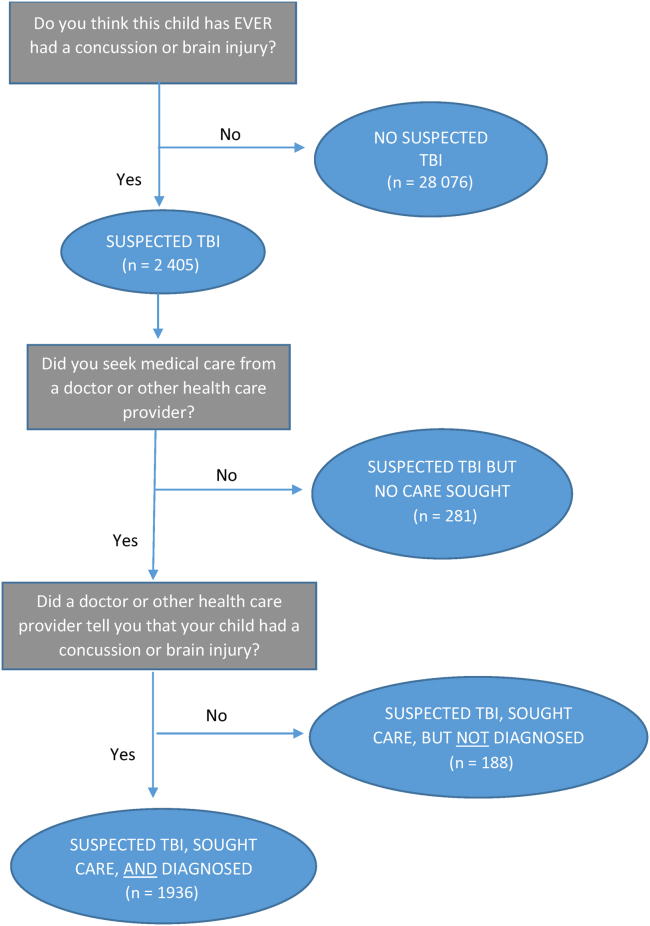
We analyzed data from the 2020 National Survey of Children's Health, a cross-sectional address-based survey of US households. A categorical variable was created on the basis of parent responses to 3 questions inquiring about their suspicion of their child having a brain injury, if they sought medical care, and if the health care provider provided a diagnosis. Parents also were asked to report on their child's additional health conditions, functional indicators, school and social factors, and health care access and service use.
The prevalence of lifetime diagnosed TBI was 4.2% (95% CI 3.8-4.5). Children with a parent-reported lifetime history of diagnosed TBI were more likely to have a variety of health conditions, special health care needs, disabilities, activity limitations, missed days of school, and unmet care coordination needs, compared with those without a history. However, they were more likely to have a usual source of sick care and to receive more health-related services.
For school-aged children, a history of TBI is associated with parent-reported health needs and conditions, as well as missed days from school. It is particularly important for parents to seek care when they suspect their child has experienced a TBI to receive a diagnosis and monitor the impacts of the TBI.
(1)根据家长报告总体情况及选定的社会人口学特征,估计疑似和确诊创伤性脑损伤(TBI)的终生患病率;(2)按儿童是否有确诊TBI的终生病史描述健康状况和健康相关风险因素患病率的差异。
我们分析了2020年全国儿童健康调查的数据,这是一项基于地址对美国家庭进行的横断面调查。根据家长对3个问题的回答创建了一个分类变量,这些问题询问他们是否怀疑孩子有脑损伤、是否寻求医疗护理以及医疗服务提供者是否给出诊断。还要求家长报告孩子的其他健康状况、功能指标、学校和社会因素以及医疗服务可及性和服务使用情况。
终生确诊TBI的患病率为4.2%(95%可信区间3.8 - 4.5)。与无病史的儿童相比,有家长报告终生确诊TBI病史的儿童更有可能有各种健康状况、特殊医疗需求、残疾、活动受限、缺课天数以及未满足的护理协调需求。然而,他们更有可能有固定的疾病护理来源,并接受更多与健康相关的服务。
对于学龄儿童,TBI病史与家长报告的健康需求和状况以及缺课天数相关。当家长怀疑孩子经历了TBI时,寻求医疗护理以获得诊断并监测TBI的影响尤为重要。