Chang Chuen-Chau, Yeh Chun-Chieh, Tiong Cheng, Sun Mao-Feng, Lin Jaung-Geng, Cherng Yih-Giun, Chen Ta-Liang, Liao Chien-Chang
Department of Anesthesiology, Taipei Medical University Hospital, Taipei, Taiwan.
Anesthesiology and Health Policy Research Center, Taipei Medical University Hospital, Taipei, Taiwan.
J Multidiscip Healthc. 2024 Jul 30;17:3727-3738. doi: 10.2147/JMDH.S466696. eCollection 2024.
Sustained hyperlipidemia contributes to fatty liver and liver cirrhosis. Red yeast rice (RYR) effectively improved the lipid profile; however, the effects of RYR on the risk of incident liver cirrhosis remain to be elucidated. We aimed to evaluate the beneficial effects of RYR use on the risk and outcome of liver cirrhosis.
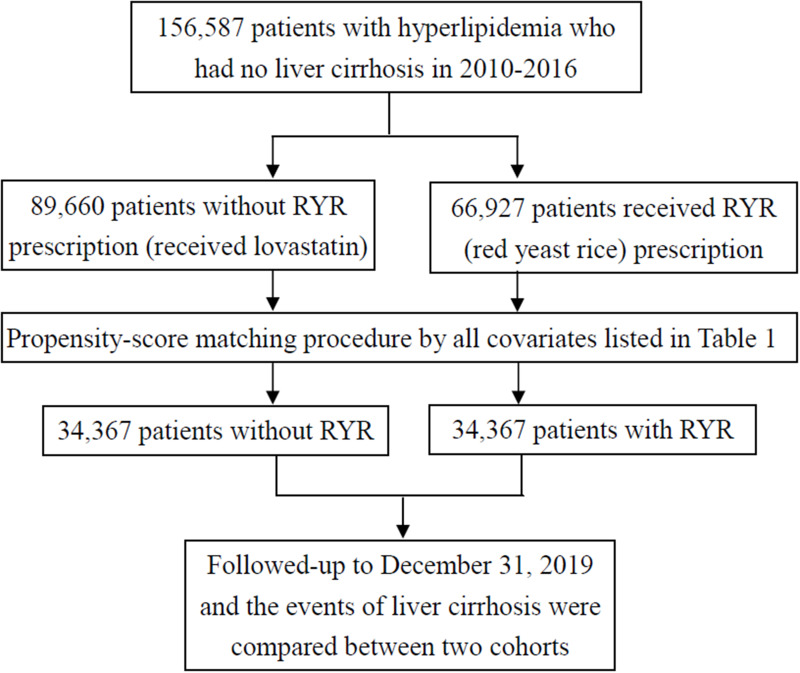
We identified 156,587 adults who had newly diagnosed hyperlipidemia in 2010-2016 from health insurance data in this retrospective cohort study. Using propensity score matching, we selected 34,367 patients who used RYR and 34,367 patients who used lovastatin. Events of incident liver cirrhosis that occurred in the two cohorts during the follow-up period of 2010-2019 were identified. We calculated adjusted hazard ratios (HRs) and 95% confidence intervals (Cis) for liver cirrhosis risk associated with RYR use in the multiple Cox proportional hazard model.
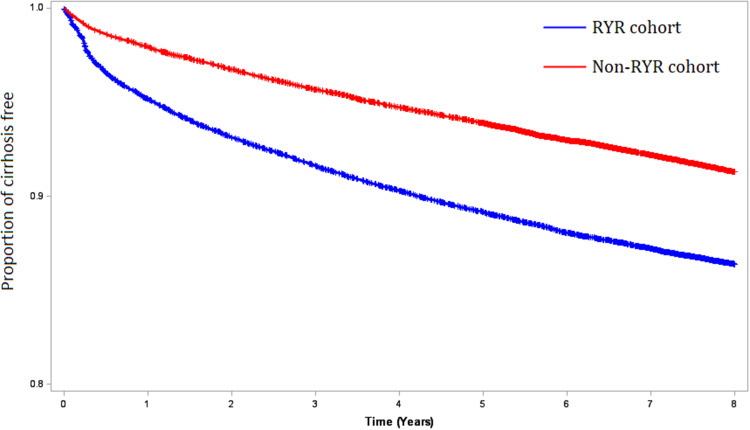
Compared with patients who used lovastatin, patients who used RYR had a decreased risk of liver cirrhosis (HR 0.60, 95% CI 0.57-0.63), and this association was significant in various subgroups. A biological gradient relationship between the frequency of RYR use and decreased liver cirrhosis was observed (p for trend < 0.0001). Reduced postcirrhosis jaundice (HR 0.56, 95% CI 0.43-0.72), ascites (HR 0.37, 95% CI 0.28-0.50), hepatic coma (HR 0.36, 95% CI 0.26-0.50), and mortality (HR 0.48, 95% CI 0.38-0.61) were also associated with RYR use.
We demonstrated the beneficial effects of RYR use on the risk and outcome of liver cirrhosis; however, the lack of compliance data should be considered. However, our study did not infer causality or claim the superiority of RYR over lovastatin.
持续性高脂血症会导致脂肪肝和肝硬化。红曲米(RYR)能有效改善血脂水平;然而,红曲米对肝硬化发病风险的影响仍有待阐明。我们旨在评估使用红曲米对肝硬化风险和预后的有益作用。
在这项回顾性队列研究中,我们从医疗保险数据中识别出2010 - 2016年新诊断为高脂血症的156,587名成年人。采用倾向评分匹配法,我们选取了34,367名使用红曲米的患者和34,367名使用洛伐他汀的患者。确定了2010 - 2019年随访期间两个队列中发生的肝硬化发病事件。我们在多重Cox比例风险模型中计算了与使用红曲米相关的肝硬化风险的调整风险比(HRs)和95%置信区间(Cis)。
与使用洛伐他汀的患者相比,使用红曲米的患者患肝硬化的风险降低(HR 0.60,95% CI 0.57 - 0.63),且这种关联在各个亚组中均显著。观察到红曲米使用频率与肝硬化风险降低之间存在生物学梯度关系(趋势p < 0.0001)。使用红曲米还与肝硬化后黄疸减轻(HR 0.56,95% CI 0.43 - 0.72)、腹水(HR 0.37,95% CI 0.28 - 0.50)、肝昏迷(HR 0.36,95% CI 0.26 - 0.50)及死亡率降低(HR 0.48,95% CI 0.38 - 0.61)相关。
我们证明了使用红曲米对肝硬化风险和预后有有益作用;然而,应考虑缺乏依从性数据的情况。不过,我们的研究并未推断因果关系,也未宣称红曲米优于洛伐他汀。