Department of Medical Oncology, Chang Gung Memorial Hospital and Chang Gung University, Taoyuan, Taiwan.
Clinical Informatics and Medical Statistics Research Center, Chang Gung University, Taoyuan, Taiwan.
Cancer Med. 2024 Aug;13(15):e70061. doi: 10.1002/cam4.70061.
While surgery remains the primary treatment for oral squamous cell carcinoma (OCSCC), induction chemotherapy (IC) can be used as a bridging or neoadjuvant therapy. This nationwide study in Taiwan examines the survival outcomes of OCSCC patients who received IC before surgery.
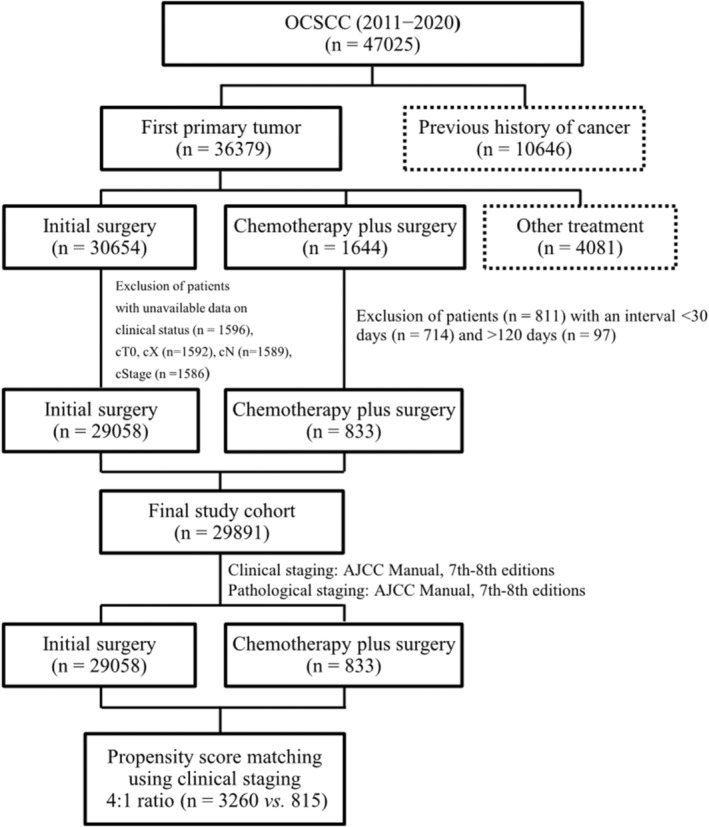
We analyzed data from 29,891 patients with OCSCC. Of these, 29,058 initially underwent surgery (OP group), whereas 833 received IC before surgery (IC + OP group). A propensity score (PS)-matched analysis (4, 1 ratio, 3260 vs. 815 patients) was performed considering tumor subsite, sex, age, Charlson comorbidity index, clinical T1-T4b tumors, clinical N0-3 disease, and clinical stage I-IV.
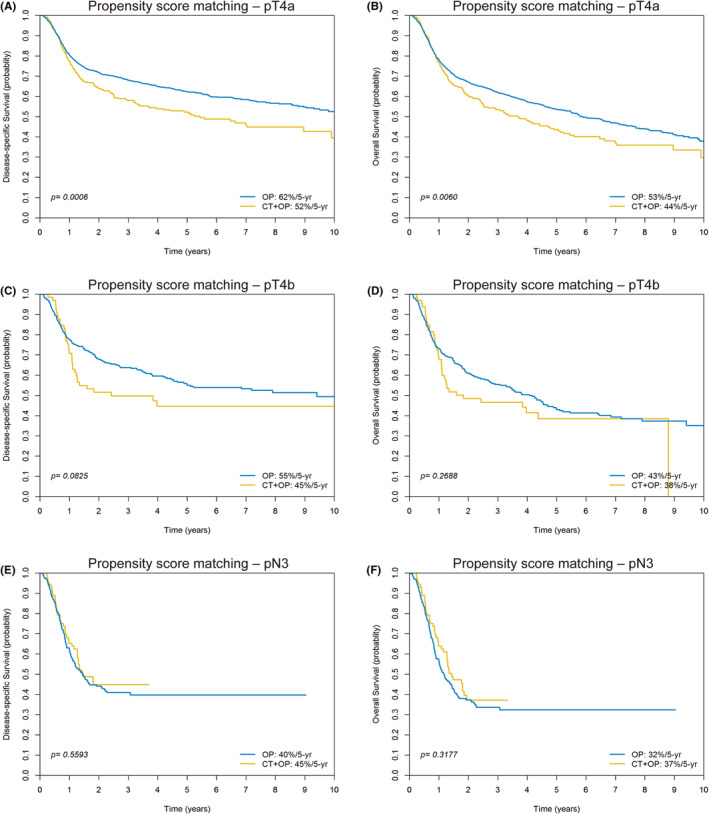
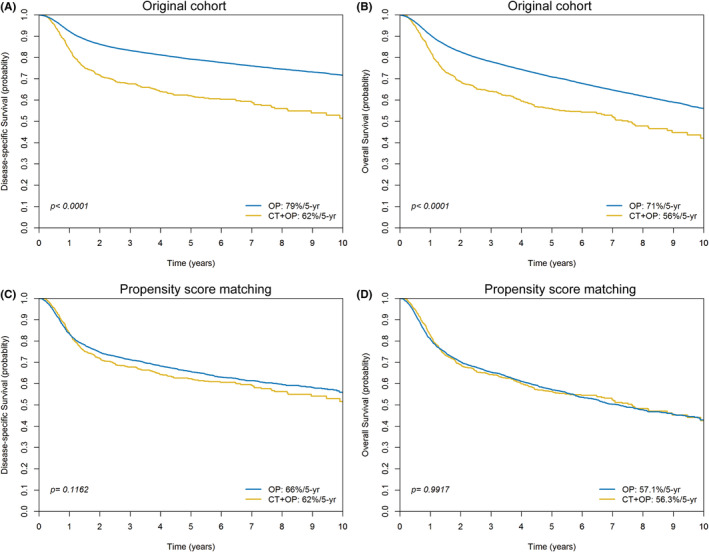
In the PS-matched cohort, the 5-year disease-specific survival (DSS) and overall survival (OS) rates were 65% and 57%, respectively. When comparing the OP and IC + OP groups, the 5-year DSS rates were 66% and 62%, respectively (p = 0.1162). Additionally, the 5-year OS rates were 57% and 56%, respectively (p = 0.9917). No significant intergroup differences in survival were observed for specific subgroups with cT4a tumors, cT4b tumors, cN3 disease, pT4b tumors, and pN3 disease. However, for patients with pT4a tumors, the OP group demonstrated superior 5-year outcomes compared to the IC + OP group, with a DSS of 62% versus 52% (p = 0.0006) and an OS of 53% versus 44% (p = 0.0060). Notably, patients with cT2-3, cN1, and c-Stage II disease in the IC + OP group were significantly more likely to achieve pT0-1 status (p < 0.05).
Following PS matching, the IC + OP group generally exhibited similar prognosis to the OP group. However, for pT4a tumors, the OP group showed superior 5-year outcomes. While IC may not universally improve survival, it could be advantageous for patients who respond positively to the treatment.
尽管手术仍然是口腔鳞状细胞癌(OCSCC)的主要治疗方法,但诱导化疗(IC)可用作桥接或新辅助治疗。这项在台湾进行的全国性研究检查了接受手术前 IC 的 OCSCC 患者的生存结果。
我们分析了 29891 名 OCSCC 患者的数据。其中,29058 名患者最初接受了手术(OP 组),而 833 名患者接受了手术前 IC(IC+OP 组)。考虑到肿瘤亚部位、性别、年龄、Charlson 合并症指数、临床 T1-T4b 肿瘤、临床 N0-3 疾病和临床分期 I-IV,进行了倾向评分(PS)匹配分析(4:1 比,3260 与 815 名患者)。
在 PS 匹配队列中,5 年疾病特异性生存率(DSS)和总生存率(OS)分别为 65%和 57%。比较 OP 和 IC+OP 组时,5 年 DSS 率分别为 66%和 62%(p=0.1162)。此外,5 年 OS 率分别为 57%和 56%(p=0.9917)。对于具有 cT4a 肿瘤、cT4b 肿瘤、cN3 疾病、pT4b 肿瘤和 pN3 疾病的特定亚组,未观察到生存方面的显著组间差异。然而,对于 pT4a 肿瘤患者,OP 组的 5 年结局优于 IC+OP 组,DSS 为 62%比 52%(p=0.0006),OS 为 53%比 44%(p=0.0060)。值得注意的是,IC+OP 组中具有 cT2-3、cN1 和 c 期 II 疾病的患者更有可能达到 pT0-1 状态(p<0.05)。
进行 PS 匹配后,IC+OP 组的总体预后通常与 OP 组相似。然而,对于 pT4a 肿瘤,OP 组显示出更好的 5 年结局。虽然 IC 不一定普遍改善生存,但对于对治疗有积极反应的患者可能是有利的。