Department of Molecular Cell Biology, Weizmann Institute of Science, Rehovot, Israel.
Department of Immunology and Regenerative Biology, Weizmann Institute of Science, Rehovot, Israel.
Nat Cell Biol. 2024 Aug;26(8):1336-1345. doi: 10.1038/s41556-024-01465-0. Epub 2024 Aug 5.
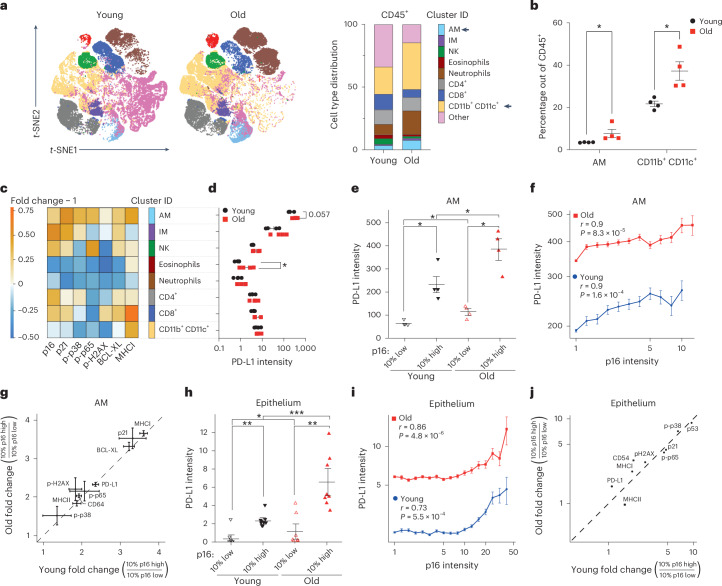
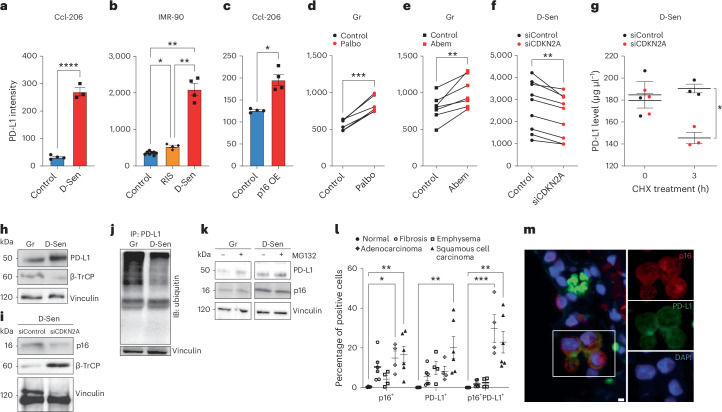
The accumulation of senescent cells promotes ageing and age-related diseases, but molecular mechanisms that senescent cells use to evade immune clearance and accumulate in tissues remain to be elucidated. Here we report that p16-positive senescent cells upregulate the immune checkpoint protein programmed death-ligand 1 (PD-L1) to accumulate in ageing and chronic inflammation. We show that p16-mediated inhibition of cell cycle kinases CDK4/6 induces PD-L1 stability in senescent cells via downregulation of its ubiquitin-dependent degradation. p16-expressing senescent alveolar macrophages elevate PD-L1 to promote an immunosuppressive environment that can contribute to an increased burden of senescent cells. Treatment with activating anti-PD-L1 antibodies engaging Fcγ receptors on effector cells leads to the elimination of PD-L1 and p16-positive cells. Our study uncovers a molecular mechanism of p16-dependent regulation of PD-L1 protein stability in senescent cells and reveals the potential of targeting PD-L1 to improve immunosurveillance of senescent cells and ameliorate senescence-associated inflammation.
衰老细胞的积累会促进衰老和与年龄相关的疾病,但衰老细胞用来逃避免疫清除并在组织中积累的分子机制仍有待阐明。在这里,我们报告 p16 阳性衰老细胞上调免疫检查点蛋白程序性死亡配体 1(PD-L1),从而在衰老和慢性炎症中积累。我们表明,p16 介导的细胞周期激酶 CDK4/6 抑制诱导衰老细胞中 PD-L1 的稳定性,通过下调其泛素依赖性降解。表达 p16 的衰老肺泡巨噬细胞上调 PD-L1,以促进免疫抑制环境,从而增加衰老细胞的负担。用激活的抗 PD-L1 抗体与效应细胞上的 Fcγ 受体结合,可导致 PD-L1 和 p16 阳性细胞的消除。我们的研究揭示了 p16 依赖性调节衰老细胞中 PD-L1 蛋白稳定性的分子机制,并揭示了靶向 PD-L1 以改善衰老细胞的免疫监视和改善与衰老相关的炎症的潜力。