• 文献检索
  • 文档翻译
  • 深度研究
  • 学术资讯
  • Suppr Zotero 插件Zotero 插件
  • 邀请有礼
  • 套餐&价格
  • 历史记录
应用&插件
Suppr Zotero 插件Zotero 插件浏览器插件Mac 客户端Windows 客户端微信小程序
定价
高级版会员购买积分包购买API积分包
服务
文献检索文档翻译深度研究API 文档MCP 服务
关于我们
关于 Suppr公司介绍联系我们用户协议隐私条款
关注我们

Suppr 超能文献

核心技术专利:CN118964589B侵权必究
粤ICP备2023148730 号-1Suppr @ 2026

文献检索

告别复杂PubMed语法,用中文像聊天一样搜索,搜遍4000万医学文献。AI智能推荐,让科研检索更轻松。

立即免费搜索

文件翻译

保留排版,准确专业,支持PDF/Word/PPT等文件格式,支持 12+语言互译。

免费翻译文档

深度研究

AI帮你快速写综述,25分钟生成高质量综述,智能提取关键信息,辅助科研写作。

立即免费体验

中国精神分裂症合并代谢综合征患者的肠道微生物群和全身免疫改变。

Altered gut microbiota and systemic immunity in Chinese patients with schizophrenia comorbid with metabolic syndrome.

机构信息

Collaborative Innovation Center for Diagnosis and Treatment of Infectious Diseases, State Key Laboratory for Diagnosis and Treatment of Infectious Diseases, National Clinical Research Center for Infectious Diseases, The First Affiliated Hospital, School of Medicine, Zhejiang University, Hangzhou, Zhejiang, 310003, China.

Jinan Microecological Biomedicine Shandong Laboratory, Jinan, Shandong, 250000, China.

出版信息

J Transl Med. 2024 Aug 5;22(1):729. doi: 10.1186/s12967-024-05533-9.

DOI:10.1186/s12967-024-05533-9
PMID:39103909
原文链接:https://pmc.ncbi.nlm.nih.gov/articles/PMC11302365/
Abstract

BACKGROUND

Metabolic syndrome (MetS) is highly prevalent in individuals with schizophrenia (SZ), leading to negative consequences like premature mortality. Gut dysbiosis, which refers to an imbalance of the microbiota, and chronic inflammation are associated with both SZ and MetS. However, the relationship between gut dysbiosis, host immunological dysfunction, and SZ comorbid with MetS (SZ-MetS) remains unclear. This study aims to explore alterations in gut microbiota and their correlation with immune dysfunction in SZ-MetS, offering new insights into its pathogenesis.

METHODS AND RESULTS

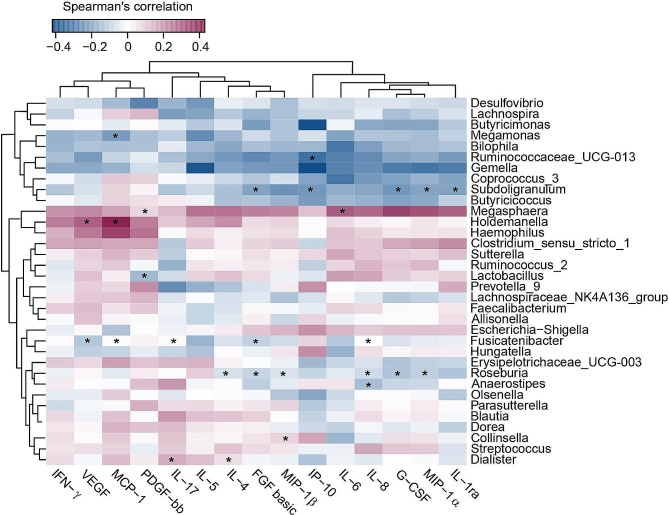
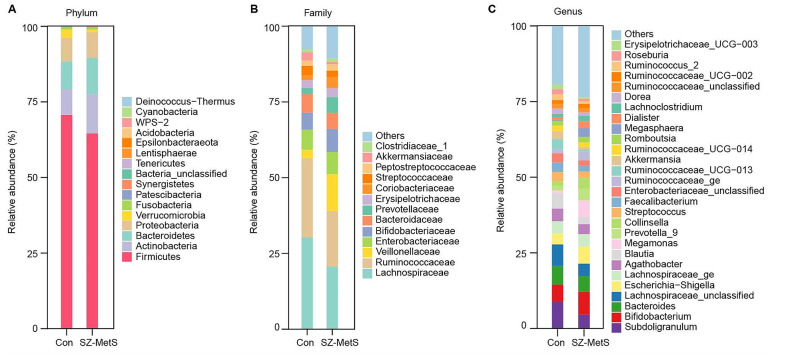
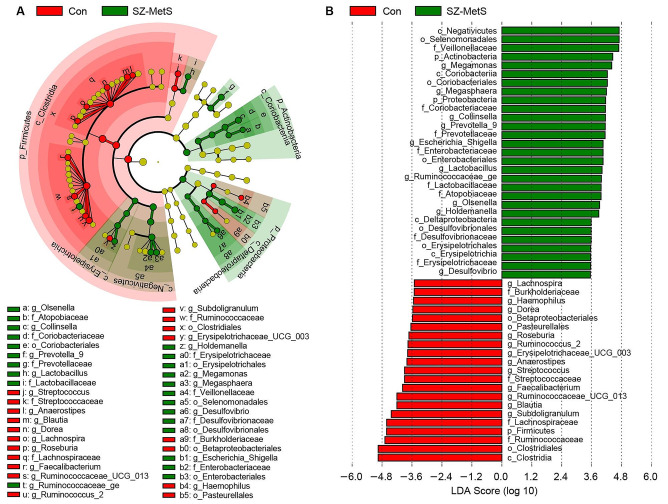
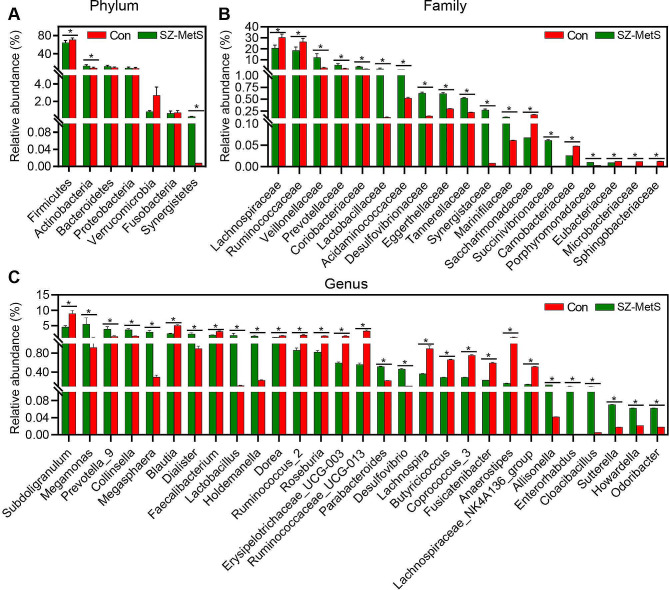
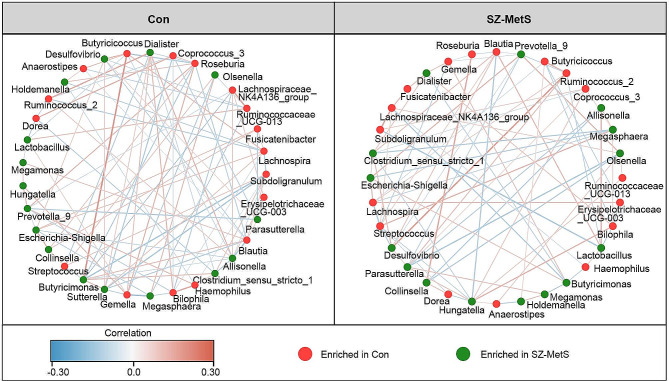
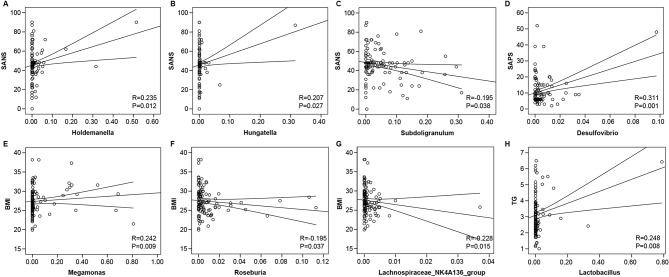
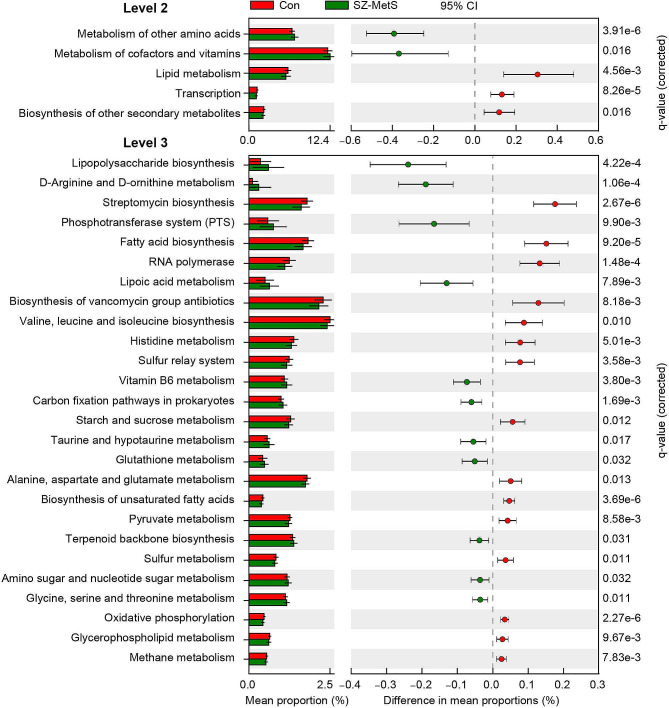
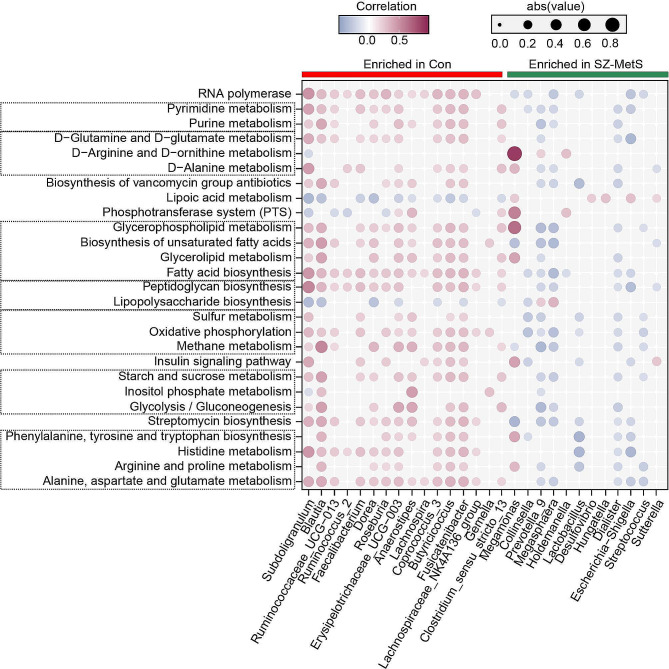
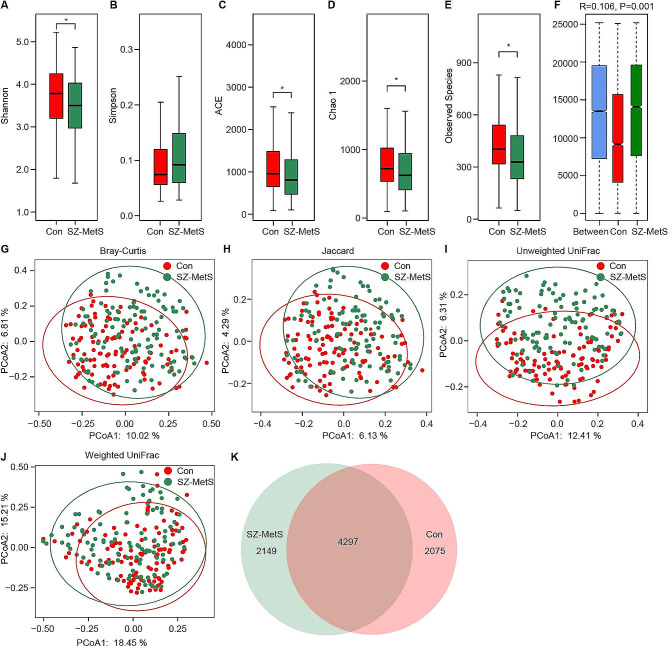
We enrolled 114 Chinese patients with SZ-MetS and 111 age-matched healthy controls from Zhejiang, China, to investigate fecal microbiota using Illumina MiSeq sequencing targeting 16 S rRNA gene V3-V4 hypervariable regions. Host immune responses were assessed using the Bio-Plex Pro Human Cytokine 27-Plex Assay to examine cytokine profiles. In SZ-MetS, we observed decreased bacterial α-diversity and significant differences in β-diversity. LEfSe analysis identified enriched acetate-producing genera (Megamonas and Lactobacillus), and decreased butyrate-producing bacteria (Subdoligranulum, and Faecalibacterium) in SZ-MetS. These altered genera correlated with body mass index, the severity of symptoms (as measured by the Scale for Assessment of Positive Symptoms and Scale for Assessment of Negative Symptoms), and triglyceride levels. Altered bacterial metabolic pathways related to lipopolysaccharide biosynthesis, lipid metabolism, and various amino acid metabolism were also found. Additionally, SZ-MetS exhibited immunological dysfunction with increased pro-inflammatory cytokines, which correlated with the differential genera.

CONCLUSION

These findings suggested that gut microbiota dysbiosis and immune dysfunction play a vital role in SZ-MetS development, highlighting potential therapeutic approaches targeting the gut microbiota. While these therapies show promise, further mechanistic studies are needed to fully understand their efficacy and safety before clinical implementation.

摘要

背景

代谢综合征(MetS)在精神分裂症(SZ)患者中高度普遍,导致早逝等负面后果。肠道菌群失调,指的是微生物群落的失衡,以及慢性炎症与 SZ 和 MetS 都有关联。然而,肠道菌群失调、宿主免疫功能障碍与 SZ 合并 MetS(SZ-MetS)之间的关系尚不清楚。本研究旨在探索 SZ-MetS 中肠道微生物群的变化及其与免疫功能障碍的相关性,为其发病机制提供新的见解。

方法和结果

我们从中国浙江招募了 114 名 SZ-MetS 中国患者和 111 名年龄匹配的健康对照者,使用靶向 16S rRNA 基因 V3-V4 高变区的 Illumina MiSeq 测序来研究粪便微生物群。使用 Bio-Plex Pro 人类细胞因子 27 plex assay 评估宿主免疫反应,以检查细胞因子谱。在 SZ-MetS 中,我们观察到细菌 α 多样性降低和 β 多样性显著差异。LEfSe 分析确定了富含乙酸产生菌(Megamonas 和 Lactobacillus),以及丁酸产生菌减少(Subdoligranulum 和 Faecalibacterium)。这些改变的属与体重指数、症状严重程度(通过阳性症状评定量表和阴性症状评定量表评估)和甘油三酯水平相关。还发现了与脂多糖生物合成、脂质代谢和各种氨基酸代谢相关的改变细菌代谢途径。此外,SZ-MetS 表现出免疫功能障碍,促炎细胞因子增加,与差异属相关。

结论

这些发现表明,肠道微生物群失调和免疫功能障碍在 SZ-MetS 的发展中起着至关重要的作用,强调了针对肠道微生物群的潜在治疗方法。虽然这些疗法显示出前景,但在临床实施之前,还需要进行进一步的机制研究,以充分了解它们的疗效和安全性。
https://cdn.ncbi.nlm.nih.gov/pmc/blobs/0212/11302365/0df49a68c9a3/12967_2024_5533_Fig10_HTML.jpg
https://cdn.ncbi.nlm.nih.gov/pmc/blobs/0212/11302365/8c19e9b87941/12967_2024_5533_Fig1_HTML.jpg
https://cdn.ncbi.nlm.nih.gov/pmc/blobs/0212/11302365/04d923b3c378/12967_2024_5533_Fig2_HTML.jpg
https://cdn.ncbi.nlm.nih.gov/pmc/blobs/0212/11302365/9aa4409c7afc/12967_2024_5533_Fig3_HTML.jpg
https://cdn.ncbi.nlm.nih.gov/pmc/blobs/0212/11302365/00fc2c5168e6/12967_2024_5533_Fig4_HTML.jpg
https://cdn.ncbi.nlm.nih.gov/pmc/blobs/0212/11302365/f1487a92c6a6/12967_2024_5533_Fig5_HTML.jpg
https://cdn.ncbi.nlm.nih.gov/pmc/blobs/0212/11302365/51b50048804b/12967_2024_5533_Fig6_HTML.jpg
https://cdn.ncbi.nlm.nih.gov/pmc/blobs/0212/11302365/7e028b362cd5/12967_2024_5533_Fig7_HTML.jpg
https://cdn.ncbi.nlm.nih.gov/pmc/blobs/0212/11302365/cb9470ab5114/12967_2024_5533_Fig8_HTML.jpg
https://cdn.ncbi.nlm.nih.gov/pmc/blobs/0212/11302365/516c5e80c00b/12967_2024_5533_Fig9_HTML.jpg
https://cdn.ncbi.nlm.nih.gov/pmc/blobs/0212/11302365/0df49a68c9a3/12967_2024_5533_Fig10_HTML.jpg
https://cdn.ncbi.nlm.nih.gov/pmc/blobs/0212/11302365/8c19e9b87941/12967_2024_5533_Fig1_HTML.jpg
https://cdn.ncbi.nlm.nih.gov/pmc/blobs/0212/11302365/04d923b3c378/12967_2024_5533_Fig2_HTML.jpg
https://cdn.ncbi.nlm.nih.gov/pmc/blobs/0212/11302365/9aa4409c7afc/12967_2024_5533_Fig3_HTML.jpg
https://cdn.ncbi.nlm.nih.gov/pmc/blobs/0212/11302365/00fc2c5168e6/12967_2024_5533_Fig4_HTML.jpg
https://cdn.ncbi.nlm.nih.gov/pmc/blobs/0212/11302365/f1487a92c6a6/12967_2024_5533_Fig5_HTML.jpg
https://cdn.ncbi.nlm.nih.gov/pmc/blobs/0212/11302365/51b50048804b/12967_2024_5533_Fig6_HTML.jpg
https://cdn.ncbi.nlm.nih.gov/pmc/blobs/0212/11302365/7e028b362cd5/12967_2024_5533_Fig7_HTML.jpg
https://cdn.ncbi.nlm.nih.gov/pmc/blobs/0212/11302365/cb9470ab5114/12967_2024_5533_Fig8_HTML.jpg
https://cdn.ncbi.nlm.nih.gov/pmc/blobs/0212/11302365/516c5e80c00b/12967_2024_5533_Fig9_HTML.jpg
https://cdn.ncbi.nlm.nih.gov/pmc/blobs/0212/11302365/0df49a68c9a3/12967_2024_5533_Fig10_HTML.jpg

相似文献

1
Altered gut microbiota and systemic immunity in Chinese patients with schizophrenia comorbid with metabolic syndrome.中国精神分裂症合并代谢综合征患者的肠道微生物群和全身免疫改变。
J Transl Med. 2024 Aug 5;22(1):729. doi: 10.1186/s12967-024-05533-9.
2
Fecal Dysbiosis and Immune Dysfunction in Chinese Elderly Patients With Schizophrenia: An Observational Study.中国老年精神分裂症患者粪便菌群失调与免疫功能障碍:一项观察性研究。
Front Cell Infect Microbiol. 2022 Jun 1;12:886872. doi: 10.3389/fcimb.2022.886872. eCollection 2022.
3
Altered oral microbiota and immune dysfunction in Chinese elderly patients with schizophrenia: a cross-sectional study.中国老年精神分裂症患者口腔微生物群改变与免疫功能障碍:一项横断面研究。
Transl Psychiatry. 2023 Dec 9;13(1):383. doi: 10.1038/s41398-023-02682-1.
4
The number of metabolic syndrome risk factors predicts alterations in gut microbiota in Chinese children from the Huantai study.肠道微生物群的改变与儿童代谢综合征的发生有关。
BMC Pediatr. 2023 Apr 21;23(1):191. doi: 10.1186/s12887-023-04017-x.
5
Changes in fecal microbiota composition and the cytokine expression profile in school-aged children with depression: A case-control study.儿童抑郁症患者粪便微生物组成和细胞因子表达谱的变化:一项病例对照研究。
Front Immunol. 2022 Aug 19;13:964910. doi: 10.3389/fimmu.2022.964910. eCollection 2022.
6
The effect of heritability and host genetics on the gut microbiota and metabolic syndrome.遗传和宿主遗传学对肠道微生物群和代谢综合征的影响。
Gut. 2017 Jun;66(6):1031-1038. doi: 10.1136/gutjnl-2015-311326. Epub 2016 Apr 6.
7
Characterizing the gut microbiota in patients with chronic kidney disease.分析慢性肾脏病患者的肠道微生物群。
Postgrad Med. 2020 Aug;132(6):495-505. doi: 10.1080/00325481.2020.1744335. Epub 2020 Apr 2.
8
The gut microbiota-bile acid axis mediates the beneficial associations between plasma vitamin D and metabolic syndrome in Chinese adults: A prospective study.肠道微生物群-胆汁酸轴介导了中国成年人血浆维生素 D 与代谢综合征之间的有益关联:一项前瞻性研究。
Clin Nutr. 2023 Jun;42(6):887-898. doi: 10.1016/j.clnu.2023.03.022. Epub 2023 Apr 13.
9
Changes in the Mucosa-Associated Microbiome and Transcriptome across Gut Segments Are Associated with Obesity in a Metabolic Syndrome Porcine Model.黏膜相关微生物组和转录组在肠道各节段的变化与代谢综合征猪模型中的肥胖有关。
Microbiol Spectr. 2022 Aug 31;10(4):e0071722. doi: 10.1128/spectrum.00717-22. Epub 2022 Jul 7.
10
Fecal metabonomics combined with 16S rRNA gene sequencing to analyze the changes of gut microbiota in rats with kidney-yang deficiency syndrome and the intervention effect of You-gui pill.基于粪便代谢组学联合 16S rRNA 基因测序分析肾阳虚证大鼠肠道菌群变化及右归丸的干预作用
J Ethnopharmacol. 2019 Nov 15;244:112139. doi: 10.1016/j.jep.2019.112139. Epub 2019 Aug 8.

引用本文的文献

1
Gut microbiota dysbiosis and systemic immune dysfunction in critical ill patients with multidrug-resistant bacterial colonization and infection.多重耐药菌定植和感染的危重症患者的肠道微生物群失调与全身免疫功能障碍
J Transl Med. 2025 Sep 2;23(1):981. doi: 10.1186/s12967-025-07049-2.
2
Schizophrenia-associated alterations in fecal mycobiota and systemic immune dysfunction: a cohort study of elderly Chinese patients.精神分裂症相关的粪便微生物群改变与全身免疫功能障碍:一项针对中国老年患者的队列研究
Front Immunol. 2025 Jul 21;16:1607739. doi: 10.3389/fimmu.2025.1607739. eCollection 2025.
3
Multi-kingdom microbial changes and their associations with the clinical characteristics in schizophrenia patients.

本文引用的文献

1
Schizophrenia and obesity: May the gut microbiota serve as a link for the pathogenesis?精神分裂症与肥胖:肠道微生物群会是发病机制的关联因素吗?
Imeta. 2023 Apr 4;2(2):e99. doi: 10.1002/imt2.99. eCollection 2023 May.
2
Associations of the Gut Microbiome With Treatment Resistance in Schizophrenia.肠道微生物群与精神分裂症治疗抵抗的关联。
JAMA Psychiatry. 2024 Mar 1;81(3):292-302. doi: 10.1001/jamapsychiatry.2023.5371.
3
Are probiotics effective in reducing the metabolic side effects of psychiatric medication? A scoping review of evidence from clinical studies.
精神分裂症患者的多菌群微生物变化及其与临床特征的关联
Transl Psychiatry. 2025 Jul 5;15(1):228. doi: 10.1038/s41398-025-03449-6.
4
Biological Susceptibility of Patients with Schizophrenia to Metabolic Syndrome: A Review.精神分裂症患者对代谢综合征的生物学易感性:综述
Alpha Psychiatry. 2025 Apr 22;26(2):39896. doi: 10.31083/AP39896. eCollection 2025 Apr.
益生菌在减少精神药物的代谢副作用方面是否有效?来自临床研究的证据范围综述。
Transl Psychiatry. 2024 Jan 15;14(1):26. doi: 10.1038/s41398-024-02735-z.
4
Altered oral microbiota and immune dysfunction in Chinese elderly patients with schizophrenia: a cross-sectional study.中国老年精神分裂症患者口腔微生物群改变与免疫功能障碍:一项横断面研究。
Transl Psychiatry. 2023 Dec 9;13(1):383. doi: 10.1038/s41398-023-02682-1.
5
Correlation between cognitive impairment and metabolic imbalance of gut microbiota in patients with schizophrenia.精神分裂症患者认知障碍与肠道微生物群代谢失衡之间的相关性
World J Psychiatry. 2023 Oct 19;13(10):724-731. doi: 10.5498/wjp.v13.i10.724.
6
Profiles and diagnostic value of intestinal microbiota in schizophrenia patients with metabolic syndrome.精神分裂症伴代谢综合征患者肠道微生物群特征及其诊断价值。
Front Endocrinol (Lausanne). 2023 Jul 27;14:1190954. doi: 10.3389/fendo.2023.1190954. eCollection 2023.
7
Altered levels of fecal short-chain fatty acids are associated with subclinical inflammation and worse cognitive performance in patients with schizophrenia.粪便短链脂肪酸水平的改变与精神分裂症患者亚临床炎症和认知功能下降有关。
J Psychiatr Res. 2023 Sep;165:298-304. doi: 10.1016/j.jpsychires.2023.07.042. Epub 2023 Jul 31.
8
Incidence, prevalence, and global burden of schizophrenia - data, with critical appraisal, from the Global Burden of Disease (GBD) 2019.精神分裂症的发病率、患病率和全球负担——来自全球疾病负担(GBD)2019 的数据,包括批判性评估。
Mol Psychiatry. 2023 Dec;28(12):5319-5327. doi: 10.1038/s41380-023-02138-4. Epub 2023 Jul 27.
9
Longitudinal Gut Microbiota Dysbiosis Underlies Olanzapine-Induced Weight Gain.长期肠道微生物失调是导致奥氮平引起体重增加的原因。
Microbiol Spectr. 2023 Aug 17;11(4):e0005823. doi: 10.1128/spectrum.00058-23. Epub 2023 Jun 1.
10
Compositional and Functional Alterations in Intestinal Microbiota in Patients with Psychosis or Schizophrenia: A Systematic Review and Meta-analysis.精神病或精神分裂症患者肠道微生物群的组成和功能改变:系统评价和荟萃分析。
Schizophr Bull. 2023 Sep 7;49(5):1239-1255. doi: 10.1093/schbul/sbad049.