Mori Yusuke, Yamamoto Ken, Kubota Naoya, Yano Koichi
Orthopaedics, Ishikiri Seiki Hospital, Higashiōsaka, JPN.
Orthopaedics, Tsuji Surgical Rehabilitation Hospital, Osaka, JPN.
Cureus. 2024 Jul 4;16(7):e63837. doi: 10.7759/cureus.63837. eCollection 2024 Jul.
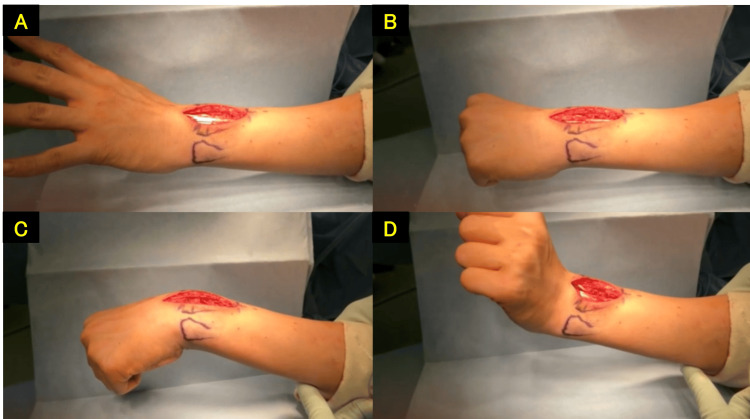
The patient was a 13-year-old male who fell while riding a bicycle and was initially diagnosed with a distal radial epiphyseal separation (volar displacement type) that was conservatively managed. Four months post-injury, he complained of limited movement in his left index finger and was referred to our hospital. Upon examination, the patient also complained of limited movement of the left index finger in wrist flexion. The wrist range of motion was 50° of volar flexion, 50° of dorsiflexion, 90° of pronation, and 90° of supination with the fingers extended. The X-ray revealed a radiolucent area in the distal radius. Ultrasound, computed tomography, and magnetic resonance imaging scans demonstrated entrapment of the extensor tendon within the medullary cavity of the radius. Five months post-injury, surgery was performed using the wide-awake local anesthesia no-tourniquet (WALANT) technique. A dorsal wrist approach was utilized, and the extensor digitorum communis tendon was found to be trapped within the medullary cavity of the radius. The tendon was released using an air drill, and sufficient improvement in the left index finger flexion was confirmed with active movement before concluding the surgery. At the 11-month postoperative follow-up, the patient showed excellent outcomes with a wrist range of motion of 75° of volar flexion, 85° of dorsiflexion, 90° of pronation, and 90° of supination. Tendon entrapment of the extensor tendons has been reported as a long-standing complication associated with distal radius fractures, particularly with volar displacement types. A benefit of the WALANT technique is the ability to communicate with the patient during surgery, allowing for active movements of the fingers and wrist. This is particularly useful in tendon surgeries for determining tendon tension. We report a case of successful tenolysis surgery using the WALANT technique for a patient with a conservatively managed distal radial epiphyseal separation (volar displacement type), who experienced a limited flexion of the index finger due to tendon entrapment.
该患者为一名13岁男性,骑自行车时摔倒,最初被诊断为桡骨远端骨骺分离(掌侧移位型),采用保守治疗。受伤后四个月,他主诉左手食指活动受限,遂被转诊至我院。经检查,患者还主诉在腕关节屈曲时左手食指活动受限。腕关节活动范围为掌屈50°、背伸50°、旋前90°、旋后90°(手指伸展)。X线显示桡骨远端有一透亮区。超声、计算机断层扫描和磁共振成像扫描显示伸肌腱被困于桡骨髓腔内。受伤后五个月,采用清醒局部麻醉无止血带(WALANT)技术进行手术。采用腕背侧入路,发现指总伸肌腱被困于桡骨髓腔内。使用气钻松解肌腱,在手术结束前通过主动活动确认左手食指屈曲有足够改善。术后11个月随访时,患者效果良好,腕关节活动范围为掌屈75°、背伸85°、旋前90°、旋后90°。伸肌腱嵌顿已被报道为桡骨远端骨折的一种长期并发症,尤其是掌侧移位型。WALANT技术的一个优点是在手术过程中能够与患者沟通,允许手指和腕关节进行主动活动。这在肌腱手术中确定肌腱张力时特别有用。我们报告了一例使用WALANT技术成功进行肌腱松解手术的病例,该患者为保守治疗的桡骨远端骨骺分离(掌侧移位型),因肌腱嵌顿导致食指屈曲受限。