Department of Psychology and Department of Neuroscience, Center for Perceptual Systems, Center for Learning and Memory, The University of Texas at Austin, Austin, TX, USA.
Indiana University School of Optometry and Program in Neuroscience, Indiana University, Bloomington IN, USA.
Neuroimage Clin. 2024;43:103646. doi: 10.1016/j.nicl.2024.103646. Epub 2024 Jul 25.
After a concussion diagnosis, the most important issue for patients and loved ones is how long it will take them to recover. The main objective of this study is to develop a prognostic model of concussion recovery. This model would benefit many patients worldwide, allowing for early treatment intervention.
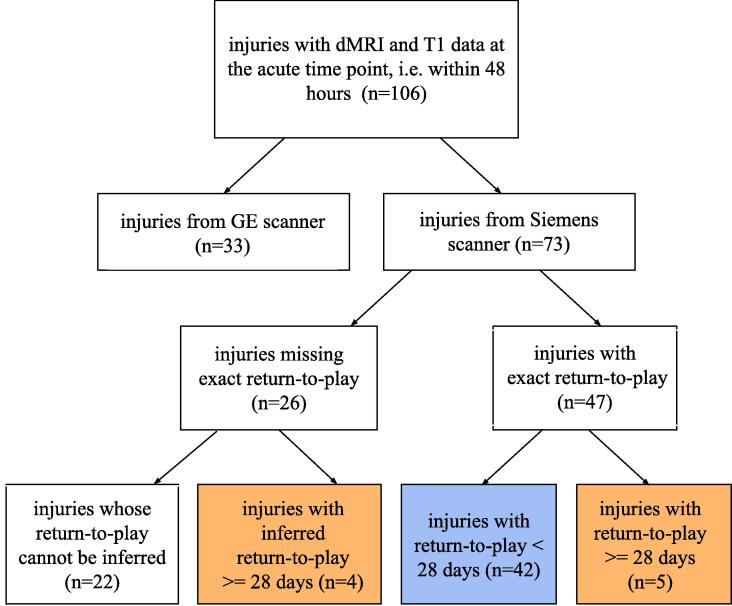
The Concussion Assessment, Research and Education (CARE) consortium study enrolled collegiate athletes from 30 sites (NCAA athletic departments and US Department of Defense service academies), 4 of which participated in the Advanced Research Core, which included diffusion-weighted MRI (dMRI) data collection. We analyzed the dMRI data of 51 injuries of concussed athletes scanned within 48 h of injury. All athletes were cleared to return-to-play by the local medical staff following a standardized, graduated protocol. The primary outcome measure is days to clearance of unrestricted return-to-play. Injuries were divided into early (return-to-play < 28 days) and late (return-to-play >= 28 days) recovery based on the return-to-play clinical records. The late recovery group meets the standard definition of Persisting Post-Concussion Symptoms (PPCS). Data were processed using automated, state-of-the-art, rigorous methods for reproducible data processing using brainlife.io. All processed data derivatives are made available at https://brainlife.io/project/63b2ecb0daffe2c2407ee3c5/dataset. The microstructural properties of 47 major white matter tracts, 5 callosal, 15 subcortical, and 148 cortical structures were mapped. Fractional Anisotropy (FA) and Mean Diffusivity (MD) were estimated for each tract and structure. Correlation analysis and Receiver Operator Characteristic (ROC) analysis were then performed to assess the association between the microstructural properties and return-to-play. Finally, a Logistic Regression binary classifier (LR-BC) was used to classify the injuries between the two recovery groups.
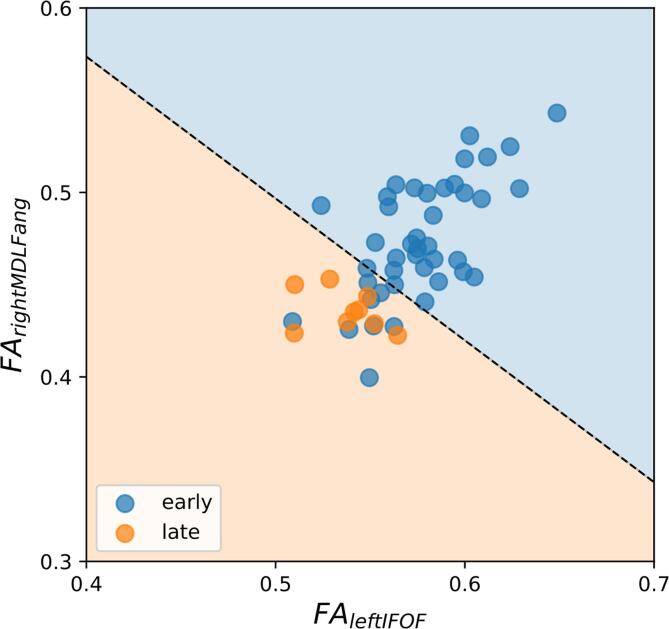
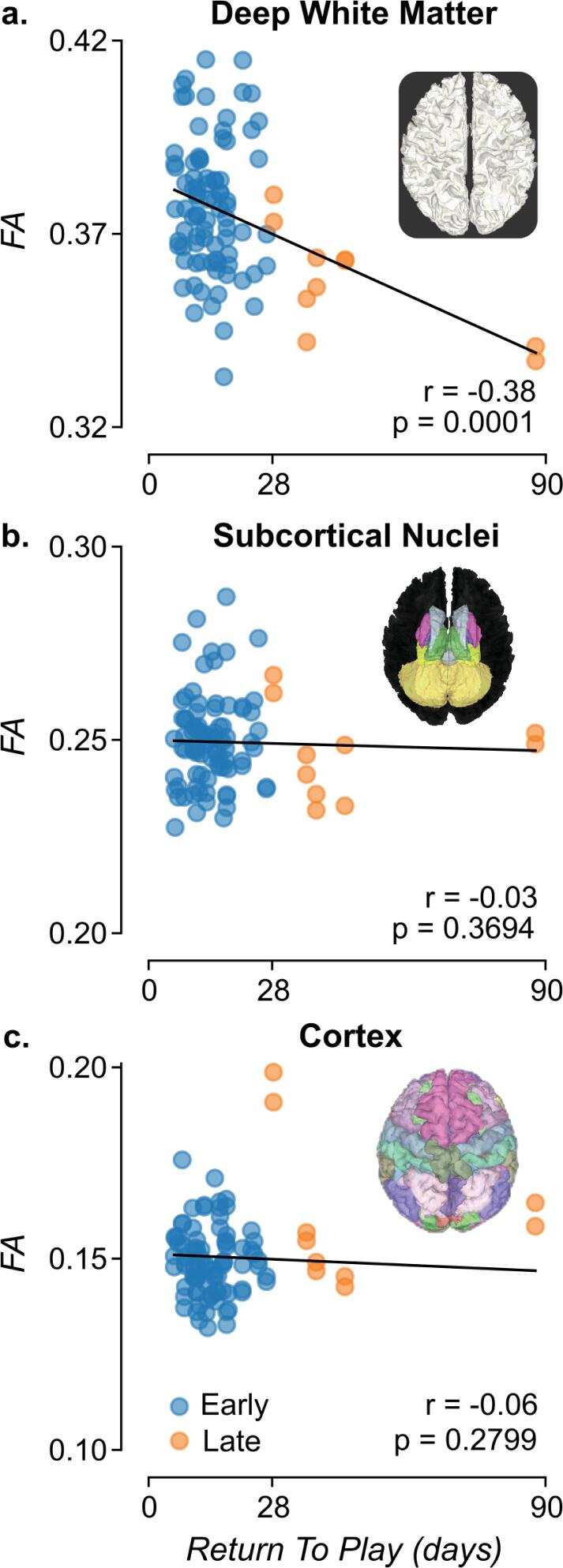
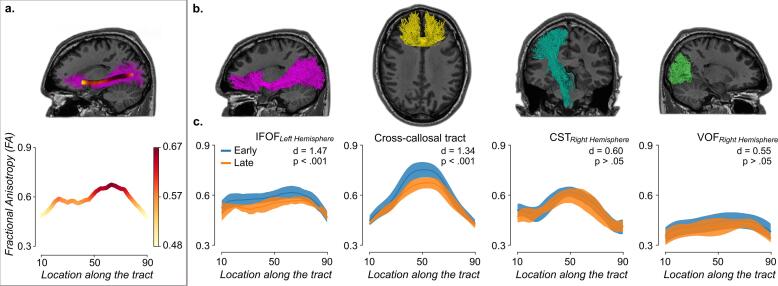
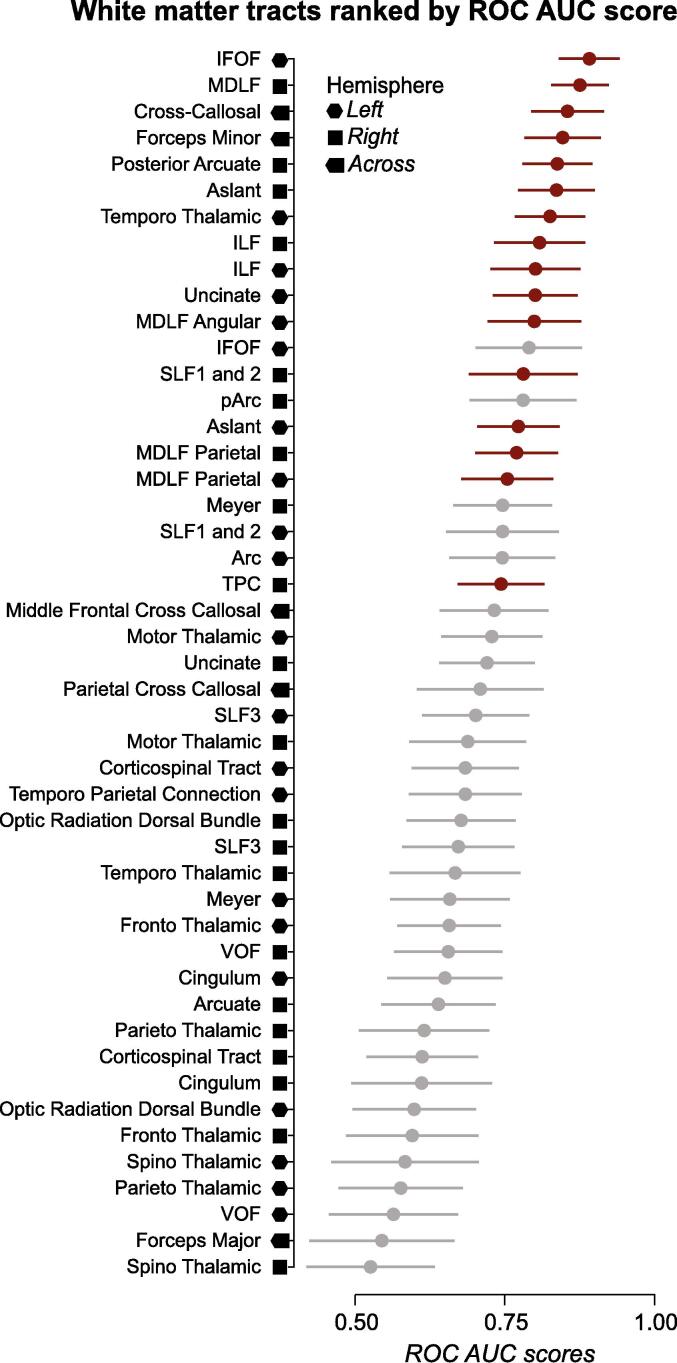
The mean FA across all white matter volume was negatively correlated with return-to-play (r = -0.38, p = 0.00001). No significant association between mean MD and return-to-play was found, neither for FA nor MD for any other structure. The mean FA of 47 white matter tracts was negatively correlated with return-to-play (rμ = -0.27; rσ = 0.08; r = -0.1; r = -0.43). Across all tracts, a large mean ROC Area Under the Curve (AUC) of 0.71 ± 0.09 SD was found. The top classification performance of the LR-BC was AUC = 0.90 obtained using the 16 statistically significant white matter tracts.
Utilizing a free, open-source, and automated cloud-based neuroimaging pipeline and app (https://brainlife.io/docs/tutorial/using-clairvoy/), a prognostic model has been developed, which predicts athletes at risk for slow recovery (PPCS) with an AUC=0.90, balanced accuracy = 0.89, sensitivity = 1.0, and specificity = 0.79. The small number of participants in this study (51 injuries) is a significant limitation and supports the need for future large concussion dMRI studies and focused on recovery.
在诊断出脑震荡后,患者及其家属最关心的问题是他们需要多长时间才能康复。本研究的主要目的是建立脑震荡康复的预后模型。这个模型将使全世界许多患者受益,使他们能够及早进行治疗干预。
Concussion Assessment, Research and Education (CARE) 联合会研究招募了来自 30 个地点(NCAA 运动部门和美国国防部服务学院)的大学生运动员,其中 4 个参加了高级研究核心,其中包括弥散加权 MRI(dMRI)数据采集。我们分析了 51 名脑震荡运动员在受伤后 48 小时内扫描的 dMRI 数据。所有运动员均按照标准化的、逐步的协议,由当地医务人员批准恢复无限制的重返赛场。主要的结果测量是从无限制重返赛场到清除的天数。根据重返赛场的临床记录,将损伤分为早期(重返赛场<28 天)和晚期(重返赛场>=28 天)康复。晚期康复组符合持续性脑震荡后症状(PPCS)的标准定义。使用自动化、最先进的、严格的方法处理数据,以使用 brainlife.io 进行可重复的数据处理。所有处理后的数据衍生品均可在 https://brainlife.io/project/63b2ecb0daffe2c2407ee3c5/dataset 获得。映射了 47 条主要白质束、5 条胼胝体、15 个皮质下和 148 个皮质结构的微观结构特性。为每条束和结构估计了分数各向异性(FA)和平均扩散系数(MD)。然后进行了相关性分析和接收者操作特征(ROC)分析,以评估微观结构特性与重返赛场之间的关系。最后,使用逻辑回归二分类器(LR-BC)对两组康复之间的损伤进行分类。
所有白质体积的平均 FA 与重返赛场呈负相关(r=-0.38,p=0.00001)。没有发现平均 MD 与重返赛场之间有显著关联,对于任何其他结构也是如此。47 条白质束的平均 FA 与重返赛场呈负相关(rμ=-0.27;rσ=-0.08;r=-0.1;r=-0.43)。在所有束中,发现平均 ROC 曲线下面积(AUC)较大,为 0.71±0.09 SD。LR-BC 的最高分类性能为 AUC=0.90,使用 16 个具有统计学意义的白质束获得。
利用免费的、开源的、自动化的基于云的神经影像学管道和应用程序(https://brainlife.io/docs/tutorial/using-clairvoy/),已经开发了一种预后模型,可以以 AUC=0.90、平衡准确性=0.89、灵敏度=1.0 和特异性=0.79 的比例预测有缓慢康复(PPCS)风险的运动员。本研究的参与者人数(51 例损伤)较少是一个显著的局限性,支持未来需要进行更多的脑震荡 dMRI 研究,并侧重于康复。