Wang Yiran, Wang Zhixiang, Zhang Bin, Yang Fan
Honors College, Nanjing Normal University, Nanjing 210023, China.
Department of Ultrasound, Beijing Friendship Hospital, Capital Medical University, Beijing, China.
J Bone Oncol. 2024 Jul 13;47:100622. doi: 10.1016/j.jbo.2024.100622. eCollection 2024 Aug.
The main objective of this study was to create and assess a detailed diagnostic model with an optimizing feature selection algorithm that combines computed tomography (CT) imaging characteristics, demographic information, and genetic markers to enhance the accuracy of benign and malignant classification of osteosarcoma. This research seeks to enhance the early identification and categorization of benign and malignant of osteosarcoma, ultimately enabling more personalized and efficient treatment approaches.
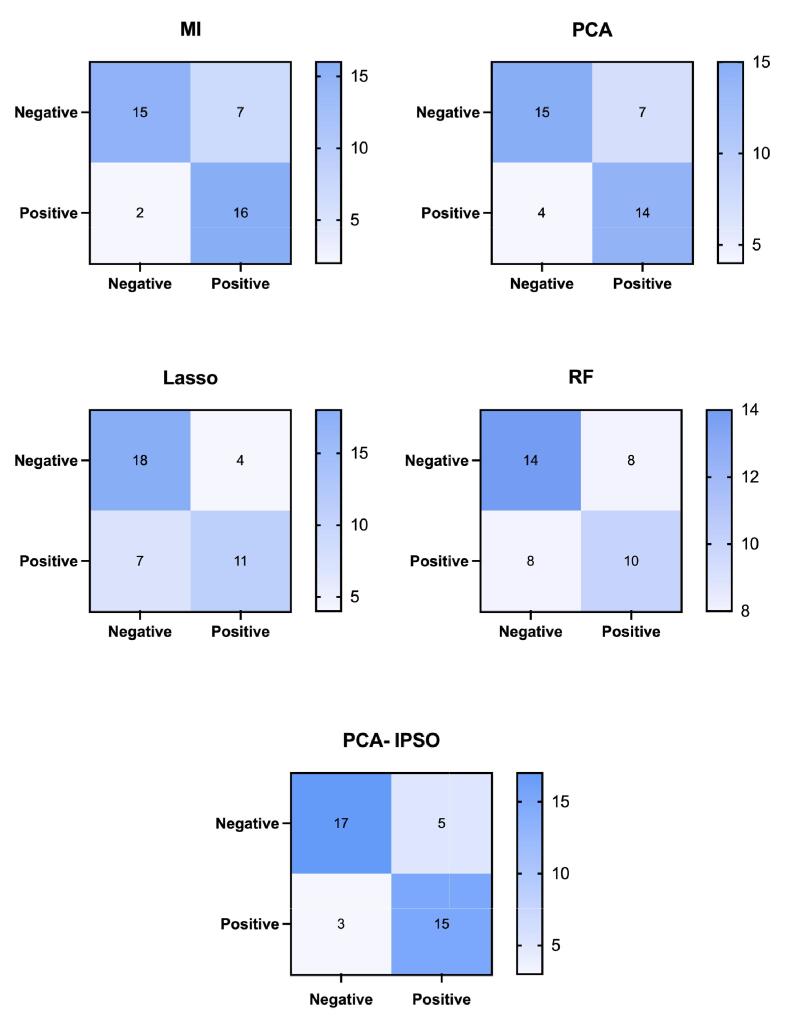
Data from 225 patients diagnosed with osteosarcoma at two different medical institutions between June 2018 and June 2021 were gathered for this research study. A novel feature selection approach that combined Principal Component Analysis (PCA) with Improved Particle Swarm Optimization (IPSO) was utilized to analyze 1743 image-derived features. The performance of the resulting model was evaluated using metrics such as area under the receiver operating characteristic curve (AUC), accuracy (ACC), sensitivity (SEN), and specificity (SPE), and compared to models developed using conventional feature selection methods.
The proposed model showed promising predictive performance with an AUC of 0.87, accuracy of 0.80, sensitivity of 0.75, and specificity of 0.85. These results suggest improved predictive ability compared to models built using traditional feature selection techniques, particularly in terms of accuracy and specificity. However, there is room for improvement in enhancing sensitivity.
Our study introduces a novel predictive model for distinguishing between benign and malignant osteosarcoma., emphasizing its potential significance in clinical practice. Through the utilization of CT imaging features, our model shows improved accuracy and specificity, marking progress in the early detection and classification of osteosarcoma as either benign or malignant. Future investigations will concentrate on enhancing the model's sensitivity and validating its effectiveness on a larger dataset, aiming to boost its clinical relevance and support personalized treatment approaches for osteosarcoma.
本研究的主要目的是创建并评估一个详细的诊断模型,该模型采用优化特征选择算法,结合计算机断层扫描(CT)成像特征、人口统计学信息和基因标记物,以提高骨肉瘤良恶性分类的准确性。本研究旨在加强骨肉瘤良恶性的早期识别和分类,最终实现更个性化、更有效的治疗方法。
本研究收集了2018年6月至2021年6月期间在两家不同医疗机构被诊断为骨肉瘤的225例患者的数据。采用一种将主成分分析(PCA)与改进粒子群优化算法(IPSO)相结合的新型特征选择方法,对1743个图像衍生特征进行分析。使用受试者操作特征曲线下面积(AUC)、准确率(ACC)、灵敏度(SEN)和特异度(SPE)等指标评估所得模型的性能,并与使用传统特征选择方法开发的模型进行比较。
所提出的模型显示出有前景的预测性能,AUC为0.87,准确率为0.80,灵敏度为0.75,特异度为0.85。这些结果表明,与使用传统特征选择技术构建的模型相比,该模型的预测能力有所提高,尤其是在准确率和特异度方面。然而,在提高灵敏度方面仍有改进空间。
我们的研究引入了一种用于区分骨肉瘤良恶性的新型预测模型,强调了其在临床实践中的潜在意义。通过利用CT成像特征,我们的模型显示出更高的准确率和特异度,标志着在骨肉瘤良恶性早期检测和分类方面取得了进展。未来的研究将集中于提高模型的灵敏度,并在更大的数据集上验证其有效性,旨在增强其临床相关性,并支持骨肉瘤的个性化治疗方法。