Institute for Medical Microbiology, Virology and Hygiene, University Medical Center Hamburg-Eppendorf, Hamburg, Germany.
Leibniz Institute of Virology, Hamburg, Germany.
PLoS Pathog. 2024 Aug 7;20(8):e1012426. doi: 10.1371/journal.ppat.1012426. eCollection 2024 Aug.
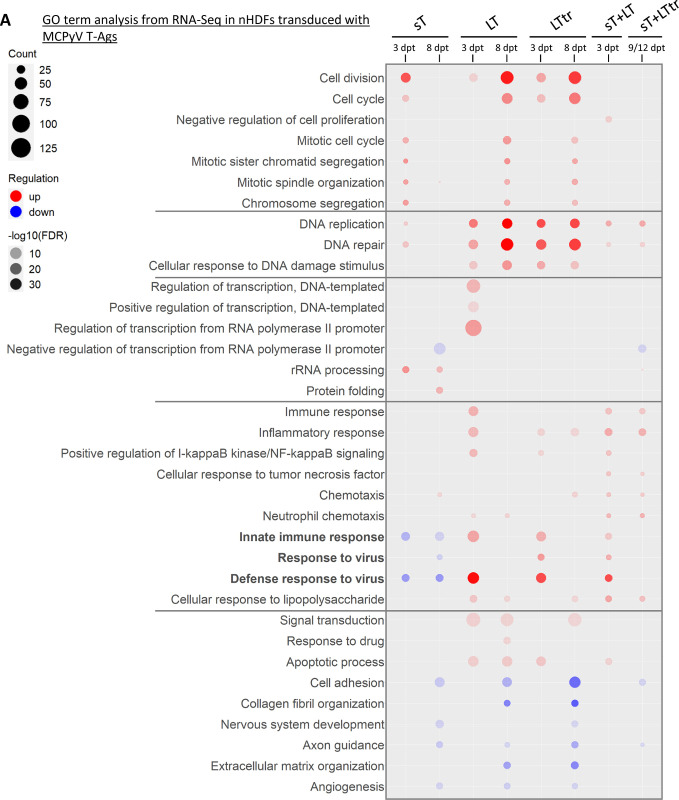
Merkel cell polyomavirus (MCPyV) is the causative agent of the majority of Merkel cell carcinomas (MCC). The virus has limited coding capacity, with its early viral proteins, large T (LT) and small T (sT), being multifunctional and contributing to infection and transformation. A fundamental difference in early viral gene expression between infection and MCPyV-driven tumorigenesis is the expression of a truncated LT (LTtr) in the tumor. In contrast, sT is expressed in both conditions and contributes significantly to oncogenesis. Here, we identified novel functions of early viral proteins by performing genome-wide transcriptome and chromatin studies in primary human fibroblasts. Due to current limitations in infection and tumorigenesis models, we mimic these conditions by ectopically expressing sT, LT or LTtr, individually or in combination, at different time points. In addition to its known function in cell cycle and inflammation modulation, we reveal a fundamentally new function of sT. We show that sT regulates the type I interferon (IFN) response downstream of the type I interferon receptor (IFNAR) by interfering with the interferon-stimulated gene factor 3 (ISGF3)-induced interferon-stimulated gene (ISG) response. Expression of sT leads to a reduction in the expression of interferon regulatory factor 9 (IRF9) which is a central component of the ISGF3 complex. We further show that this function of sT is conserved in BKPyV. We provide a first mechanistic understanding of which early viral proteins trigger and control the type I IFN response, which may influence MCPyV infection, persistence and, during MCC progression, regulation of the tumor microenvironment.
默克尔细胞多瘤病毒(MCPyV)是大多数默克尔细胞癌(MCC)的病原体。该病毒的编码能力有限,其早期病毒蛋白大 T(LT)和小 T(sT)具有多功能性,有助于感染和转化。感染和 MCPyV 驱动的肿瘤发生中早期病毒基因表达的一个根本区别是肿瘤中 LT 截短(LTtr)的表达。相比之下,sT 在两种情况下均表达,并对致癌作用有重大贡献。在这里,我们通过在原代人成纤维细胞中进行全基因组转录组和染色质研究,确定了早期病毒蛋白的新功能。由于目前在感染和肿瘤发生模型方面存在限制,我们通过异位表达 sT、LT 或 LTtr,单独或组合,在不同时间点来模拟这些条件。除了其在细胞周期和炎症调节中的已知功能外,我们还揭示了 sT 的一个全新功能。我们表明,sT 通过干扰干扰素刺激基因因子 3(ISGF3)诱导的干扰素刺激基因(ISG)反应,调节 I 型干扰素(IFN)受体(IFNAR)下游的 I 型 IFN 反应。sT 的表达导致干扰素调节因子 9(IRF9)的表达减少,IRF9 是 ISGF3 复合物的核心组成部分。我们进一步表明,sT 的这种功能在 BKPyV 中是保守的。我们首次从机制上了解了哪些早期病毒蛋白触发和控制 I 型 IFN 反应,这可能影响 MCPyV 感染、持续存在以及在 MCC 进展过程中调节肿瘤微环境。