University of Exeter Medical School, University of Exeter, Exeter, United Kingdom.
University of Liverpool, Department of Health Data Science, Liverpool, United Kingdom.
J Med Internet Res. 2024 Aug 7;26:e56528. doi: 10.2196/56528.
Health service policy in many jurisdictions is driving greater investment into digital primary care services. While some patients and practices may benefit, there are concerns that not all are able or wish to access primary care services online. "Digital facilitation" is the "range of processes, procedures, and personnel seeking to support patients in their uptake and use of online services" and may address such concerns.
As part of a multimethod research program, we undertook surveys of practice staff and patients to gain insight into the support being offered by practices and explore patients' experiences of this support.
General practices from 4 regions of England were sent a questionnaire exploring the modes of digital facilitation offered, the personnel involved in its delivery, and views on the motivations and drivers for providing support. Moreover, 12,822 patients registered with 62 general practices (predominantly those providing practice survey responses) were sent a questionnaire exploring their experiences of any support offered by their practice to use online services.
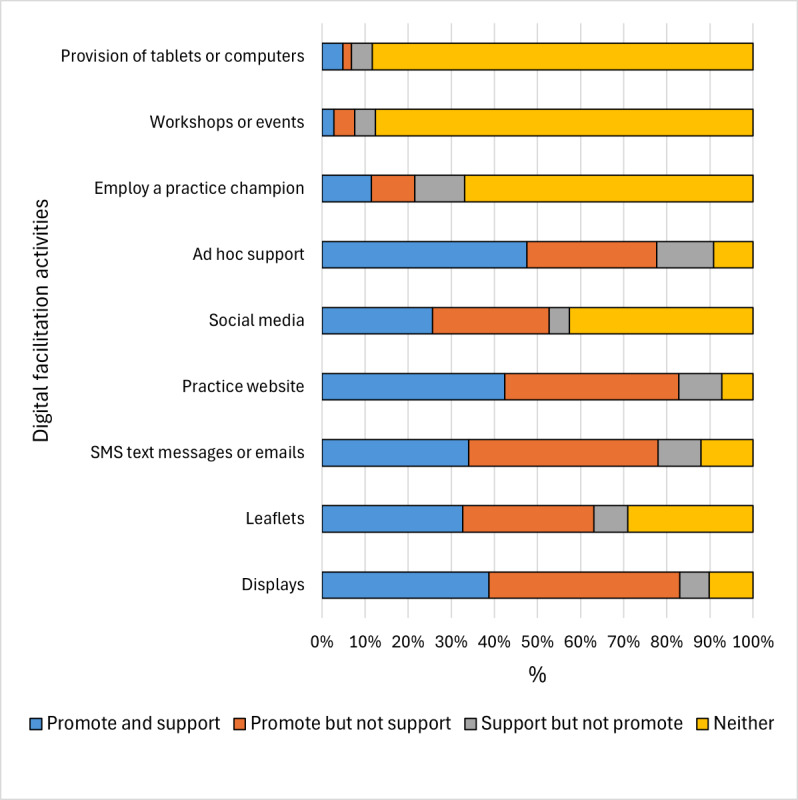
Almost one-third of practices (156/500, 31.2%) responded to the practice survey, with most reporting using passive modes of digital facilitation (eg, display, leaflets, and SMS text messages) and few using active modes (eg, offering tablets or computers or using practice champions). However, 90.9% (130/143) reported providing ad hoc support. Practices agreed that it was the responsibility of both the practice (105/144, 72.9%) and the wider National Health Service (118/143, 82.5%) to support patients in using online services and that providing such support benefited the practice (126/144, 87.5%) and their patients (132/144, 91.7%). Nearly a quarter of the patients (3051/12,822, 23.8%) responded to the patient survey, with few (522/3051, 17.11% or less) reporting awareness of any modes of digital facilitation apart from text messages and emails (1205/3051, 39.5%) and only 13.36% (392/2935) reporting receiving support to use online services. Adjusted logistic regression analyses showed that older patients had a lower likelihood of 4 outcomes: being aware of, or of using, digital facilitation efforts, or being told about or being helped to use online services (all P<.05), particularly with regard to being helped to use online services (adjusted odds ratio for patients aged 85 years versus those aged 55-64 years: 0.08, 95% CI 0.02-0.36). However, ethnic minority participants or those for whom their first language was not English had positive associations with these outcomes.
General practices recognize that patients would benefit from support to access online services. However, the support provided is often passive or ad hoc, and patients were seldom aware of digital facilitation efforts that their practice provided. There is potential to increase engagement with online primary care services by providing more support for all patients, particularly to provide targeted support for older patients.
许多司法管辖区的医疗服务政策正在推动对数字初级保健服务的更大投资。虽然一些患者和实践可能受益,但也有人担心并非所有人都能够或愿意在线接受初级保健服务。“数字促进”是“旨在支持患者接受和使用在线服务的一系列流程、程序和人员”,可能会解决这些问题。
作为一项多方法研究计划的一部分,我们对实践工作人员和患者进行了调查,以深入了解实践提供的支持,并探讨患者对这种支持的体验。
从英格兰的 4 个地区向全科医生发放了一份调查问卷,调查了所提供的数字促进模式、参与提供的人员,以及对提供支持的动机和驱动因素的看法。此外,向 62 家全科医生(主要是那些提供实践调查回复的医生)注册的 12822 名患者发放了一份调查问卷,调查他们在使用在线服务时从实践中获得的任何支持的体验。
近三分之一的实践(500 家中有 156 家,31.2%)回复了实践调查,大多数报告使用被动模式的数字促进(例如,展示、传单和短信),很少使用主动模式(例如,提供平板电脑或计算机或使用实践拥护者)。然而,90.9%(130/143)报告提供了临时支持。实践认为,支持患者使用在线服务是实践(105/144,72.9%)和更广泛的国家卫生服务体系(118/143,82.5%)的共同责任,提供这种支持对实践(126/144,87.5%)及其患者(132/144,91.7%)都有益。约四分之一的患者(12822 名中的 3051 名,23.8%)回复了患者调查,很少有(522/3051,17.11%或更少)除短信和电子邮件(1205/3051,39.5%)之外,了解任何数字促进模式,只有 13.36%(392/2935)报告接受了使用在线服务的支持。调整后的逻辑回归分析表明,年龄较大的患者有以下四个结果的可能性较低:了解或使用数字促进工作、被告知或获得使用在线服务的帮助(均 P<.05),特别是在获得使用在线服务的帮助方面(年龄在 85 岁的患者与年龄在 55-64 岁的患者相比,调整后的优势比为 0.08,95%置信区间为 0.02-0.36)。然而,少数民族参与者或其第一语言不是英语的参与者与这些结果呈正相关。
全科医生认识到患者将从获得在线服务的支持中受益。然而,提供的支持往往是被动或临时的,患者很少了解实践提供的数字促进工作。通过为所有患者提供更多支持,特别是为老年患者提供有针对性的支持,有可能增加对在线初级保健服务的参与度。