RAND Europe, Cambridge, United Kingdom.
University of Exeter Medical School, Exeter, United Kingdom.
J Med Internet Res. 2022 Jul 14;24(7):e33911. doi: 10.2196/33911.
The use of web-based services within primary care (PC) in the National Health Service in England is increasing, with medically underserved populations being less likely to engage with web-based services than other patient groups. Digital facilitation-referring to a range of processes, procedures, and personnel that seek to support patients in the uptake and use of web-based services-may be a way of addressing these challenges. However, the models and impact of digital facilitation currently in use are unclear.
This study aimed to identify, characterize, and differentiate between different approaches to digital facilitation in PC; establish what is known about the effectiveness of different approaches; and understand the enablers of digital facilitation.
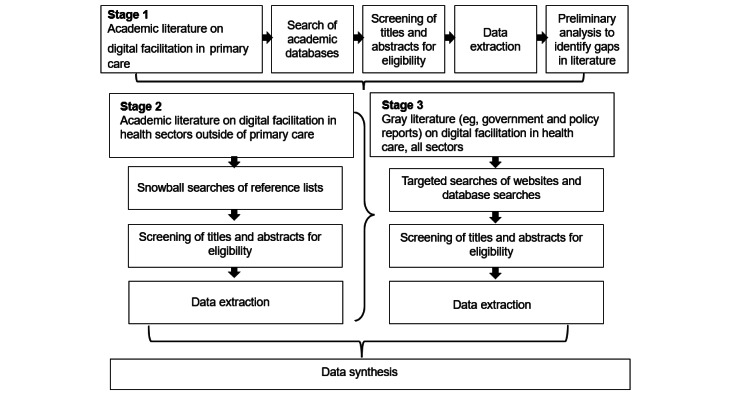
Adopting scoping review methodology, we searched academic databases (PubMed, EMBASE, CINAHL, Web of Science, and Cochrane Library) and gray literature published between 2015 and 2020. We conducted snowball searches of reference lists of included articles and articles identified during screening as relevant to digital facilitation, but which did not meet the inclusion criteria because of article type restrictions. Titles and abstracts were independently screened by 2 reviewers. Data from eligible studies were analyzed using a narrative synthesis approach.
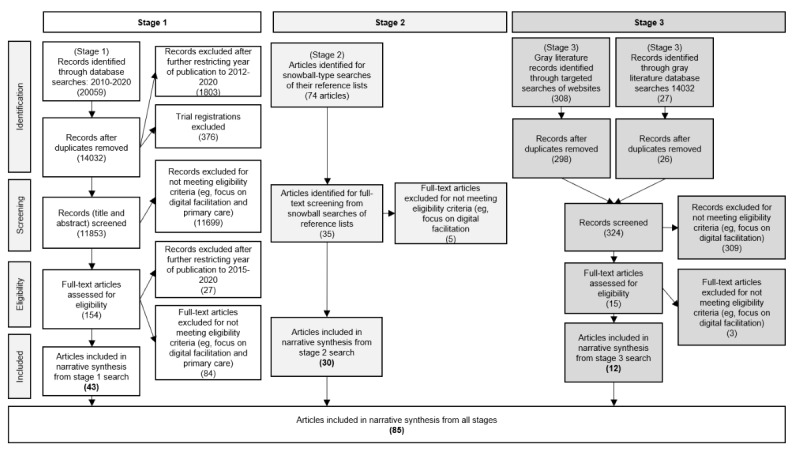
A total of 85 publications were included. Most (71/85, 84%) were concerned with digital facilitation approaches targeted at patients (promotion of services, training patients to improve their technical skills, or other guidance and support). Further identified approaches targeted PC staff to help patients (eg, improving staff knowledge of web-based services and enhancing their technical or communication skills). Qualitative evidence suggests that some digital facilitation may be effective in promoting the uptake and use of web-based services by patients (eg, recommendation of web-based services by practice staff and coaching). We found little evidence that providing patients with initial assistance in registering for or accessing web-based services leads to increased long-term use. Few studies have addressed the effects of digital facilitation on health care inequalities. Those that addressed this suggested that providing technical training for patients could be effective, at least in part, in reducing inequalities, although not entirely. Factors affecting the success of digital facilitation include perceptions of the usefulness of the web-based service, trust in the service, patients' trust in providers, the capacity of PC staff, guidelines or regulations supporting facilitation efforts, and staff buy-in and motivation.
Digital facilitation has the potential to increase the uptake and use of web-based services by PC patients. Understanding the approaches that are most effective and cost-effective, for whom, and under what circumstances requires further research, including rigorous evaluations of longer-term impacts. As efforts continue to increase the use of web-based services in PC in England and elsewhere, we offer an early typology to inform conceptual development and evaluations.
PROSPERO International Prospective Register of Systematic Reviews CRD42020189019; https://www.crd.york.ac.uk/prospero/display_record.php?RecordID=189019.
在英格兰国民保健服务体系中,初级保健(PC)中使用基于网络的服务正在增加,但医疗服务不足的人群与其他患者群体相比,不太可能使用基于网络的服务。数字促进——指一系列旨在支持患者使用和采用基于网络服务的流程、程序和人员——可能是解决这些挑战的一种方法。然而,目前使用的数字促进模型和影响尚不清楚。
本研究旨在确定、描述和区分 PC 中的不同数字促进方法;确定不同方法的有效性;并了解数字促进的促成因素。
采用范围综述方法,我们搜索了学术数据库(PubMed、EMBASE、CINAHL、Web of Science 和 Cochrane Library)和 2015 年至 2020 年期间发表的灰色文献。我们对纳入文章的参考文献列表以及在筛选过程中发现的与数字促进相关但由于文章类型限制而不符合纳入标准的文章进行了滚雪球式搜索。两名评审员分别对标题和摘要进行了独立筛选。使用叙述性综合方法分析合格研究的数据。
共纳入 85 篇出版物。其中大多数(71/85,84%)是针对患者的数字促进方法(服务推广、培训患者提高技术技能或其他指导和支持)。进一步确定的方法针对的是 PC 工作人员,以帮助患者(例如,提高工作人员对基于网络服务的了解并增强他们的技术或沟通技能)。定性证据表明,一些数字促进可能会有效促进患者对基于网络服务的采用和使用(例如,由实践工作人员推荐基于网络的服务和辅导)。我们发现几乎没有证据表明为患者提供注册或访问基于网络服务的初始帮助会导致长期使用增加。很少有研究涉及数字促进对医疗保健不平等的影响。那些解决这一问题的研究表明,为患者提供技术培训至少在一定程度上可以有效减少不平等,但并非完全如此。影响数字促进成功的因素包括对基于网络服务的有用性的看法、对服务的信任、患者对提供者的信任、PC 工作人员的能力、支持促进工作的指南或法规以及工作人员的投入和积极性。
数字促进有可能增加 PC 患者对基于网络服务的采用和使用。了解哪些方法最有效和最具成本效益,对谁有效,在什么情况下有效,需要进一步研究,包括对长期影响的严格评估。随着在英格兰和其他地方继续努力增加 PC 中基于网络服务的使用,我们提供了一个早期的类型学,以提供概念开发和评估的信息。
PROSPERO 国际前瞻性系统评价注册中心 CRD42020189019;https://www.crd.york.ac.uk/prospero/display_record.php?RecordID=189019。