Department of Psychology, The University of Hong Kong, Hong Kong, China (Hong Kong).
Institute for Implementation Science in Health Care, University of Zurich, Zurich, Switzerland.
JMIR Ment Health. 2024 Aug 7;11:e51716. doi: 10.2196/51716.
Digital cognitive behavioral therapy for insomnia (dCBTi) is an effective intervention for treating insomnia. The findings regarding its efficacy compared to face-to-face cognitive behavioral therapy for insomnia are inconclusive but suggest that dCBTi might be inferior. The lack of human support and low treatment adherence are believed to be barriers to dCBTi achieving its optimal efficacy. However, there has yet to be a direct comparative trial of dCBTi with different types of coaching support.
This study examines whether adding chatbot-based and human coaching would improve the treatment efficacy of, and adherence to, dCBTi.
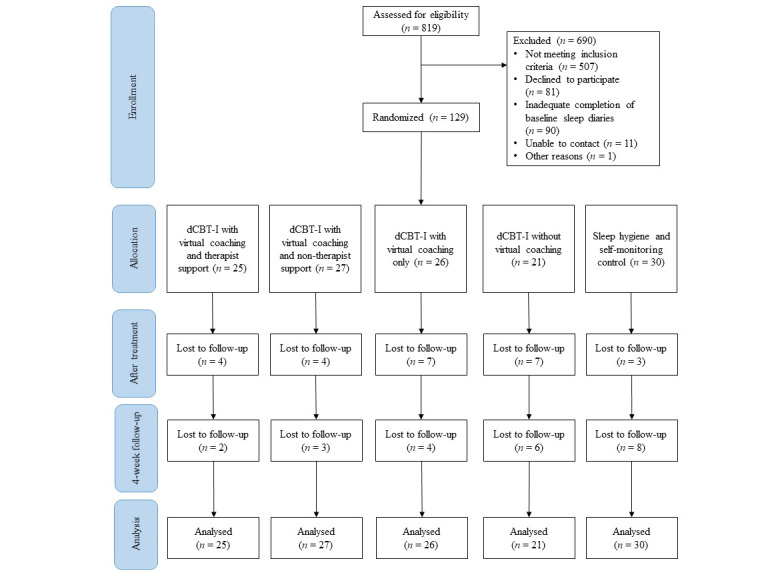
Overall, 129 participants (n=98, 76% women; age: mean 34.09, SD 12.05 y) whose scores on the Insomnia Severity Index [ISI] were greater than 9 were recruited. A randomized controlled comparative trial with 5 arms was conducted: dCBTi with chatbot-based coaching and therapist support (dCBTi-therapist), dCBTi with chatbot-based coaching and research assistant support, dCBTi with chatbot-based coaching only, dCBTi without any coaching, and digital sleep hygiene and self-monitoring control. Participants were blinded to the condition assignment and study hypotheses, and the outcomes were self-assessed using questionnaires administered on the web. The outcomes included measures of insomnia (the ISI and the Sleep Condition Indicator), mood disturbances, fatigue, daytime sleepiness, quality of life, dysfunctional beliefs about sleep, and sleep-related safety behaviors administered at baseline, after treatment, and at 4-week follow-up. Treatment adherence was measured by the completion of video sessions and sleep diaries. An intention-to-treat analysis was conducted.
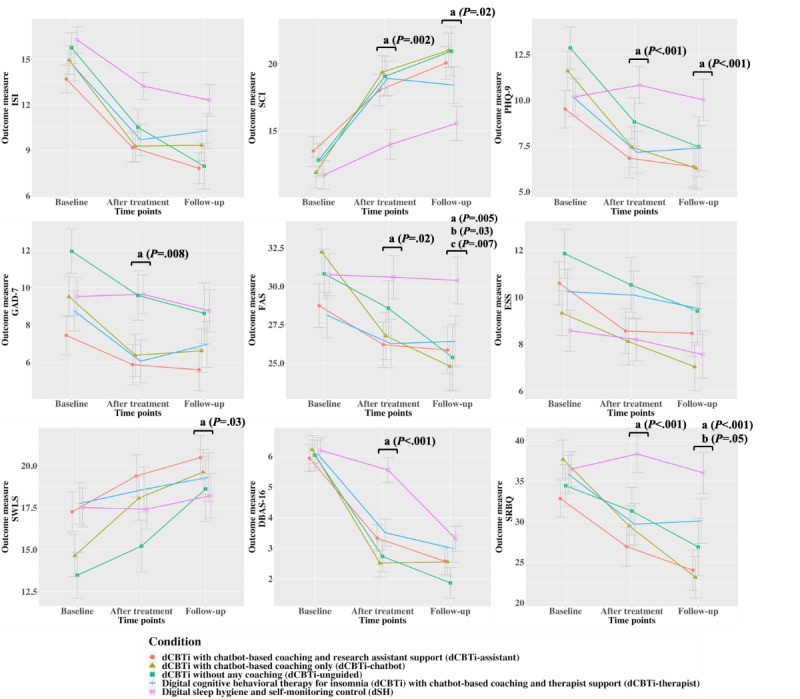
Significant condition-by-time interaction effects showed that dCBTi recipients, regardless of having any coaching, had greater improvements in insomnia measured by the Sleep Condition Indicator (P=.003; d=0.45) but not the ISI (P=.86; d=-0.28), depressive symptoms (P<.001; d=-0.62), anxiety (P=.01; d=-0.40), fatigue (P=.02; d=-0.35), dysfunctional beliefs about sleep (P<.001; d=-0.53), and safety behaviors related to sleep (P=.001; d=-0.50) than those who received digital sleep hygiene and self-monitoring control. The addition of chatbot-based coaching and human support did not improve treatment efficacy. However, adding human support promoted greater reductions in fatigue (P=.03; d=-0.33) and sleep-related safety behaviors (P=.05; d=-0.30) than dCBTi with chatbot-based coaching only at 4-week follow-up. dCBTi-therapist had the highest video and diary completion rates compared to other conditions (video: 16/25, 60% in dCBTi-therapist vs <3/21, <25% in dCBTi without any coaching), indicating greater treatment adherence.
Our findings support the efficacy of dCBTi in treating insomnia, reducing thoughts and behaviors that perpetuate insomnia, reducing mood disturbances and fatigue, and improving quality of life. Adding chatbot-based coaching and human support did not significantly improve the efficacy of dCBTi after treatment. However, adding human support had incremental benefits on reducing fatigue and behaviors that could perpetuate insomnia, and hence may improve long-term efficacy.
ClinicalTrials.gov NCT05136638; https://www.clinicaltrials.gov/study/NCT05136638.
数字认知行为疗法(dCBTi)是治疗失眠的有效干预措施。虽然 dCBTi 与失眠认知行为疗法(CBTi)的疗效比较结果尚无定论,但现有研究结果提示 dCBTi 的疗效可能逊于 CBTi。缺乏人际支持和治疗依从性低被认为是 dCBTi 难以达到最佳疗效的障碍。然而,目前还没有直接比较不同类型辅导支持的 dCBTi 的对照试验。
本研究旨在考察在 dCBTi 中增加基于聊天机器人的辅导和人际辅导是否会提高 dCBTi 的治疗效果和依从性。
共有 129 名(n=98,76%为女性;年龄:平均 34.09 岁,标准差 12.05 岁)ISI 评分大于 9 的参与者被招募入组。进行了一项随机对照比较试验,共设 5 个组:dCBTi 联合基于聊天机器人的辅导和治疗师支持(dCBTi-therapist)、dCBTi 联合基于聊天机器人的辅导和研究助理支持、dCBTi 联合基于聊天机器人的辅导、dCBTi 无任何辅导、数字睡眠卫生和自我监测对照。参与者对条件分配和研究假设均不知情,研究结果通过在线问卷进行自我评估。结果指标包括基线、治疗后和 4 周随访时的失眠(ISI 和睡眠状况指标)、情绪障碍、疲劳、日间嗜睡、生活质量、睡眠相关信念和睡眠相关安全行为。治疗依从性通过视频课程和睡眠日记的完成情况进行测量。采用意向治疗分析。
显著的条件-时间交互效应表明,接受 dCBTi 的患者,无论是否有任何辅导,在失眠的改善方面都优于接受数字睡眠卫生和自我监测对照的患者(睡眠状况指标:P=.003;d=0.45;ISI:P=.86;d=-0.28),在抑郁症状(P<.001;d=-0.62)、焦虑(P=.01;d=-0.40)、疲劳(P=.02;d=-0.35)、睡眠相关信念(P<.001;d=-0.53)和睡眠相关安全行为(P=.001;d=-0.50)方面也有显著改善。与仅接受基于聊天机器人的辅导相比,增加基于聊天机器人的辅导和人际支持并不能提高治疗效果。然而,在 4 周随访时,增加人际支持可使疲劳(P=.03;d=-0.33)和睡眠相关安全行为(P=.05;d=-0.30)的减少更为显著。与其他条件相比,dCBTi-therapist 的视频和日记完成率最高(视频:25 人中有 16 人完成,dCBTi-therapist 中的完成率为 60%,而 dCBTi 中无任何辅导的完成率不足 3/21,不足 25%),提示治疗依从性更高。
本研究结果支持 dCBTi 治疗失眠的疗效,可减少维持失眠的想法和行为,减轻情绪障碍和疲劳,提高生活质量。治疗后增加基于聊天机器人的辅导和人际支持并不能显著提高 dCBTi 的疗效。然而,增加人际支持在减轻疲劳和维持失眠的行为方面具有增量获益,从而可能提高长期疗效。
ClinicalTrials.gov NCT05136638;https://www.clinicaltrials.gov/study/NCT05136638。