Harada Mikiko, Motoki Hirohiko, Kuwahara Koichiro
Department of Cardiovascular Medicine, Shinshu University School of Medicine, Japan.
Institute of Preventive Pediatrics, Department Health and Sport Sciences, TUM School of Medicine and Health, Technical University of Munich, Germany.
Intern Med. 2025 Feb 15;64(4):483-491. doi: 10.2169/internalmedicine.4264-24. Epub 2024 Aug 8.
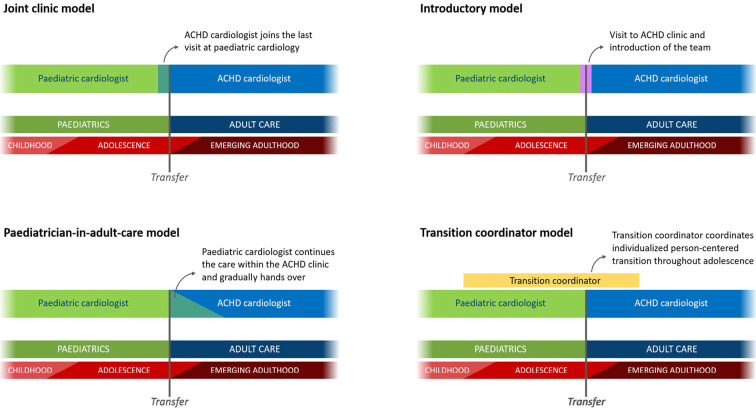
The prognosis of congenital heart disease (CHD) has improved, and most patients now reach adulthood. Owing to residual disease and comorbidities, it is recommended that adult CHD (ACHD) patients transition to adult care for lifelong monitoring and treatment. However, this transition period can be challenging for CHD patients owing to obstacles such as independence from their parents and establishing self-management. To achieve a seamless shift from pediatric to adult care and ensure continuity, it is important to educate and motivate patients appropriately, and an established transition system is needed that involves collaboration between CHD specialists and healthcare providers across medical specialties. The present review describes the epidemiology of ACHD and notable points in patient care as the background of transition. The concepts and an overview of transition systems, educational systems, and potential lapses in the care of their relevant causes are then provided with supporting evidence.
先天性心脏病(CHD)的预后已有所改善,现在大多数患者能够活到成年。由于存在残留疾病和合并症,建议成年先天性心脏病(ACHD)患者转诊至成人医疗体系进行终身监测和治疗。然而,由于诸如脱离父母独立生活和建立自我管理等障碍,这一过渡期对CHD患者来说可能具有挑战性。为了实现从儿科到成人医疗的无缝过渡并确保连续性,对患者进行适当的教育和激励非常重要,并且需要一个既定的过渡系统,该系统涉及CHD专家与各医学专科的医疗服务提供者之间的协作。本综述描述了ACHD的流行病学以及作为过渡背景的患者护理中的要点。随后提供了过渡系统、教育系统的概念和概述,以及其相关原因护理中潜在失误的支持证据。