Alotaibi Madawi, Arnold Brent L, Munk Niki, Dierks Tracy, Altenburger Peter, Alqabbani Samiah, Almuwais Afrah
Department of Rehabilitation Sciences, College of Health and Rehabilitation Sciences, Princess Nourah Bint Abdulrahman University, Riyadh, Saudi Arabia.
Department of Health Sciences, School of Health and Rehabilitation Sciences, Indiana University-Purdue University, Indianapolis, IN, USA.
Heliyon. 2024 Jul 10;10(14):e34318. doi: 10.1016/j.heliyon.2024.e34318. eCollection 2024 Jul 30.
Children with cerebral palsy often have weak ankle muscles and reduced ankle dorsiflexion, which leads to activity limitations and eventually affects quality of life. Robotic ankle training was recently developed to facilitates muscle function through a high repetition of exercises. This study investigated the effect of six-week ankle training using the Anklebot device to improve lower limb structural and functional impairments and the resulting impact on quality of life.
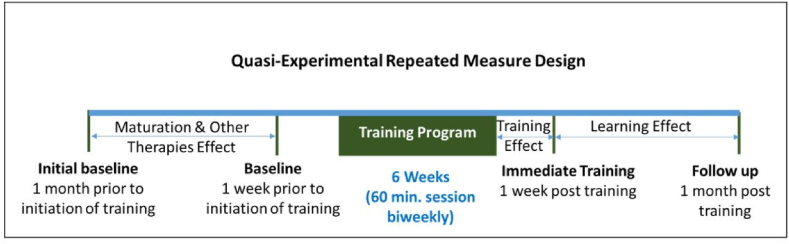
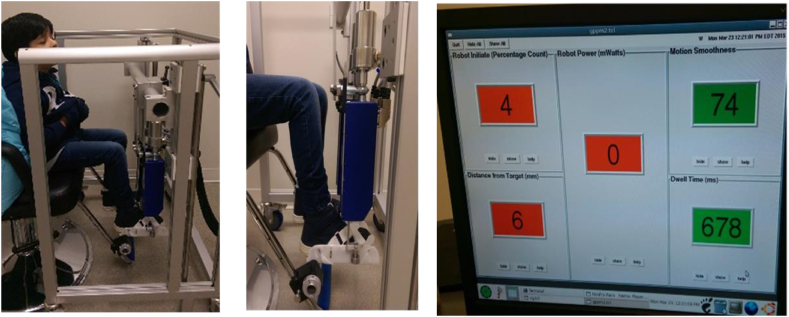
Five children with spastic cerebral palsy aged between 4 and 11 years participated in six weeks of bilateral ankle assistive training using the Anklebot device. All lower limb muscle strength was measured with a hand-held dynameter, and range of motion was measured with a goniometer, at four different time points. Muscle architecture was assessed using a portable diagnostic ultrasound device, and quality of life was assessed using the Life Habits for Children scale, at two points in time only.
Muscle strength and range of motion for all lower limb joints demonstrated significant improvement on both sides after training. The ankle muscle architecture showed non-significant improvement, while an overall significant improvement in the total score of the Life Habits for Children scale was detected after training.
Robot-assisted task-specific ankle training provides promising effects by allowing the required repetition to improve structural and functional muscle and joint impairments, which has a positive influence on the children's quality of life. However, due to a limited sample size, these results should be considered as preliminary; further study is needed.
脑瘫患儿通常踝关节肌肉力量较弱且背屈受限,这会导致活动受限并最终影响生活质量。最近开发了机器人踝关节训练,通过高重复次数的练习来促进肌肉功能。本研究调查了使用踝关节机器人设备进行为期六周的踝关节训练对改善下肢结构和功能损伤的效果以及对生活质量的影响。
五名年龄在4至11岁之间的痉挛型脑瘫患儿参与了为期六周的使用踝关节机器人设备的双侧踝关节辅助训练。在四个不同时间点,使用手持测力计测量所有下肢肌肉力量,使用量角器测量活动范围。仅在两个时间点使用便携式诊断超声设备评估肌肉结构,并使用儿童生活习惯量表评估生活质量。
训练后,所有下肢关节的肌肉力量和活动范围在两侧均有显著改善。踝关节肌肉结构改善不显著,而训练后儿童生活习惯量表总分总体有显著改善。
机器人辅助的特定任务踝关节训练通过允许进行所需的重复练习来改善肌肉和关节的结构及功能损伤,从而产生了有前景的效果,这对儿童的生活质量有积极影响。然而,由于样本量有限,这些结果应被视为初步的;需要进一步研究。