Li Wei, Li Hu, Zha Cheng, Che Bangwei, Yu Ying, Yang Jianjun, Li Tao
Department of Urology, the Affiliated Hospital of Guizhou Medical University, Guiyang, China.
Emergency Department, Affiliated Hospital of Binzhou Medical College, Binzhou, China.
Front Endocrinol (Lausanne). 2024 Jul 24;15:1392533. doi: 10.3389/fendo.2024.1392533. eCollection 2024.
Previous observational studies have reported a possible association between circulating lipids and lipid-lowering drugs and male infertility (MIF), as well as the mediating role of circulating vitamin D. Then, due to issues such as bias, reverse causality, and residual confounding, inferring causal relationships from these studies may be challenging. Therefore, this study aims to explore the effects of circulating lipids and lipid-lowering drugs on MIF through Mendelian randomization (MR) analysis and evaluate the mediating role of vitamin D.
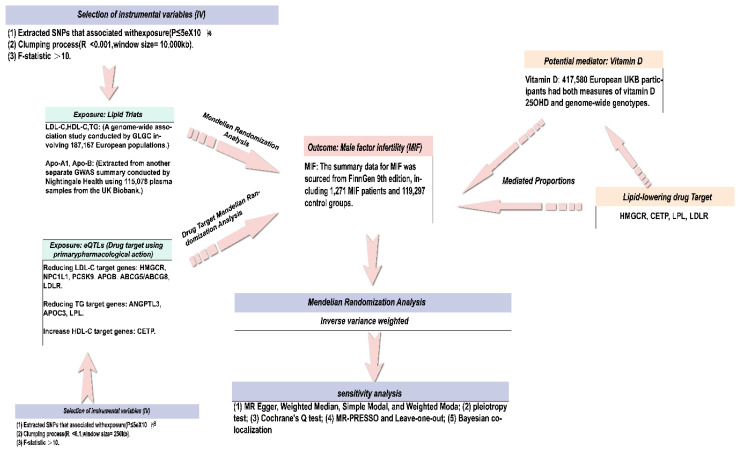
Genetic variations related to lipid traits and the lipid-lowering effect of lipid modification targets are extracted from the Global Alliance for Lipid Genetics Genome-Wide Association Study. The summary statistics for MIF are from the FinnGen 9th edition. Using quantitative expression feature loci data from relevant organizations to obtain genetic variations related to gene expression level, further to explore the relationship between these target gene expression levels and MIF risk. Two-step MR analysis is used to explore the mediating role of vitamin D. Multiple sensitivity analysis methods (co-localization analysis, Egger intercept test, Cochrane's Q test, pleiotropy residuals and outliers (MR-PRESSO), and the leave-one-out method) are used to demonstrate the reliability of our results.
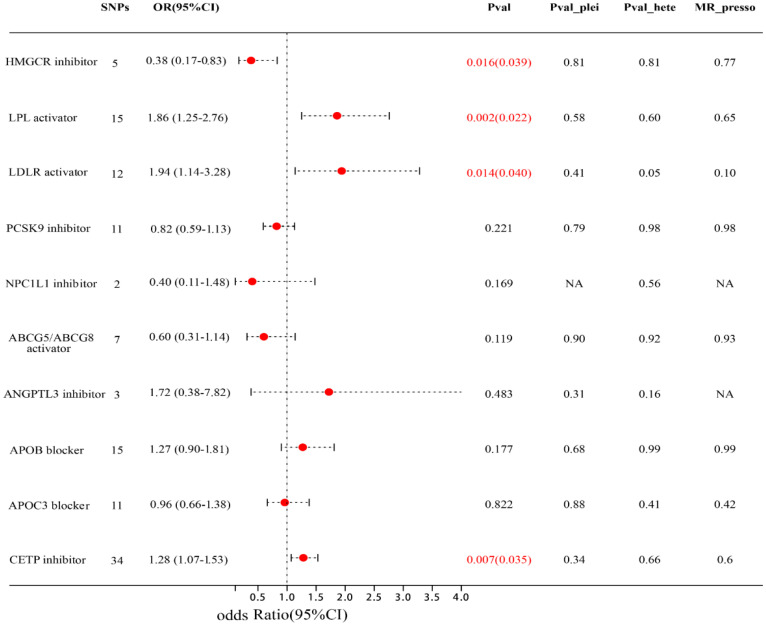
In our study, we observed that lipid modification of four lipid-lowering drug targets was associated with MIF risk, the LDLR activator (equivalent to a 1-SD decrease in LDL-C) (OR=1.94, 95% CI 1.14-3.28, FDR=0.040), LPL activator (equivalent to a 1-SD decrease in TG) (OR=1.86, 95% CI 1.25-2.76, FDR=0.022), and CETP inhibitor (equivalent to a 1-SD increase in HDL-C) (OR=1.28, 95% CI 1.07-1.53, FDR=0.035) were associated with a higher risk of MIF. The HMGCR inhibitor (equivalent to a 1-SD decrease in LDL-C) was associated with a lower risk of MIF (OR=0.38, 95% CI 0.17-0.83, FDR=0.39). Lipid-modifying effects of three targets were partially mediated by serum vitamin D levels. Mediation was 0.035 (LDLR activator), 0.012 (LPL activator), and 0.030 (CETP inhibitor), with mediation ratios of 5.34% (LDLR activator), 1.94% (LPL activator), and 12.2% (CETP inhibitor), respectively. In addition, there was no evidence that lipid properties and lipid modification effects of six other lipid-lowering drug targets were associated with MIF risk. Multiple sensitivity analysis methods revealed insignificant evidence of bias arising from pleiotropy or genetic confounding.
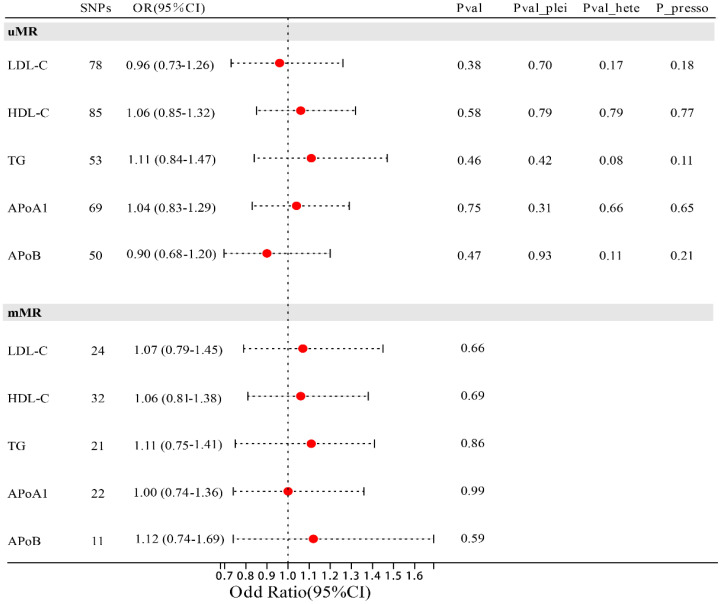
This study did not support lipid traits (LDL-C, HDL-C, TG, Apo-A1, and Apo-B) as pathogenic risk factors for MIF. It emphasized that LPL, LDLR, CETP, and HMGCR were promising drug targets for improving male fertility.
既往观察性研究报告了循环脂质、降脂药物与男性不育症(MIF)之间可能存在关联,以及循环维生素D的中介作用。然而,由于存在偏倚、反向因果关系和残余混杂等问题,从这些研究中推断因果关系可能具有挑战性。因此,本研究旨在通过孟德尔随机化(MR)分析探讨循环脂质和降脂药物对MIF的影响,并评估维生素D的中介作用。
从全球脂质遗传学联盟全基因组关联研究中提取与脂质性状及脂质修饰靶点降脂作用相关的基因变异。MIF的汇总统计数据来自芬兰基因库第9版。利用相关机构的定量表达特征位点数据获取与基因表达水平相关的基因变异,进一步探讨这些靶基因表达水平与MIF风险之间的关系。采用两步MR分析探讨维生素D的中介作用。使用多种敏感性分析方法(共定位分析、Egger截距检验、Cochrane's Q检验、多效性残差和异常值检验(MR-PRESSO)以及留一法)来证明我们结果的可靠性。
在本研究中,我们观察到四种降脂药物靶点的脂质修饰与MIF风险相关,低密度脂蛋白受体(LDLR)激活剂(相当于LDL-C降低1个标准差)(OR = 1.94,95%CI 1.14 - 3.28,FDR = 0.040)、脂蛋白脂肪酶(LPL)激活剂(相当于甘油三酯(TG)降低1个标准差)(OR = 1.86,95%CI 1.25 - 2.76,FDR = 0.022)和胆固醇酯转运蛋白(CETP)抑制剂(相当于高密度脂蛋白胆固醇(HDL-C)升高1个标准差)(OR = 1.28,95%CI 1.07 - 1.53,FDR = 0.035)与MIF风险较高相关。3-羟基-3-甲基戊二酰辅酶A还原酶(HMGCR)抑制剂(相当于LDL-C降低1个标准差)与MIF风险较低相关(OR = 0.38,95%CI 0.17 - 0.83,FDR = 0.39)。三个靶点的脂质修饰作用部分由血清维生素D水平介导。中介效应分别为0.035(LDLR激活剂)、0.012(LPL激活剂)和0.030(CETP抑制剂),中介比例分别为5.34%(LDLR激活剂)、1.94%(LPL激活剂)和12.2%(CETP抑制剂)。此外,没有证据表明其他六种降脂药物靶点的脂质特性和脂质修饰作用与MIF风险相关。多种敏感性分析方法显示,多效性或基因混杂导致偏倚的证据不显著。
本研究不支持脂质性状(LDL-C、HDL-C、TG、载脂蛋白A1(Apo-A1)和载脂蛋白B(Apo-B))作为MIF的致病危险因素。研究强调LPL、LDLR、CETP和HMGCR是改善男性生育能力的有前景的药物靶点。