Department of Anesthesiology, Peking Union Medical College and Chinese Academy of Medical Sciences, Peking Union Medical College Hospital, No.1, Shuaifuyuan, Beijing, China.
Department of Anesthesiology, West China Hospital, Sichuan University, No.37, Guoxue Valley, Chengdu, Sichuan, China.
J Headache Pain. 2023 Aug 18;24(1):112. doi: 10.1186/s10194-023-01633-x.
Migraine, a prevalent headache disorder with unclear mechanisms and limited treatments, may be influenced by dyslipidemia and genetic factors. Statins and emerging lipid-modifying agents show potential but lack evidence for migraine management. Mendelian Randomization analysis offers insights into causal relationships and therapeutic targets. This study aims to explore genetically predicted lipid traits, drug targets, and their association with migraine risk.
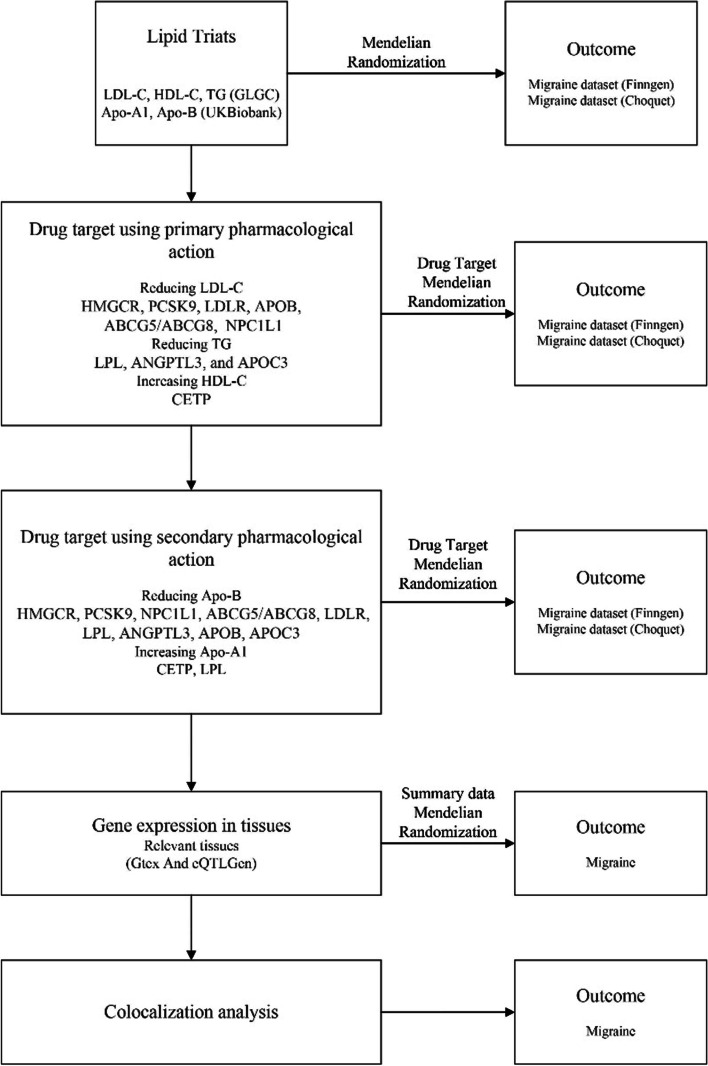
We conducted Mendelian randomization (MR) analyses utilizing genetic variants associated with lipid traits and variants in genes encoding the protein targets of various classes of lipid-lowering drugs. The specific drug classes investigated included HMGCR, PCSK9, NPC1L1, ABCG5/ABCG8, LDLR, LPL, ANGPTL3, APOB, CETP, and APOC3. To determine the effects on migraine risk, we meta-analyzed MR estimates for regional variants using data from two large sample sets. The genetic variants were weighted based on their associations with specific lipid traits, such as low-density lipoprotein cholesterol (LDL-C), high-density lipoprotein cholesterol (HDL-C), Apolipoprotein A1, and Apolipoprotein B. To obtain association weights, we utilized data from lipid genetics consortia. For lipid-modifying drug targets that exhibited suggestive significance, we further employed expression quantitative trait locus (eQTL) data. Additionally, we performed colocalization analysis to assess genetic confounding.
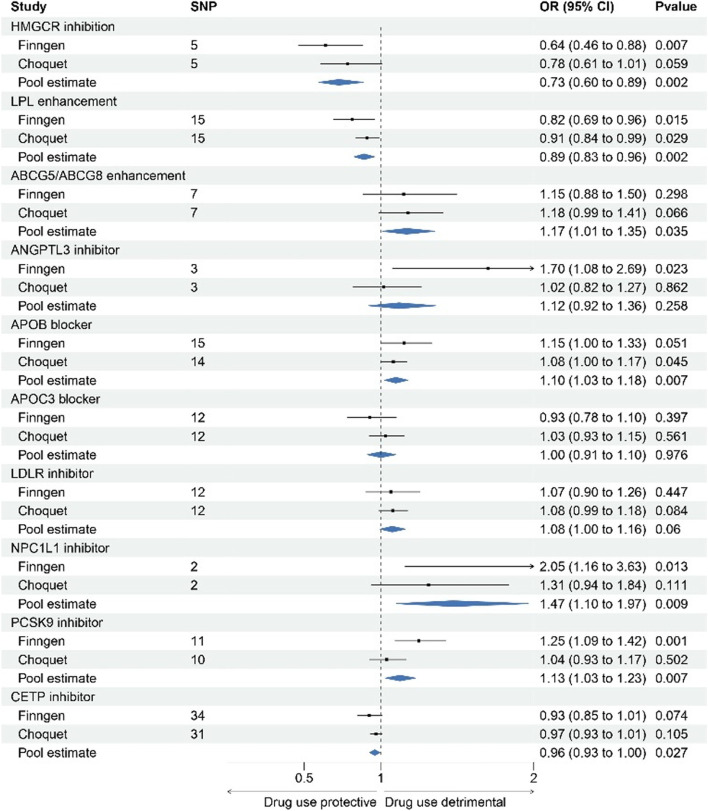
The use of genetic proxies for HMGCR inhibition demonstrated a significant association with a decreased risk of migraine in the FinnGen dataset (OR = 0.64, 95% CI: 0.46-0.88, p = 0.0006) and a nearly significant association in the Choquet dataset (OR = 0.78, 95% CI: 0.60-1.01, p = 0.06). When pooling the estimates, the overall effect size showed a reduced risk of migraine (OR = 0.73, 95% CI: 0.60-0.89, p = 0.0016). Similarly, genetic mimicry of LPL enhancement was associated with a lower risk of migraine in the FinnGen dataset (OR = 0.82, 95% CI: 0.69-0.96, p = 0.01) and the Choquet dataset (OR = 0.91, 95% CI: 0.83-0.99, p = 0.03). Pooling the estimates showed a consistent effect size (OR = 0.89, 95% CI: 0.83-0.96, p = 0.002). Sensitivity analyses yielded no statistically significant evidence of bias arising from pleiotropy or genetic confounding.
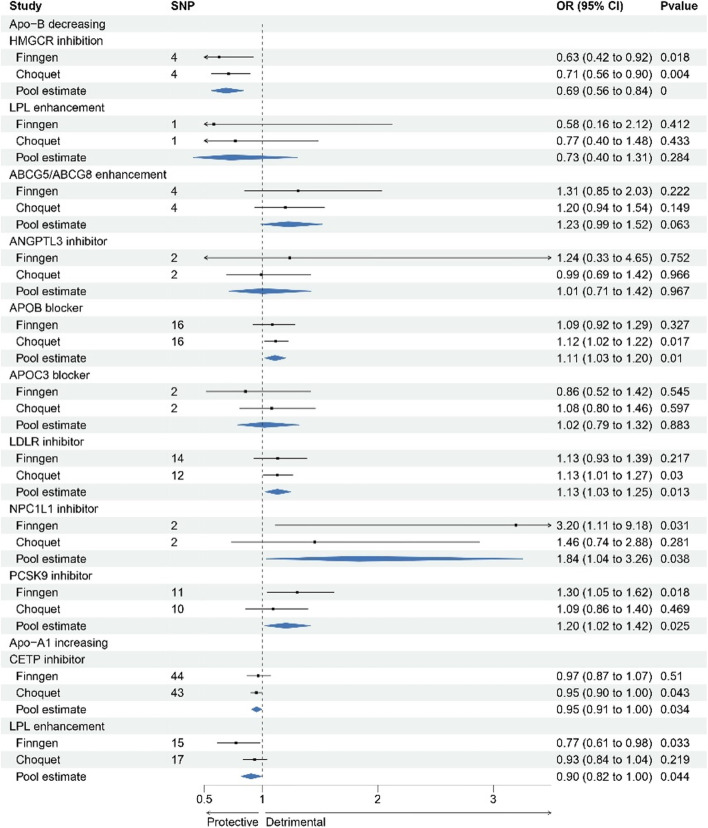
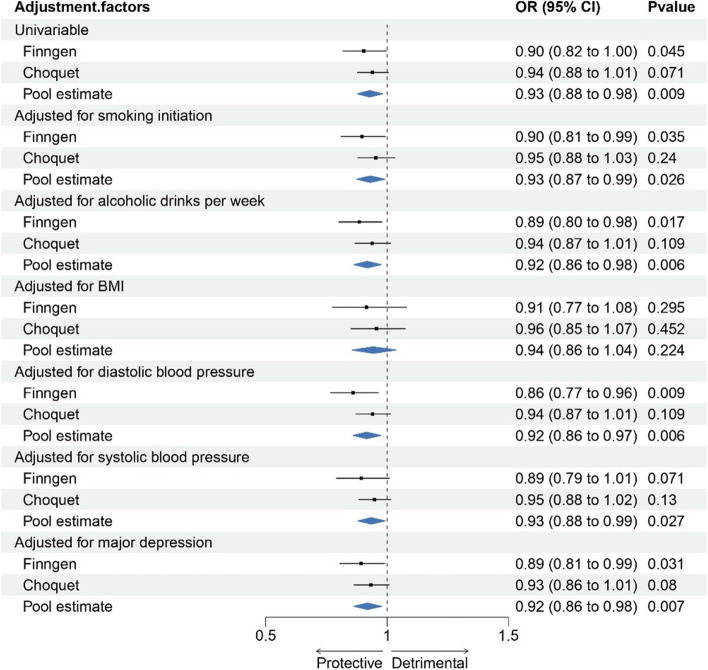
In the study, it was observed that among the 10 lipid-lowering drug targets investigated, LPL and HMGCR showed significant associations with migraine risk. These findings indicate that LPL and HMGCR have the potential to serve as candidate drug targets for the treatment or prevention of migraines.
偏头痛是一种常见的头痛疾病,其发病机制尚不明确,治疗方法也有限。偏头痛可能受到血脂异常和遗传因素的影响。他汀类药物和新兴的降脂药物显示出一定的潜力,但缺乏偏头痛管理的证据。孟德尔随机分析提供了对因果关系和治疗靶点的深入了解。本研究旨在探索遗传预测的血脂特征、药物靶点及其与偏头痛风险的关联。
我们进行了孟德尔随机分析(MR),利用与血脂特征相关的遗传变异和各种降脂药物靶点基因的变异。研究中涉及的特定药物类别包括 HMGCR、PCSK9、NPC1L1、ABCG5/ABCG8、LDLR、LPL、ANGPTL3、APOB、CETP 和 APOC3。为了确定对偏头痛风险的影响,我们使用来自两个大型样本集的数据对区域变异的 MR 估计值进行了荟萃分析。遗传变异根据其与特定血脂特征(如低密度脂蛋白胆固醇 [LDL-C]、高密度脂蛋白胆固醇 [HDL-C]、载脂蛋白 A1 和载脂蛋白 B)的关联进行加权。为了获得关联权重,我们利用了脂质遗传学联盟的数据。对于表现出提示性意义的降脂药物靶点,我们进一步使用了表达数量性状基因座(eQTL)数据。此外,我们进行了共定位分析以评估遗传混杂。
使用 HMGCR 抑制的遗传替代物与 FinnGen 数据集(OR=0.64,95%CI:0.46-0.88,p=0.0006)和 Choquet 数据集(OR=0.78,95%CI:0.60-1.01,p=0.06)中偏头痛风险降低显著相关。当合并估计值时,总体效应大小显示偏头痛风险降低(OR=0.73,95%CI:0.60-0.89,p=0.0016)。同样,FinnGen 数据集(OR=0.82,95%CI:0.69-0.96,p=0.01)和 Choquet 数据集(OR=0.91,95%CI:0.83-0.99,p=0.03)中 LPL 增强的遗传模拟与偏头痛风险降低相关。合并估计值显示一致的效应大小(OR=0.89,95%CI:0.83-0.96,p=0.002)。敏感性分析没有发现来自多效性或遗传混杂的统计学上显著的偏差证据。
在这项研究中,在所研究的 10 种降脂药物靶点中,LPL 和 HMGCR 与偏头痛风险显著相关。这些发现表明,LPL 和 HMGCR 有可能成为偏头痛治疗或预防的候选药物靶点。