Kudo Masatoshi, Tsuchiya Kaoru, Shao Yu-Yun, Finn Richard S, Galle Peter R, Ducreux Michel, Cheng Ann-Lii, Yamashita Tatsuya, Koga Hironori, Take Ryosuke, Yamada Kyoko, Asakawa Takashi, Nakagawa Yuki, Ikeda Masafumi
Department of Gastroenterology and Hepatology, Kindai University Faculty of Medicine, Osaka, Japan.
Department of Gastroenterology and Hepatology, Musashino Red Cross Hospital, Tokyo, Japan.
Liver Cancer. 2023 Nov 28;13(4):401-412. doi: 10.1159/000535501. eCollection 2024 Aug.
The phase III IMbrave150 study established atezolizumab + bevacizumab as the global standard of care in patients with unresectable hepatocellular carcinoma (HCC). This exploratory analysis examined the impact of bevacizumab interruption due to bevacizumab adverse events of special interest (AESIs).
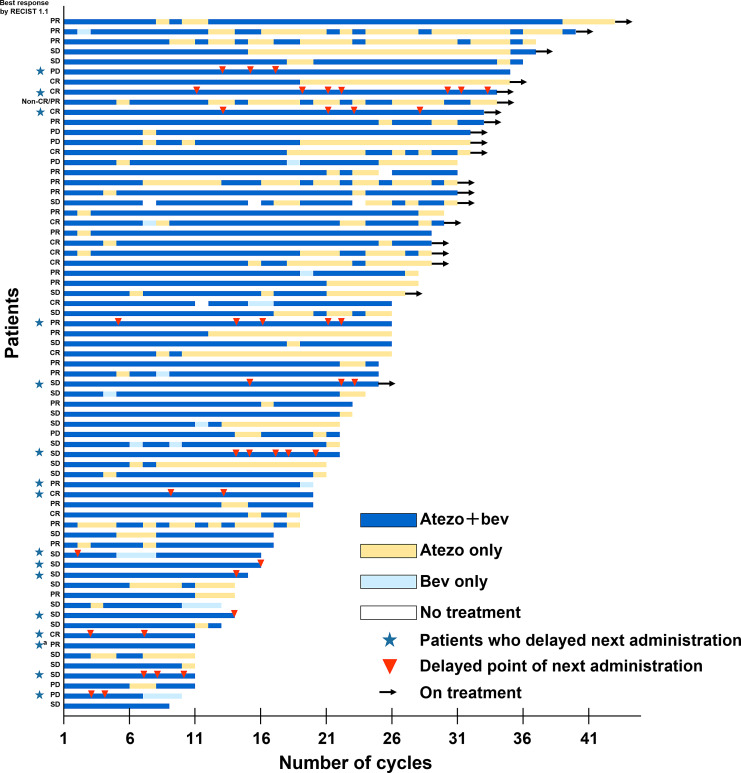
Patients in IMbrave150 who were randomized to atezolizumab + bevacizumab and received treatment for ≥6 months (to reduce immortal time bias) were included in group A-1 if bevacizumab had ever been skipped due to bevacizumab AESIs or to group A-2 otherwise. Efficacy analyses included overall survival (OS) and progression-free survival (PFS) by whether bevacizumab was skipped (group A-1 vs. A-2). PFS was evaluated per independent review facility (IRF)-assessed Response Evaluation Criteria in Solid Tumours (RECIST) version 1.1 and HCC-modified RECIST (IRF-HCC mRECIST). Safety was also evaluated.
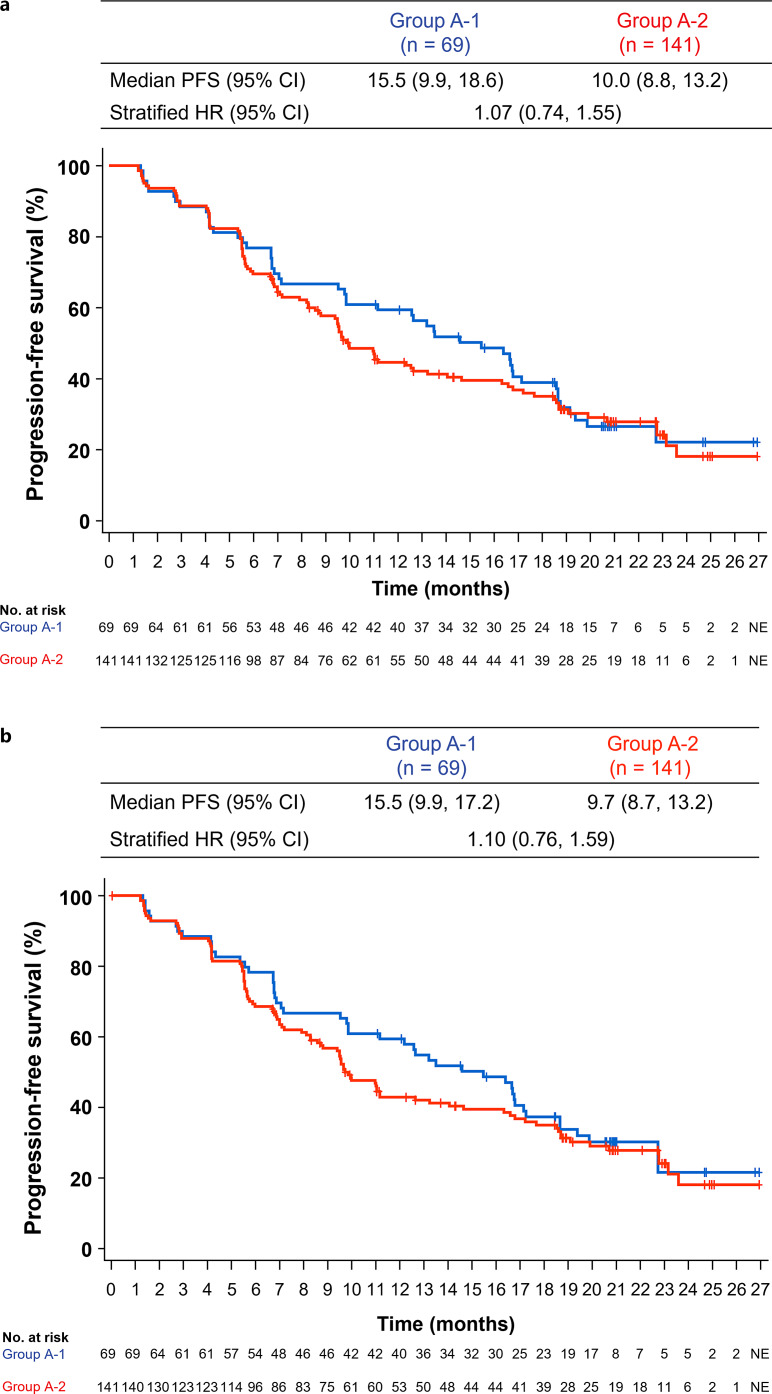
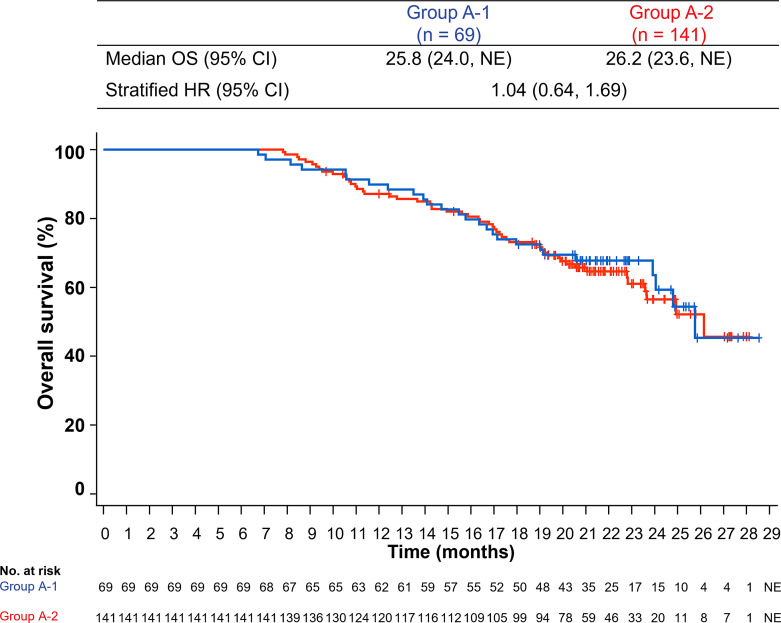
Of the 210 patients who received ≥6 months of atezolizumab + bevacizumab, 69 were assigned to group A-1 and 141 to A-2. At data cutoff (August 20, 2020), hazard ratio (HR) for OS was 1.04 (95% CI: 0.64, 1.69) for group A-1 versus A-2. HR for PFS was 1.07 (95% CI: 0.74, 1.55) per IRF-assessed RECIST 1.1 and 1.10 (95% CI: 0.76, 1.59; 15.5 vs. 9.7 months) per IRF-HCC mRECIST for group A-1 versus A-2. Safety profiles for atezolizumab and bevacizumab were largely similar between groups. More group A-1 patients had grade 3/4 adverse events. A separate analysis investigating the impact of immortal time bias in patients who received ≥3 months of atezolizumab + bevacizumab supported the appropriateness of the ≥6-month landmark analysis.
DISCUSSION/CONCLUSION: Efficacy was similar between patients who skipped bevacizumab due to bevacizumab AESIs and those who did not. Although this comparison was nonrandomized and exploratory, results suggest that skipping bevacizumab due to bevacizumab AESIs did not considerably impact the efficacy and safety of atezolizumab + bevacizumab.
III期IMbrave150研究确立了阿替利珠单抗+贝伐珠单抗作为不可切除肝细胞癌(HCC)患者的全球标准治疗方案。本探索性分析研究了因特殊关注的贝伐珠单抗不良事件(AESIs)导致贝伐珠单抗中断的影响。
IMbrave150中随机接受阿替利珠单抗+贝伐珠单抗治疗且治疗≥6个月(以减少永生时间偏倚)的患者,如果曾因贝伐珠单抗AESIs而跳过贝伐珠单抗,则纳入A-1组,否则纳入A-2组。疗效分析包括根据是否跳过贝伐珠单抗(A-1组与A-2组)进行的总生存期(OS)和无进展生存期(PFS)分析。PFS根据独立审查机构(IRF)评估的实体瘤疗效评价标准(RECIST)1.1版和HCC改良RECIST(IRF-HCC mRECIST)进行评估。同时也对安全性进行了评估。
在210例接受阿替利珠单抗+贝伐珠单抗≥6个月的患者中,69例被分配至A-1组,141例被分配至A-2组。在数据截止时(2020年8月20日),A-1组与A-2组的OS风险比(HR)为1.04(95%CI:0.64,1.69)。根据IRF评估的RECIST 1.1,A-1组与A-2组的PFS HR为1.07(95%CI:0.74,1.55);根据IRF-HCC mRECIST,PFS HR为1.10(95%CI:0.76,1.59;15.5对9.7个月)。两组之间阿替利珠单抗和贝伐珠单抗的安全性特征基本相似。A-1组中3/4级不良事件的患者更多。一项针对接受阿替利珠单抗+贝伐珠单抗≥3个月的患者中永生时间偏倚影响的单独分析支持了≥6个月界标分析的合理性。
讨论/结论:因贝伐珠单抗AESIs而跳过贝伐珠单抗的患者与未跳过的患者疗效相似。尽管这种比较是非随机的且为探索性的,但结果表明,因贝伐珠单抗AESIs而跳过贝伐珠单抗对阿替利珠单抗+贝伐珠单抗的疗效和安全性没有显著影响。