Liu Ruiyu, Yang Jie, Zhu Yiling, Zhou Xiaoxiao, Zhou Qiaolin, Liang Ting, Wang Huan, Luo Yan, Xie Yue, Liu Haifeng, Zhong Zhijun, Peng Guangneng, Zhuang Hao, Ai Shengquan, Jiang Lingxue, Zheng Chengli, Zhou Ziyao
College of Veterinary Medicine, Sichuan Agricultural University, Chengdu, China.
Sichuan Institute of Musk Deer Breeding, Chengdu, China.
BMC Vet Res. 2024 Aug 8;20(1):353. doi: 10.1186/s12917-024-04221-6.
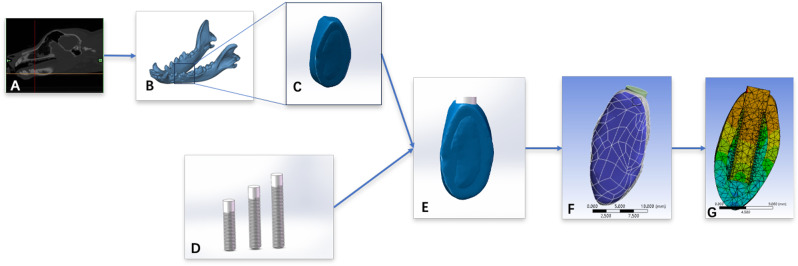
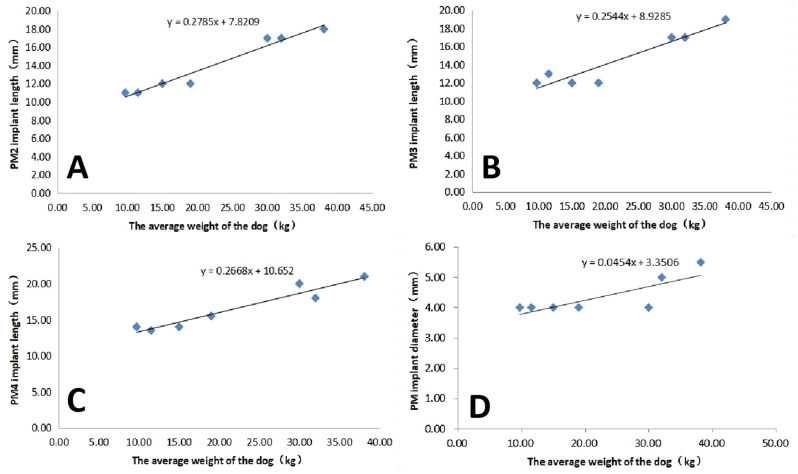
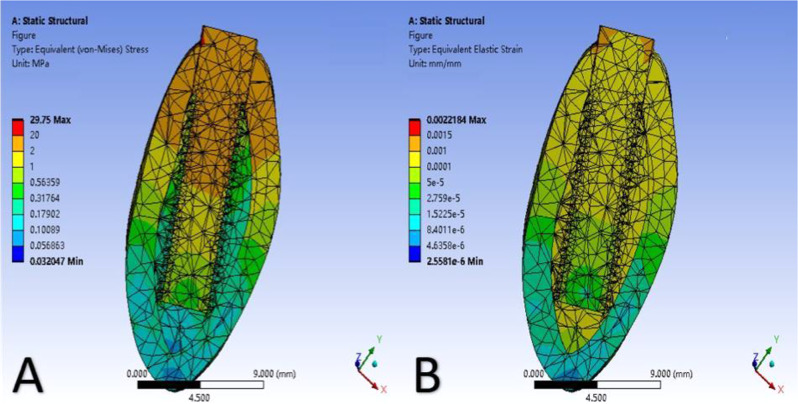
In recent years, dental implants have become a trend in the treatment of human patients with missing teeth, which may also be an acceptable method for companion animal dentistry. However, there is a gap challenge in determining appropriate implant sizes for different dog breeds and human. In this study, we utilized skull computed tomography data to create three-dimensional models of the mandibles of dogs in different sizes. Subsequently, implants of various sizes were designed and subjected to biomechanical finite element analysis to determine the optimal implant size. Regression models were developed, exploring the relationship between the average weight of dogs and the size of premolar implants. Our results illustrated that the regression equations for mean body weight (x, kg) and second premolar (PM2), third premolar (PM3), and fourth premolar (PM4) implant length (y, mm) in dogs were: y = 0.2785x + 7.8209, y = 0.2544x + 8.9285, and y = 0.2668x + 10.652, respectively; the premolar implant diameter (mm) y = 0.0454x + 3.3506, which may provide a reference for determine suitable clinical implant sizes for dogs.
近年来,牙种植体已成为人类牙齿缺失治疗的一种趋势,这对于伴侣动物牙科来说可能也是一种可接受的方法。然而,在为不同犬种和人类确定合适的种植体尺寸方面存在差距挑战。在本研究中,我们利用颅骨计算机断层扫描数据创建了不同体型犬下颌骨的三维模型。随后,设计了各种尺寸的种植体并进行生物力学有限元分析,以确定最佳种植体尺寸。建立了回归模型,探索犬平均体重与前磨牙种植体尺寸之间的关系。我们的结果表明,犬平均体重(x,kg)与第二前磨牙(PM2)、第三前磨牙(PM3)和第四前磨牙(PM4)种植体长度(y,mm)的回归方程分别为:y = 0.2785x + 7.8209、y = 0.2544x + 8.9285和y = 0.2668x + 10.652;前磨牙种植体直径(mm)y = 0.0454x + 3.3506,这可能为确定适合犬的临床种植体尺寸提供参考。