Xu Yurong, Liu Meng, Zhao Ruidong, Pan Yue, Wu Panpan, Zhang Chi, Chi Xiangying, Zhang Buchang, Wu Hang
Department of Chemical and Pharmaceutical Engineering, Hefei Normal University, Hefei, 230601, China.
School of Life Sciences, Institute of Physical Science and Information Technology, Anhui University, Hefei, 230601, China.
Microb Cell Fact. 2024 Aug 8;23(1):223. doi: 10.1186/s12934-024-02498-8.
The TetR family of transcriptional regulators (TFRs), serving as crucial regulators of diverse cellular processes, undergo conformational changes induced by small-molecule ligands, which either inhibit or activate them to modulate target gene expression. Some ligands of TFRs in actinomycetes and their regulatory effects have been identified and studied; however, regulatory mechanisms of the TetR family in the lincomycin-producing Streptomyces lincolnensis remain poorly understood.
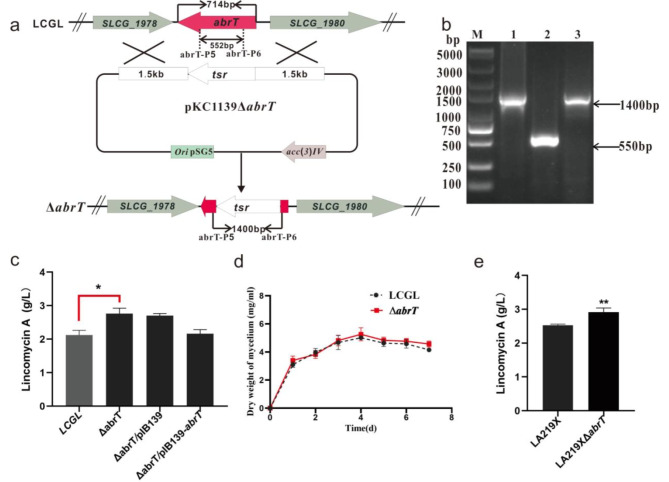
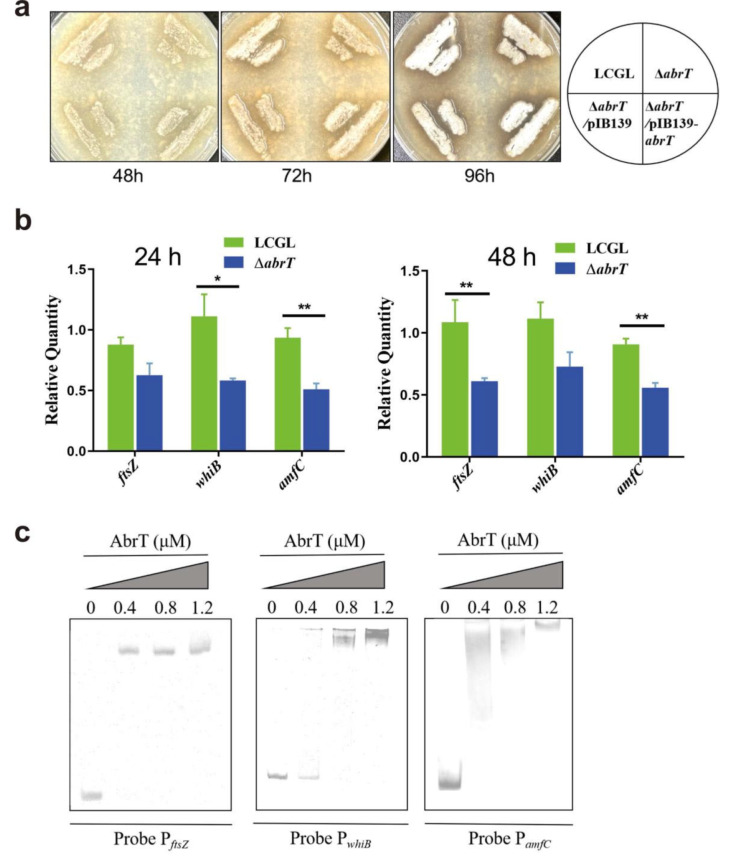
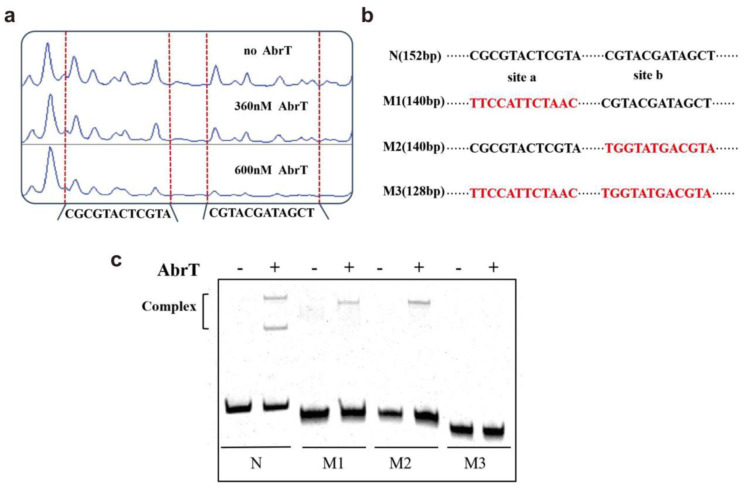
In this study, we found that AbrT (SLCG_1979), a TetR family regulator, plays a pivotal role in regulating lincomycin production and morphological development in S. lincolnensis. Deletion of abrT gene resulted in increased lincomycin A (Lin-A) production, but delayed mycelium formation and sporulation on solid media. AbrT directly or indirectly repressed the expression of lincomycin biosynthetic (lin) cluster genes and activated that of the morphological developmental genes amfC, whiB, and ftsZ. We demonstrated that AbrT bound to two motifs (5'-CGCGTACTCGTA-3' and 5'-CGTACGATAGCT-3') present in the bidirectional promoter between abrT and SLCG_1980 genes. This consequently repressed abrT itself and its adjacent gene SLCG_1980 that encodes an arabinose efflux permease. D-arabinose, not naturally occurring as L-arabinose, was identified as the effector molecule of AbrT, reducing its binding affinity to abrT-SLCG_1980 intergenic region. Furthermore, based on functional analysis of the AbrT homologue in Saccharopolyspora erythraea, we inferred that the TetR family regulator AbrT may play an important role in regulating secondary metabolism in actinomycetes.
AbrT functions as a regulator for governing lincomycin production and morphological development of S. lincolnensis. Our findings demonstrated that D-arabinose acts as a ligand of AbrT to mediate the regulation of lincomycin biosynthesis in S. lincolnensis. Our findings provide novel insights into ligand-mediated regulation in antibiotic biosynthesis.
转录调节因子的TetR家族(TFRs)作为多种细胞过程的关键调节因子,会经历由小分子配体诱导的构象变化,这些小分子配体要么抑制要么激活它们以调节靶基因表达。放线菌中TFRs的一些配体及其调节作用已被鉴定和研究;然而,TetR家族在产林可霉素的林肯链霉菌中的调节机制仍知之甚少。
在本研究中,我们发现TetR家族调节因子AbrT(SLCG_1979)在调节林肯链霉菌的林可霉素生产和形态发育中起关键作用。abrT基因的缺失导致林可霉素A(Lin-A)产量增加,但在固体培养基上菌丝体形成和孢子形成延迟。AbrT直接或间接抑制林可霉素生物合成(lin)簇基因的表达,并激活形态发育基因amfC、whiB和ftsZ的表达。我们证明AbrT与abrT和SLCG_1980基因之间双向启动子中存在的两个基序(5'-CGCGTACTCGTA-3'和5'-CGTACGATAGCT-3')结合。这进而抑制了abrT自身及其相邻基因SLCG_1980,该基因编码一种阿拉伯糖外排通透酶。D-阿拉伯糖,而非天然存在的L-阿拉伯糖,被鉴定为AbrT的效应分子,降低了其与abrT-SLCG_1980基因间区域的结合亲和力。此外,基于对糖多孢红霉菌中AbrT同源物的功能分析,我们推断TetR家族调节因子AbrT可能在调节放线菌的次级代谢中起重要作用。
AbrT作为调节林肯链霉菌林可霉素生产和形态发育的调节因子发挥作用。我们的研究结果表明D-阿拉伯糖作为AbrT的配体介导林肯链霉菌中林可霉素生物合成的调节。我们的研究结果为抗生素生物合成中配体介导的调节提供了新的见解。