Tian Jiangyue, Lin Zongwei, Sun Xiaoqian, Jia Xiaoning, Zhang Yanling, Zhang Guihua, Xiao Jie, Lu Huixia, Zhang Xinyu
State Key Laboratory for Innovation and Transformation of Luobing Theory, Key Laboratory of Cardiovascular Remodeling and Function Research, Chinese Ministry of Education, Chinese National Health Commission and Chinese Academy of Medical Sciences, Department of Cardiology, Qilu Hospital of Shandong University, Jinan, China.
ESC Heart Fail. 2024 Dec;11(6):4092-4103. doi: 10.1002/ehf2.14938. Epub 2024 Aug 8.
Limited literature shows the existence of sex differences in the long-term prognosis of heart failure (HF) patients with frailty. In this study, whether sex differences exist in the impact of frailty on death from cardiovascular causes in patients with HF was investigated by conducting a retrospective cohort study.
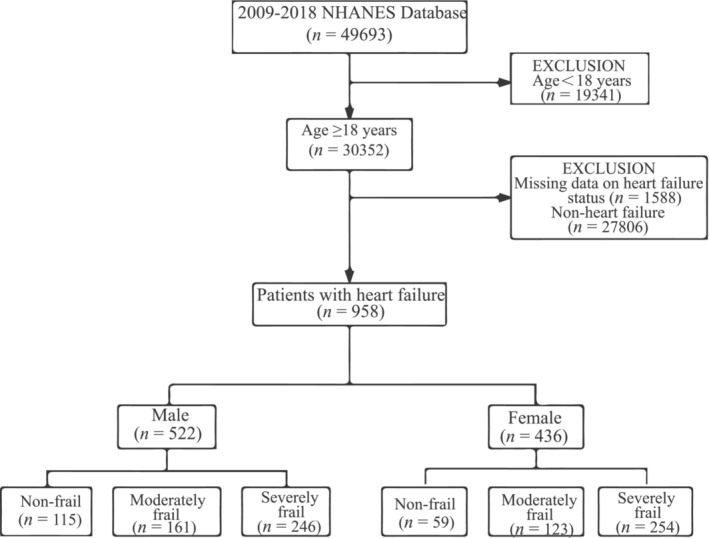
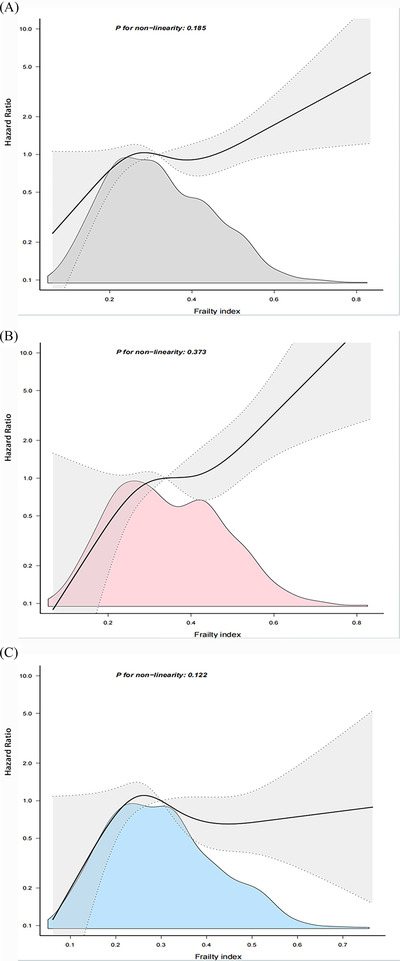
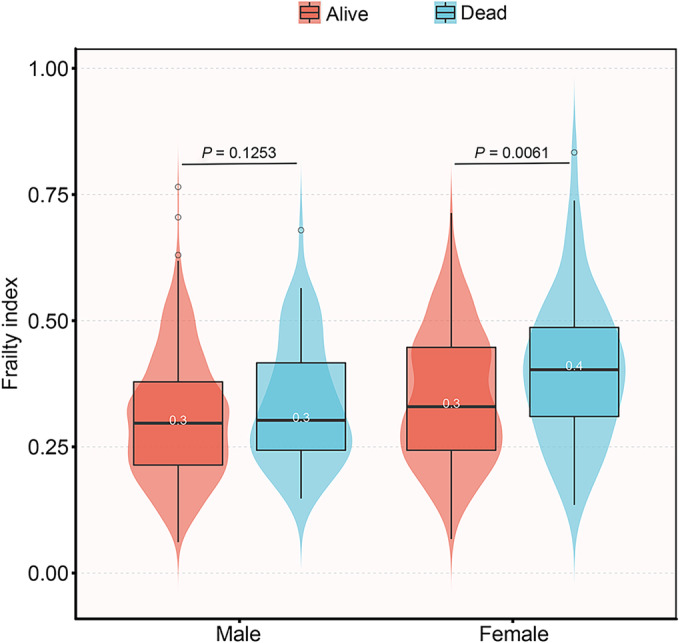
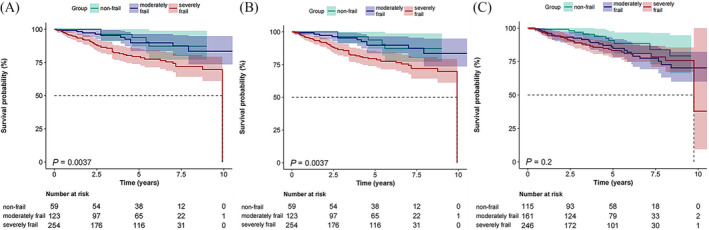
Data from the National Health and Nutrition Examination Survey (NHANES) study (2009-2018) were used to conduct a retrospective cohort study of 958 participants with HF. Patients were grouped based on sex and frailty index (FI). The relationship between death from cardiovascular causes and baseline frailty was assessed by Cox proportional hazard analysis and the Kaplan-Meier (K-M) plot. The study population had an age of 67.3 ± 12.3. Among them, around 54.5% were male. A median follow-up of 3.6 years was performed. After that, females who died from cardiovascular causes exhibited higher baseline FI values, while males did not show this trend (P < 0.05; P = 0.1253). Cox regression analysis demonstrated a significant association between FI and cardiovascular mortality in females (most frail: hazard ratio (HR) = 3.65, 95% confidence interval (CI): 1.07 ~ 12.39, P < 0.05; per 1-unit increase in FI: HR = 1.78, 95% CI: 1.33 ~ 2.39, P < 0.001). A dose-response association between FI and cardiovascular mortality was presented by restricted cubic splines.
Frailty is related to an increased risk of cardiovascular mortality in HF patients, particularly female patients.
有限的文献表明,衰弱的心力衰竭(HF)患者的长期预后存在性别差异。在本研究中,通过进行一项回顾性队列研究,调查衰弱对HF患者心血管原因死亡的影响中是否存在性别差异。
使用来自国家健康和营养检查调查(NHANES)研究(2009 - 2018年)的数据,对958名HF参与者进行回顾性队列研究。患者根据性别和衰弱指数(FI)分组。通过Cox比例风险分析和Kaplan - Meier(K - M)曲线评估心血管原因死亡与基线衰弱之间的关系。研究人群的年龄为67.3±12.3岁。其中,约54.5%为男性。进行了3.6年的中位随访。之后,死于心血管原因的女性表现出更高的基线FI值,而男性未显示出这种趋势(P < 0.05;P = 0.1253)。Cox回归分析表明,FI与女性心血管死亡率之间存在显著关联(最衰弱:风险比(HR)= 3.65,95%置信区间(CI):1.07 ~ 12.39,P < 0.05;FI每增加1个单位:HR = 1.78,95%CI:1.33 ~ 2.39,P < 0.001)。受限立方样条显示了FI与心血管死亡率之间的剂量反应关联。
衰弱与HF患者,尤其是女性患者心血管死亡风险增加有关。