Li Panpan, Lai Shiu-Lun, Chen Ziyong, Tang Wai Kit, Leung Ming-Yi, Ng Maggie, Kwok Wing-Kei, Chan Mei-Yee, Yam Vivian Wing-Wah
Institute of Molecular Functional Materials and Department of Chemistry, The University of Hong Kong Pokfulam Road Hong Kong P. R. China
Hong Kong Quantum AI Lab Limited 17 Science Park West Avenue Pak Shek Kok Hong Kong P. R. China.
Chem Sci. 2024 Jul 8;15(31):12606-12615. doi: 10.1039/d3sc06989c. eCollection 2024 Aug 7.
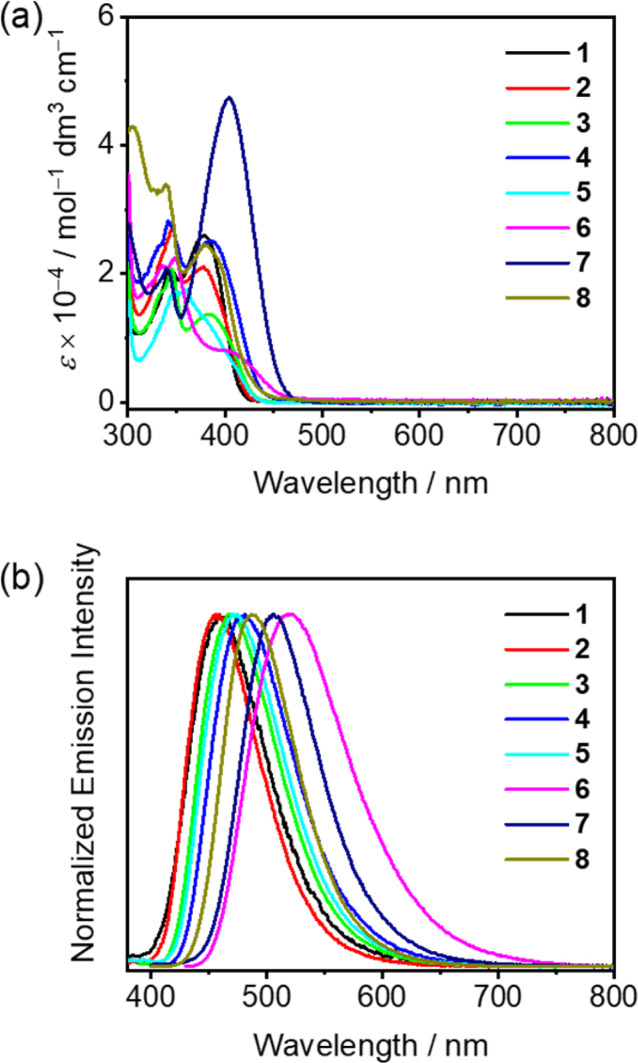
Achieving both high efficiency and high stability in blue thermally activated delayed fluorescence organic light-emitting diodes (TADF-OLEDs) is challenging for practical displays and lighting. Here, we have successfully developed a series of sky-blue to pure-blue emitting donor-acceptor (D-A) type TADF materials featuring a four-coordinated boron with 2,2'-(pyridine-2,6-diyl)diphenolate (dppy) ligands, 1-8. Synergistic engineering of substituents on the phenyl bridge as well as the electronic properties and the attached positions of heteroatom N-donors not only enables fine-tuning of the emission colors, but also modulates the nature and energies of their triplet excited states that are important for the reverse intersystem crossing (RISC). Particularly for the compound with two methyl substituents on the phenyl bridge (compound 8), RISC is significantly facilitated through the vibronic coupling of the energetically close-lying triplet charge transfer (CT) and the triplet local excited (LE) states, when compared to analogue 7. Efficient sky-blue to pure-blue OLEDs with electroluminescence peaks ( ) at 460-492 nm have been obtained, in which . five-fold higher external quantum efficiencies (EQEs) of 18.9% have been demonstrated by 8 than that by 7. Moreover, . thirty times longer device operational half-lifetimes (LT) of 9113 hours for 8 than that for 7 as well as satisfactory LT reaching 26 643 hours for 6 at an initial luminance of 100 cd m have also been demonstrated. To the best of our knowledge, these results represent one of the best high-performance blue OLEDs based on tetracoordinated boron TADF emitters. Moreover, the design strategy presented here has provided an attractive strategy for enhancing the device performance of blue TADF-OLEDs.
在蓝色热激活延迟荧光有机发光二极管(TADF - OLEDs)中实现高效率和高稳定性对于实际显示和照明应用来说具有挑战性。在此,我们成功开发了一系列天蓝色至纯蓝色发光的供体 - 受体(D - A)型TADF材料,其具有带有2,2' - (吡啶 - 2,6 - 二基)二酚盐(dppy)配体的四配位硼,即1 - 8。对苯桥上官能团以及杂原子氮供体的电子性质和连接位置进行协同工程设计,不仅能够微调发射颜色,还能调节其三重激发态的性质和能量,这对于反向系间窜越(RISC)很重要。特别是对于在苯桥上有两个甲基取代基的化合物(化合物8),与类似物7相比,通过能量上紧密相邻的三重态电荷转移(CT)和三重态局域激发(LE)态的振动耦合,显著促进了RISC。已获得了电致发光峰值()在460 - 492 nm的高效天蓝色至纯蓝色OLED,其中。化合物8的外量子效率(EQEs)比化合物7高出五倍,达到18.9%。此外,还证明了化合物8的器件工作半衰期(LT)比化合物7长三十倍,达到9113小时,并且在初始亮度为100 cd m时,化合物6的LT也令人满意地达到了26643小时。据我们所知,这些结果代表了基于四配位硼TADF发射体的最佳高性能蓝色OLED之一。此外,这里提出的设计策略为提高蓝色TADF - OLEDs的器件性能提供了一种有吸引力的策略。