Liu Yifan, Ying Xinxin, Li Yao, Zhu Xingyu, Jing Wangwei, Wang Xiaohong, He Zhengfu
Department of Thoracic Surgery, Sir Run Run Shaw Hospital, School of Medicine, Zhejiang University, Hangzhou, China.
Department of Cardiology, Affiliated Hangzhou First People's Hospital, School of Medicine, Westlake University, Hangzhou, China.
Transl Lung Cancer Res. 2024 Jul 30;13(7):1718-1726. doi: 10.21037/tlcr-24-480. Epub 2024 Jul 25.
There is increasing evidence that sex hormones are involved in the development of lung cancer, but the correlation between the reproductive behavior that changes sex hormone levels and lung cancer is not yet clear. Many previous studies have investigated the association between reproductive factors and lung cancer risk, but the results have been inconsistent. Therefore, we conducted a two-sample Mendelian randomization (MR) analysis to explore the potential relationship between age at first sexual intercourse (AFS), age at menarche, and age at menopause, and lung cancer.
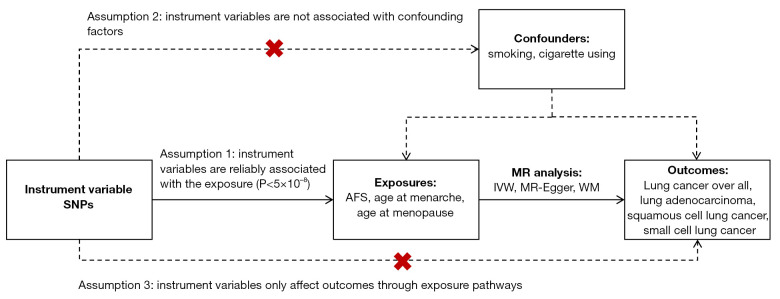
We performed a MR analysis of the data from the genome-wide association study (GWAS) of European ancestry to evaluate the independent effects of three reproductive behaviors on lung cancer overall (LUCA), lung adenocarcinoma (LUAD), lung squamous cell carcinoma (LUSC), and small cell lung cancer (SCLC). We mainly used the inverse-variance weighting method for the MR analysis. Sensitivity was determined by a MR-pleiotropy residual sum and outlier analysis, a weighted median analysis, a MR-Egger analysis, and a leave-one-out analysis.
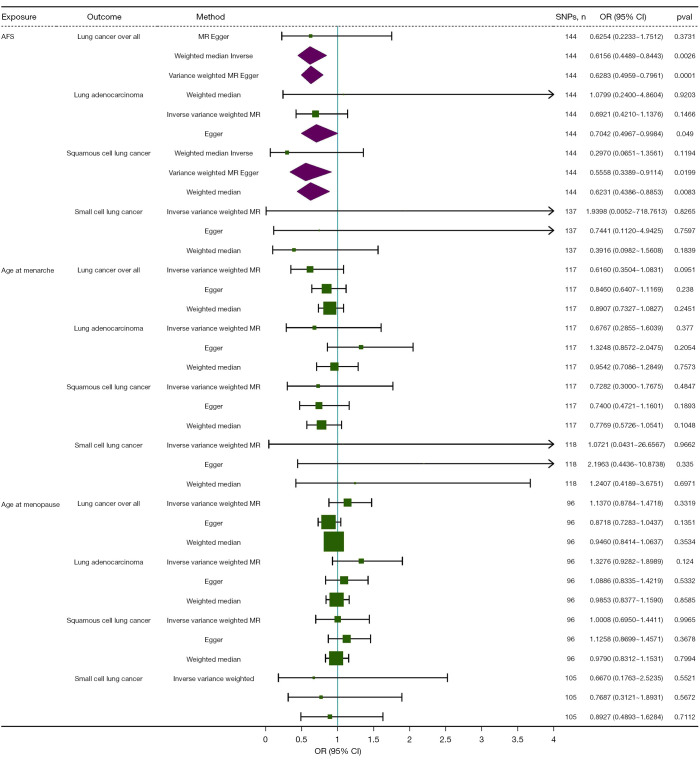
The MR analysis results revealed that older AFS had a causal relationship with LUCA [odds ratio (OR) =0.6283, 95% confidence interval (CI): 0.4959-0.7961, P=0.0001), LUAD (OR =0.7042, 95% CI: 0.4967-0.9984, P=0.049), and LUSC (OR =0.6231, 95% CI: 0.4386-0.8853, P=0.0083).
Our results revealed a causal relationship between older AFS and a lower risk of lung cancer. Our findings emphasize the importance of providing sex education, as early sexual intercourse may have undesirable effects. In addition, early psychological treatment is also essential.
越来越多的证据表明性激素参与肺癌的发生发展,但改变性激素水平的生殖行为与肺癌之间的相关性尚不清楚。此前许多研究调查了生殖因素与肺癌风险之间的关联,但结果并不一致。因此,我们进行了一项两样本孟德尔随机化(MR)分析,以探讨首次性交年龄(AFS)、初潮年龄和绝经年龄与肺癌之间的潜在关系。
我们对欧洲血统的全基因组关联研究(GWAS)数据进行了MR分析,以评估三种生殖行为对总体肺癌(LUCA)、肺腺癌(LUAD)、肺鳞状细胞癌(LUSC)和小细胞肺癌(SCLC)的独立影响。我们在MR分析中主要使用逆方差加权法。通过MR多效性残差和离群值分析、加权中位数分析、MR-Egger分析和留一法分析来确定敏感性。
MR分析结果显示,AFS较大与LUCA[比值比(OR)=0.6283,95%置信区间(CI):0.4959-0.7961,P=0.0001]、LUAD(OR =0.7042,95%CI:0.4967-0.9984,P=0.049)和LUSC(OR =0.6231,95%CI:0.4386-0.8853,P=0.0083)存在因果关系。
我们的结果揭示了AFS较大与肺癌风险较低之间的因果关系。我们的研究结果强调了提供性教育的重要性,因为过早性交可能会产生不良影响。此外,早期心理治疗也至关重要。