Zhao Zhi-Yi, Siow Yong, Liu Ling-Yun, Li Xian, Wang Hong-Liang, Lei Zhen-Min
Department of Andrology, The First Hospital of Jilin University, Changchun 130021, China.
Department of OB/GYN, University of Louisville School of Medicine, Louisville, KY 40202, USA.
Asian J Androl. 2025 Jan 1;27(1):44-51. doi: 10.4103/aja202449. Epub 2024 Aug 9.
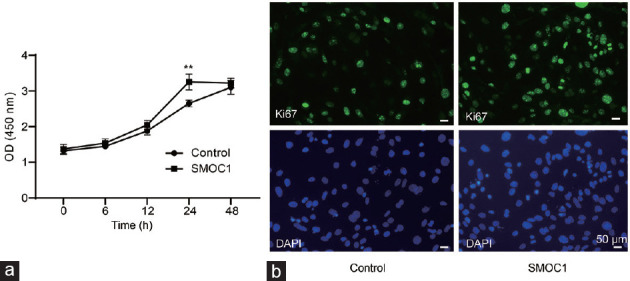
Testicular descent occurs in two consecutive stages: the transabdominal stage and the inguinoscrotal stage. Androgens play a crucial role in the second stage by influencing the development of the gubernaculum, a structure that pulls the testis into the scrotum. However, the mechanisms of androgen actions underlying many of the processes associated with gubernaculum development have not been fully elucidated. To identify the androgen-regulated genes, we conducted large-scale gene expression analyses on the gubernaculum harvested from luteinizing hormone/choriogonadotropin receptor knockout ( Lhcgr KO) mice, an animal model of inguinoscrotal testis maldescent resulting from androgen deficiency. We found that the expression of secreted protein acidic and rich in cysteine (SPARC)-related modular calcium binding 1 ( Smoc1 ) was the most severely suppressed at both the transcript and protein levels, while its expression was the most dramatically induced by testosterone administration in the gubernacula of Lhcgr KO mice. The upregulation of Smoc1 expression by testosterone was curtailed by the addition of an androgen receptor antagonist, flutamide. In addition, in vitro studies demonstrated that SMOC1 modestly but significantly promoted the proliferation of gubernacular cells. In the cultures of myogenic differentiation medium, both testosterone and SMOC1 enhanced the expression of myogenic regulatory factors such as paired box 7 ( Pax7 ) and myogenic factor 5 ( Myf5 ). After short-interfering RNA-mediated knocking down of Smoc1 , the expression of Pax7 and Myf5 diminished, and testosterone alone did not recover, but additional SMOC1 did. These observations indicate that SMOC1 is pivotal in mediating androgen action to regulate gubernaculum development during inguinoscrotal testicular descent.
经腹阶段和腹股沟阴囊阶段。雄激素在第二阶段通过影响引带的发育发挥关键作用,引带是一种将睾丸拉入阴囊的结构。然而,与引带发育相关的许多过程中雄激素作用的机制尚未完全阐明。为了鉴定雄激素调节的基因,我们对从促黄体生成素/绒毛膜促性腺激素受体敲除(Lhcgr KO)小鼠收获的引带进行了大规模基因表达分析,Lhcgr KO小鼠是一种由于雄激素缺乏导致腹股沟阴囊睾丸下降异常的动物模型。我们发现,富含半胱氨酸的酸性分泌蛋白(SPARC)相关模块化钙结合蛋白1(Smoc1)的表达在转录和蛋白质水平上受到的抑制最为严重,而在Lhcgr KO小鼠的引带中,其表达在给予睾酮后诱导最为显著。睾酮对Smoc1表达的上调被雄激素受体拮抗剂氟他胺抑制。此外,体外研究表明,SMOC1适度但显著地促进了引带细胞的增殖。在成肌分化培养基培养中,睾酮和SMOC1均增强了成对盒7(Pax7)和成肌因子5(Myf5)等成肌调节因子的表达。在短干扰RNA介导的Smoc1敲低后,Pax7和Myf5的表达降低,单独使用睾酮无法恢复,但额外添加SMOC1可以恢复。这些观察结果表明,SMOC1在介导雄激素作用以调节腹股沟阴囊睾丸下降过程中的引带发育方面至关重要。