Aljouda Nour A, Shrestha Dewan, DeVaux Chelsea, Olsen Rachelle R, Alleboina Satyanarayana, Walker Megan, Cheng Yong, Freeman Kevin W
Department of Genetics, Genomics and Informatics, University of Tennessee Health Science Center, Memphis, TN, USA.
Department of Hematology, St. Jude Children's Research Hospital, Memphis, TN, USA.
Mol Oncol. 2025 Mar;19(3):808-824. doi: 10.1002/1878-0261.13714. Epub 2024 Aug 9.
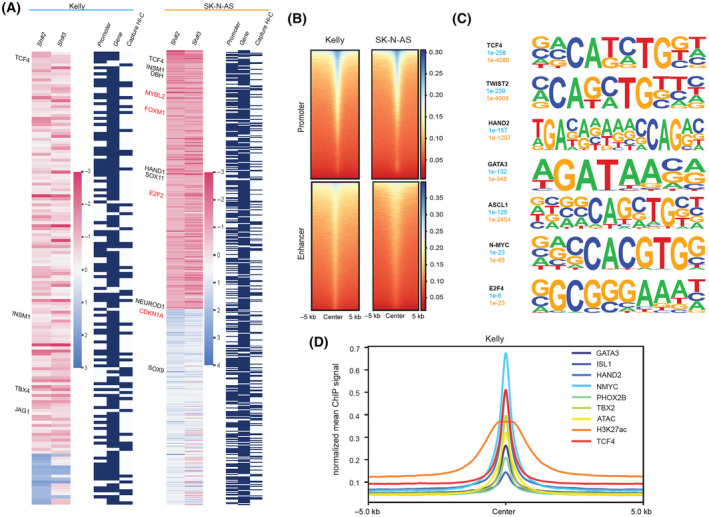
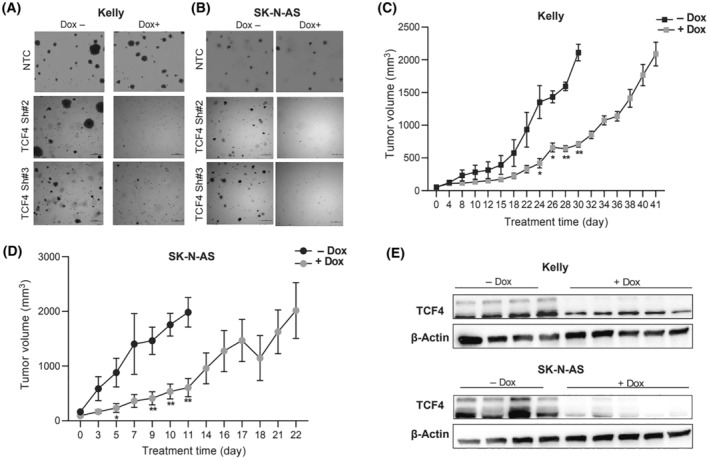
Super-enhancer-associated transcription factor networks define cell identity in neuroblastoma (NB). Dysregulation of these transcription factors contributes to the initiation and maintenance of NB by enforcing early developmental identity states. We report that the class I basic helix-loop-helix (bHLH) transcription factor 4 (TCF4; also known as E2-2) is a critical NB dependency gene that significantly contributes to these identity states through heterodimerization with cell-identity-specific bHLH transcription factors. Knockdown of TCF4 significantly induces apoptosis in vitro and inhibits tumorigenicity in vivo. We used genome-wide expression profiling, TCF4 chromatin immunoprecipitation sequencing (ChIP-seq) and TCF4 immunoprecipitation-mass spectrometry to determine the role of TCF4 in NB cells. Our results, along with recent findings in NB for the transcription factors T-box transcription factor TBX2, heart- and neural crest derivatives-expressed protein 2 (HAND2) and twist-related protein 1 (TWIST1), propose a role for TCF4 in regulating forkhead box protein M1 (FOXM1)/transcription factor E2F-driven gene regulatory networks that control cell cycle progression in cooperation with N-myc proto-oncogene protein (MYCN), TBX2, and the TCF4 dimerization partners HAND2 and TWIST1. Collectively, we showed that TCF4 promotes cell proliferation through direct transcriptional regulation of the c-MYC/MYCN oncogenic program that drives high-risk NB. Mechanistically, our data suggest the novel finding that TCF4 acts to support MYC activity by recruiting multiple factors known to regulate MYC function to sites of colocalization between critical NB transcription factors, TCF4 and MYC oncoproteins. Many of the TCF4-recruited factors are druggable, giving insight into potential therapies for high-risk NB. This study identifies a new function for class I bHLH transcription factors (e.g., TCF3, TCF4, and TCF12) that are important in cancer and development.
超级增强子相关转录因子网络决定神经母细胞瘤(NB)的细胞身份。这些转录因子的失调通过强化早期发育身份状态,促进了NB的起始和维持。我们报告称,I类碱性螺旋-环-螺旋(bHLH)转录因子4(TCF4;也称为E2-2)是一个关键的NB依赖性基因,它通过与细胞身份特异性bHLH转录因子异源二聚化,对这些身份状态有显著贡献。敲低TCF4在体外显著诱导细胞凋亡,在体内抑制肿瘤发生。我们使用全基因组表达谱分析、TCF4染色质免疫沉淀测序(ChIP-seq)和TCF4免疫沉淀-质谱分析来确定TCF4在NB细胞中的作用。我们的结果,连同最近在NB中关于转录因子T盒转录因子TBX2、心脏和神经嵴衍生物表达蛋白2(HAND2)和 twist相关蛋白1(TWIST1)的发现,提出了TCF4在调节叉头框蛋白M1(FOXM1)/转录因子E2F驱动的基因调控网络中的作用,该网络与N- myc原癌基因蛋白(MYCN)、TBX2以及TCF4二聚化伙伴HAND2和TWIST1协同控制细胞周期进程。总体而言,我们表明TCF4通过直接转录调控驱动高危NB的c-MYC/MYCN致癌程序来促进细胞增殖。从机制上讲,我们的数据表明了一个新发现,即TCF4通过招募多个已知调节MYC功能的因子到关键NB转录因子TCF4和MYC癌蛋白的共定位位点,来支持MYC活性。许多被TCF4招募的因子是可药物化的,这为高危NB的潜在治疗提供了思路。这项研究确定了I类bHLH转录因子(如TCF3、TCF4和TCF12)在癌症和发育中重要的新功能。