Department of Stomatology, Shunde Hospital, Southern Medical University (The First People's Hospital of Shunde, Foshan), Foshan, Guangdong, 528308, China.
Stomatological Hospital, School of Stomatology, Southern Medical University, Guangzhou, Guangdong, 510515, China.
BMC Oral Health. 2024 Aug 9;24(1):924. doi: 10.1186/s12903-024-04626-7.
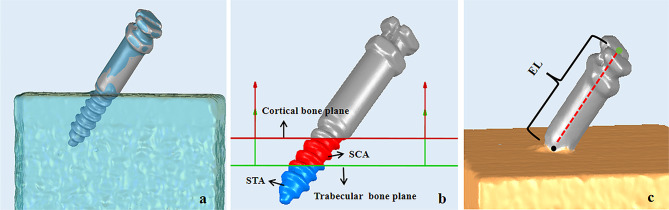
The infrazygomatic crest mini-screw has been widely used, but the biomechanical performance of mini-screws at different insertion angles is still uncertain. The aim of this study was to analyse the primary stability of infrazygomatic crest mini-screws at different angles and to explore the effects of the exposure length (EL), screw-cortical bone contact area (SCA), and screw-trabecular bone contact area (STA) on this primary stability.
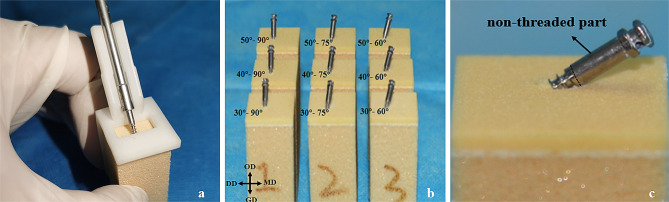
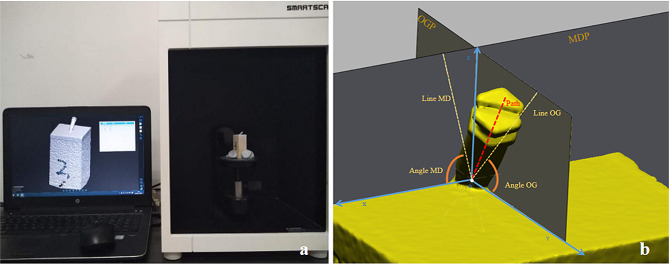
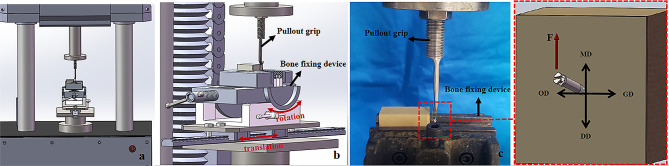
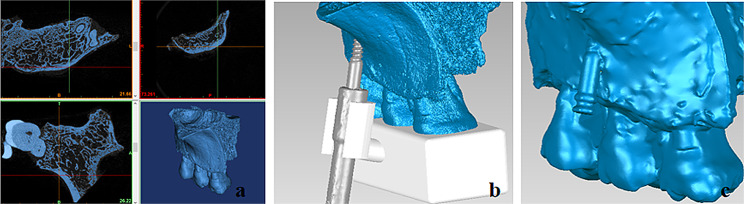
Ninety synthetic bones were assigned to nine groups to insert mini-screws at the cross-combined angles in the occlusogingival and mesiodistal directions. SCA, STA, EL, and lateral pull-out strength (LPS) were measured, and their relationships were analysed. Twelve mini-screws were then inserted at the optimal and poor angulations into the maxillae from six fresh cadaver heads, and the same biomechanical metrics were measured for validation.
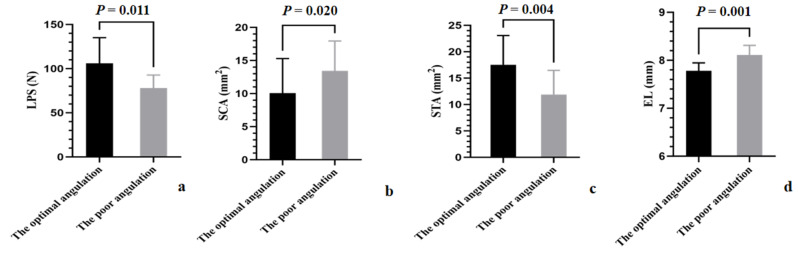
In the synthetic-bone test, the LPS, SCA, STA, and EL had significant correlations with the angle in the occlusogingival direction (r = 0.886, r = -0.946, r = 0.911, and r= -0.731; all P < 0.001). In the cadaver-validation test, significant differences were noted in the LPS (P = 0.011), SCA (P = 0.020), STA (P = 0.004), and EL (P = 0.001) between the poor and optimal angulations in the occlusogingival direction. The STA had positive correlations with LPS (r = 0.245 [synthetic-bone test] and r = 0.720 [cadaver-validation test]; both P < 0.05).
The primary stability of the infrazygomatic crest mini-screw was correlated with occlusogingival angulations. The STA significantly affected the primary stability of the infrazygomatic crest mini-screw, but the SCA and EL did not.
眶下嵴微型螺钉已被广泛应用,但不同植入角度下微型螺钉的生物力学性能仍不确定。本研究旨在分析不同角度眶下嵴微型螺钉的初始稳定性,并探讨暴露长度(EL)、螺钉-皮质骨接触面积(SCA)和螺钉-松质骨接触面积(STA)对这种初始稳定性的影响。
将 90 块合成骨随机分为 9 组,以牙合龈向和近远中向的交叉组合角植入微型螺钉。测量 SCA、STA、EL 和侧向拔出强度(LPS),并分析其相关性。然后从 6 具新鲜尸体头颅上以最佳和较差的角度将 12 个微型螺钉植入上颌骨,验证同样的生物力学指标。
在合成骨试验中,LPS、SCA、STA 和 EL 与牙合龈向角度有显著相关性(r=0.886,r=-0.946,r=0.911,r=-0.731;均 P<0.001)。在尸体验证试验中,牙合龈向角度不佳和良好时,LPS(P=0.011)、SCA(P=0.020)、STA(P=0.004)和 EL(P=0.001)有显著差异。STA 与 LPS 呈正相关(r=0.245 [合成骨试验]和 r=0.720 [尸体验证试验];均 P<0.05)。
眶下嵴微型螺钉的初始稳定性与牙合龈向角度有关。STA 显著影响眶下嵴微型螺钉的初始稳定性,但 SCA 和 EL 没有。