• 文献检索
  • 文档翻译
  • 深度研究
  • 学术资讯
  • Suppr Zotero 插件Zotero 插件
  • 邀请有礼
  • 套餐&价格
  • 历史记录
应用&插件
Suppr Zotero 插件Zotero 插件浏览器插件Mac 客户端Windows 客户端微信小程序
定价
高级版会员购买积分包购买API积分包
服务
文献检索文档翻译深度研究API 文档MCP 服务
关于我们
关于 Suppr公司介绍联系我们用户协议隐私条款
关注我们

Suppr 超能文献

核心技术专利:CN118964589B侵权必究
粤ICP备2023148730 号-1Suppr @ 2026

文献检索

告别复杂PubMed语法,用中文像聊天一样搜索,搜遍4000万医学文献。AI智能推荐,让科研检索更轻松。

立即免费搜索

文件翻译

保留排版,准确专业,支持PDF/Word/PPT等文件格式,支持 12+语言互译。

免费翻译文档

深度研究

AI帮你快速写综述,25分钟生成高质量综述,智能提取关键信息,辅助科研写作。

立即免费体验

结直肠癌患者来源的肿瘤类器官在研究及治疗应用方面的进展

Advancements in Research and Treatment Applications of Patient-Derived Tumor Organoids in Colorectal Cancer.

作者信息

van der Graaff Denise, Seghers Sofie, Vanclooster Pieterjan, Deben Christophe, Vandamme Timon, Prenen Hans

机构信息

Department of Medical Oncology, University Hospital Antwerp, 2650 Edegem, Belgium.

Center for Oncological Research (CORE), University of Antwerp, 2610 Wilrijk, Belgium.

出版信息

Cancers (Basel). 2024 Jul 26;16(15):2671. doi: 10.3390/cancers16152671.

DOI:10.3390/cancers16152671
PMID:39123399
原文链接:https://pmc.ncbi.nlm.nih.gov/articles/PMC11311786/
Abstract

Colorectal cancer (CRC) remains a significant health burden globally, being the second leading cause of cancer-related mortality. Despite significant therapeutic advancements, resistance to systemic antineoplastic agents remains an important obstacle, highlighting the need for innovative screening tools to tailor patient-specific treatment. This review explores the application of patient-derived tumor organoids (PDTOs), three-dimensional, self-organizing models derived from patient tumor samples, as screening tools for drug resistance in CRC. PDTOs offer unique advantages over traditional models by recapitulating the tumor architecture, cellular heterogeneity, and genomic landscape and are a valuable ex vivo predictive drug screening tool. This review provides an overview of the current literature surrounding the use of PDTOs as an instrument for predicting therapy responses in CRC. We also explore more complex models, such as co-cultures with important stromal cells, such as cancer-associated fibroblasts, and organ-on-a-chip models. Furthermore, we discuss the use of PDTOs for drug repurposing, offering a new approach to identify the existing drugs effective against drug-resistant CRC. Additionally, we explore how PDTOs serve as models to gain insights into drug resistance mechanisms, using newer techniques, such as single-cell RNA sequencing and CRISPR-Cas9 genome editing. Through this review, we aim to highlight the potential of PDTOs in advancing our understanding of predicting therapy responses, drug resistance, and biomarker identification in CRC management.

摘要

结直肠癌(CRC)仍是全球一项重大的健康负担,是癌症相关死亡的第二大主要原因。尽管在治疗方面取得了重大进展,但对全身抗肿瘤药物的耐药性仍然是一个重要障碍,这凸显了需要创新的筛查工具来定制针对患者的治疗方案。本综述探讨了患者来源的肿瘤类器官(PDTO)的应用,这是一种从患者肿瘤样本中获得的三维自组织模型,作为CRC耐药性的筛查工具。与传统模型相比,PDTO具有独特的优势,它能够重现肿瘤结构、细胞异质性和基因组格局,是一种有价值的体外预测性药物筛选工具。本综述概述了围绕使用PDTO作为预测CRC治疗反应的工具的当前文献。我们还探讨了更复杂的模型,例如与重要的基质细胞(如癌症相关成纤维细胞)的共培养模型以及芯片器官模型。此外,我们讨论了将PDTO用于药物重新定位,为识别对耐药性CRC有效的现有药物提供了一种新方法。此外,我们探讨了PDTO如何作为模型,利用单细胞RNA测序和CRISPR-Cas9基因组编辑等新技术深入了解耐药机制。通过本综述,我们旨在突出PDTO在推进我们对CRC管理中预测治疗反应、耐药性和生物标志物识别的理解方面的潜力。
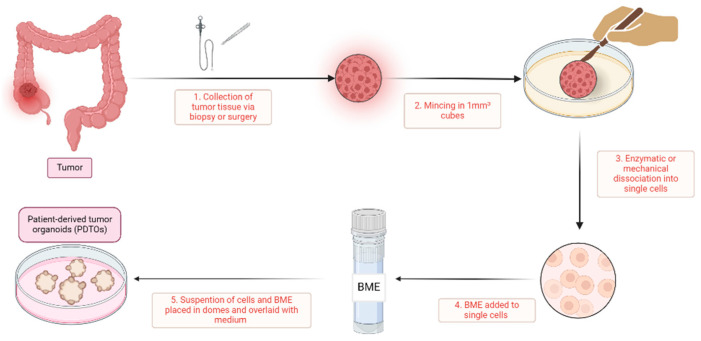
https://cdn.ncbi.nlm.nih.gov/pmc/blobs/2505/11311786/18c49c350b5b/cancers-16-02671-g001.jpg

相似文献

1
Advancements in Research and Treatment Applications of Patient-Derived Tumor Organoids in Colorectal Cancer.结直肠癌患者来源的肿瘤类器官在研究及治疗应用方面的进展
Cancers (Basel). 2024 Jul 26;16(15):2671. doi: 10.3390/cancers16152671.
2
Patient-Derived Tumor Organoids for Drug Repositioning in Cancer Care: A Promising Approach in the Era of Tailored Treatment.用于癌症治疗中药物重新定位的患者来源肿瘤类器官:个体化治疗时代的一种有前景的方法。
Cancers (Basel). 2020 Dec 4;12(12):3636. doi: 10.3390/cancers12123636.
3
Tumour organoids and assembloids: Patient-derived cancer avatars for immunotherapy.肿瘤类器官和组装体:用于免疫治疗的患者来源癌症模型
Clin Transl Med. 2024 Apr;14(4):e1656. doi: 10.1002/ctm2.1656.
4
Tumor Organoids: The Era of Personalized Medicine.肿瘤类器官:个性化医疗的时代。
Biochemistry (Mosc). 2024 Jan;89(Suppl 1):S127-S147. doi: 10.1134/S0006297924140086.
5
Patient-derived tumor organoids: a new avenue for preclinical research and precision medicine in oncology.患者来源的肿瘤类器官:肿瘤学临床前研究和精准医学的新途径。
Exp Mol Med. 2024 Jul;56(7):1531-1551. doi: 10.1038/s12276-024-01272-5. Epub 2024 Jul 1.
6
Establishment of patient-derived tumor organoids to functionally inform treatment decisions in metastatic colorectal cancer.建立患者来源的肿瘤类器官,以在转移性结直肠癌中为治疗决策提供功能信息。
ESMO Open. 2023 Jun;8(3):101198. doi: 10.1016/j.esmoop.2023.101198. Epub 2023 Apr 27.
7
Comparison of Cell and Organoid-Level Analysis of Patient-Derived 3D Organoids to Evaluate Tumor Cell Growth Dynamics and Drug Response.比较基于患者来源的 3D 类器官的细胞和类器官水平分析,以评估肿瘤细胞生长动力学和药物反应。
SLAS Discov. 2020 Aug;25(7):744-754. doi: 10.1177/2472555220915827. Epub 2020 Apr 30.
8
Organoids as a Robust Preclinical Model for Precision Medicine in Colorectal Cancer: A Systematic Review.类器官作为结直肠癌精准医学的强大临床前模型:一项系统综述。
Ann Surg Oncol. 2022 Jan;29(1):47-59. doi: 10.1245/s10434-021-10829-x. Epub 2021 Oct 1.
9
Exploring Tumor-Immune Interactions in Co-Culture Models of T Cells and Tumor Organoids Derived from Patients.探索患者来源 T 细胞与肿瘤类器官共培养模型中的肿瘤免疫相互作用。
Int J Mol Sci. 2023 Sep 27;24(19):14609. doi: 10.3390/ijms241914609.
10
Validation of a Novel EUS-FNB-Derived Organoid Co-Culture System for Drug Screening in Patients with Pancreatic Cancer.一种用于胰腺癌患者药物筛选的新型超声内镜引导下细针穿刺活检衍生类器官共培养系统的验证
Cancers (Basel). 2023 Jul 19;15(14):3677. doi: 10.3390/cancers15143677.

引用本文的文献

1
Dual modulation of cytotoxic and checkpoint receptors tunes the efficacy of adoptive Delta One T cell therapy against colorectal cancer.细胞毒性受体和检查点受体的双重调节可调整过继性Delta One T细胞疗法治疗结直肠癌的疗效。
Nat Cancer. 2025 Apr 16. doi: 10.1038/s43018-025-00948-9.

本文引用的文献

1
Organoids as a biomarker for personalized treatment in metastatic colorectal cancer: drug screen optimization and correlation with patient response.类器官作为转移性结直肠癌个体化治疗的生物标志物:药物筛选优化及与患者反应的相关性。
J Exp Clin Cancer Res. 2024 Feb 27;43(1):61. doi: 10.1186/s13046-024-02980-6.
2
Prediction for oxaliplatin-induced liver injury using patient-derived liver organoids.使用患者来源的肝类器官预测奥沙利铂诱导的肝损伤。
Cancer Med. 2024 Feb;13(3):e7042. doi: 10.1002/cam4.7042.
3
Why Do I Choose an Animal Model or an Alternative Method in Basic and Preclinical Biomedical Research? A Spectrum of Ethically Relevant Reasons and Their Evaluation.
为何在基础和临床前生物医学研究中选择动物模型或替代方法?一系列与伦理相关的原因及其评估
Animals (Basel). 2024 Feb 18;14(4):651. doi: 10.3390/ani14040651.
4
A growth factor-reduced culture system for colorectal cancer organoids.用于结直肠癌细胞类器官的生长因子减少培养体系。
Cancer Lett. 2024 Apr 28;588:216737. doi: 10.1016/j.canlet.2024.216737. Epub 2024 Feb 19.
5
Circulating microRNA Analysis in a Prospective Co-clinical Trial Identifies MIR652-3p as a Response Biomarker and Driver of Regorafenib Resistance Mechanisms in Colorectal Cancer.前瞻性临床队列研究中的循环 microRNA 分析鉴定出 MIR652-3p 作为结直肠癌regorafenib 耐药机制的反应生物标志物和驱动因子。
Clin Cancer Res. 2024 May 15;30(10):2140-2159. doi: 10.1158/1078-0432.CCR-23-2748.
6
A systematic review of patient-derived tumor organoids generation from malignant effusions.从恶性积液中生成患者来源的肿瘤类器官的系统评价。
Crit Rev Oncol Hematol. 2024 Mar;195:104285. doi: 10.1016/j.critrevonc.2024.104285. Epub 2024 Feb 3.
7
Pre-existing subclones determine radioresistance in rectal cancer organoids.预先存在的亚克隆决定直肠癌类器官的放射抵抗性。
Cell Rep. 2024 Feb 27;43(2):113735. doi: 10.1016/j.celrep.2024.113735. Epub 2024 Feb 3.
8
Tumor-on-a-chip models combined with mini-tissues or organoids for engineering tumor tissues.芯片上的肿瘤模型与微组织或类器官结合,用于工程化肿瘤组织。
Theranostics. 2024 Jan 1;14(1):33-55. doi: 10.7150/thno.90093. eCollection 2024.
9
Repurposing Metabolic Inhibitors in the Treatment of Colon Adenocarcinoma Patient-Derived Models.代谢抑制剂在结直肠腺癌患者衍生模型治疗中的再利用。
Cells. 2023 Dec 18;12(24):2859. doi: 10.3390/cells12242859.
10
Unified framework for patient-derived, tumor-organoid-based predictive testing of standard-of-care therapies in metastatic colorectal cancer.用于转移性结直肠癌患者来源的肿瘤类器官的标准治疗预测性检测的统一框架。
Cell Rep Med. 2023 Dec 19;4(12):101335. doi: 10.1016/j.xcrm.2023.101335.