
三种不同射束排列用于前列腺癌术后全盆腔调强质子治疗的计算机模拟比较
In Silico Comparison of Three Different Beam Arrangements for Intensity-Modulated Proton Therapy for Postoperative Whole Pelvic Irradiation of Prostate Cancer.
作者信息
Gogineni Emile, Chen Hao, Cruickshank Ian K, Koempel Andrew, Gogineni Aarush, Li Heng, Deville Curtiland
机构信息
Department of Radiation Oncology, The Ohio State University Wexner Medical Center, Columbus, OH 43210, USA.
Department of Radiation Oncology and Molecular Radiation Sciences, Johns Hopkins University School of Medicine, Baltimore, MD 21205, USA.
出版信息
Cancers (Basel). 2024 Jul 30;16(15):2702. doi: 10.3390/cancers16152702.
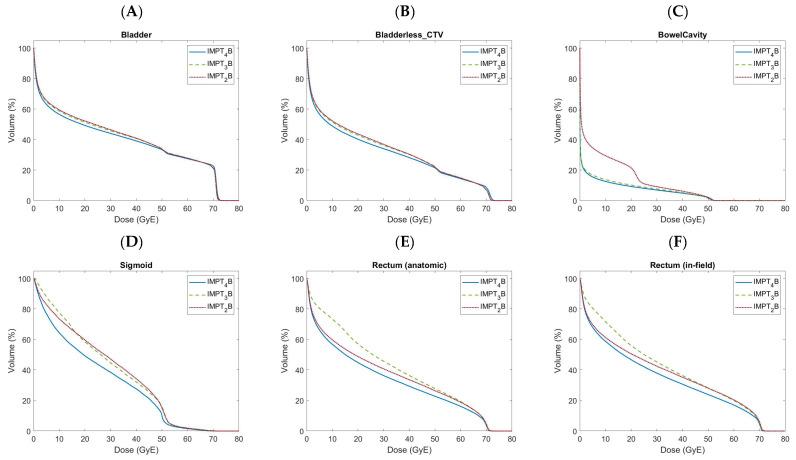
Proton therapy has been shown to provide dosimetric benefits in comparison with IMRT when treating prostate cancer with whole pelvis radiation; however, the optimal proton beam arrangement has yet to be established. The aim of this study was to evaluate three different intensity-modulated proton therapy (IMPT) beam arrangements when treating the prostate bed and pelvis in the postoperative setting. Twenty-three post-prostatectomy patients were planned using three different beam arrangements: two-field (IMPTB) (opposed laterals), three-field (IMPTB) (opposed laterals inferiorly matched to a posterior-anterior beam superiorly), and four-field (IMPTB) (opposed laterals inferiorly matched to two posterior oblique beams superiorly) arrangements. The prescription was 50 Gy radiobiological equivalent (GyE) to the pelvis and 70 GyE to the prostate bed. Comparisons were made using paired two-sided Wilcoxon signed-rank tests. CTV coverages were met for all IMPT plans, with 99% of CTVs receiving ≥ 100% of prescription doses. All organ at risk (OAR) objectives were met with IMPTB and IMPTB plans, while several rectum objectives were exceeded by IMPTB plans. IMPTB provided the lowest doses to OARs for the majority of analyzed outcomes, with significantly lower doses than IMPTB +/- IMPTB for bladder V30-V50 and mean dose; bowel V15-V45 and mean dose; sigmoid maximum dose; rectum V40-V72.1, maximum dose, and mean dose; femoral head V37-40 and maximum dose; bone V40 and mean dose; penile bulb mean dose; and skin maximum dose. This study is the first to compare proton beam arrangements when treating the prostate bed and pelvis. four-field plans provided better sparing of the bladder, bowel, and rectum than 2- and three-field plans. The data presented herein may help inform the future delivery of whole pelvis IMPT for prostate cancer.
与调强适形放疗(IMRT)相比,质子治疗在全盆腔放疗治疗前列腺癌时已显示出剂量学优势;然而,最佳质子束排列尚未确定。本研究的目的是评估术后治疗前列腺床和盆腔时三种不同的调强质子治疗(IMPT)束排列。23例前列腺切除术后患者采用三种不同的束排列进行计划:两野(IMPTB)(对侧侧野)、三野(IMPTB)(对侧侧野在下与前后野在上匹配)和四野(IMPTB)(对侧侧野在下与两个后斜野在上匹配)排列。处方剂量为盆腔50 Gy生物等效剂量(GyE),前列腺床70 GyE。使用配对双侧Wilcoxon符号秩检验进行比较。所有IMPT计划均满足临床靶区(CTV)覆盖要求,99%的CTV接受≥100%的处方剂量。IMPTB和IMPTB计划均满足所有危及器官(OAR)目标,而IMPTB计划超出了几个直肠目标。对于大多数分析结果,IMPTB对OAR的剂量最低,膀胱V30 - V50和平均剂量、肠V15 - V45和平均剂量、乙状结肠最大剂量、直肠V40 - V72.1、最大剂量和平均剂量、股骨头V37 - 40和最大剂量、骨骼V40和平均剂量、阴茎球部平均剂量以及皮肤最大剂量均显著低于IMPTB +/- IMPTB。本研究是首次比较治疗前列腺床和盆腔时的质子束排列。四野计划比两野和三野计划能更好地保护膀胱、肠和直肠。本文提供的数据可能有助于为未来前列腺癌全盆腔IMPT的实施提供参考。

 Zotero 插件