Department of Psychology, University of Fribourg, Fribourg, Switzerland.
Sleep. 2024 Oct 11;47(10). doi: 10.1093/sleep/zsae179.
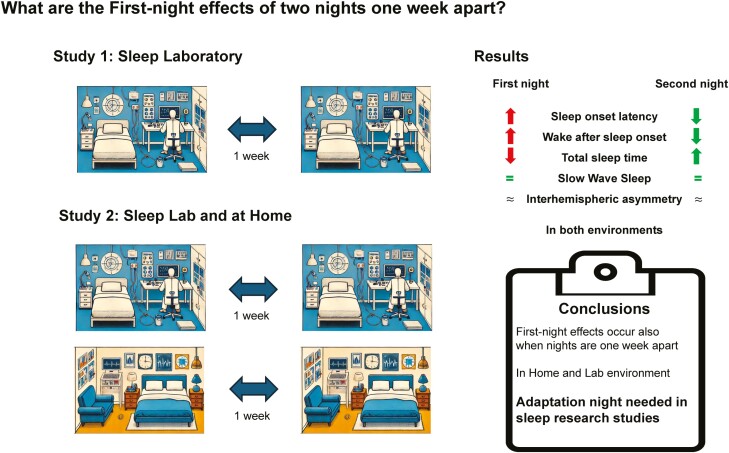
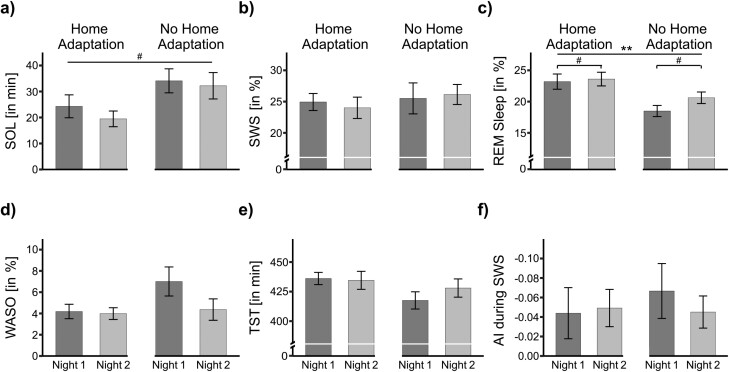
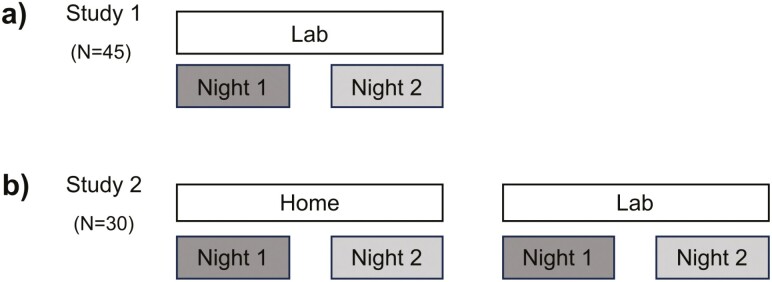
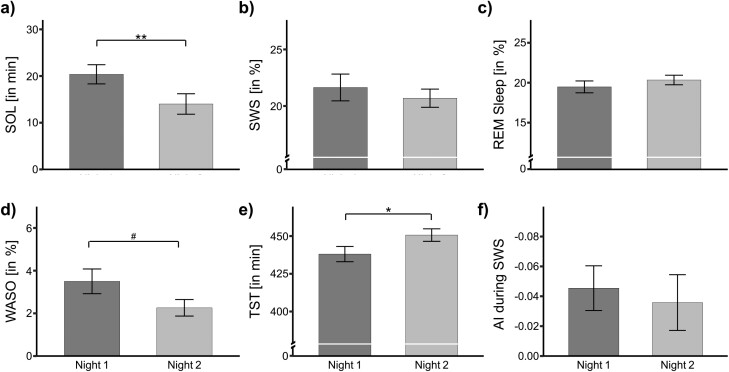
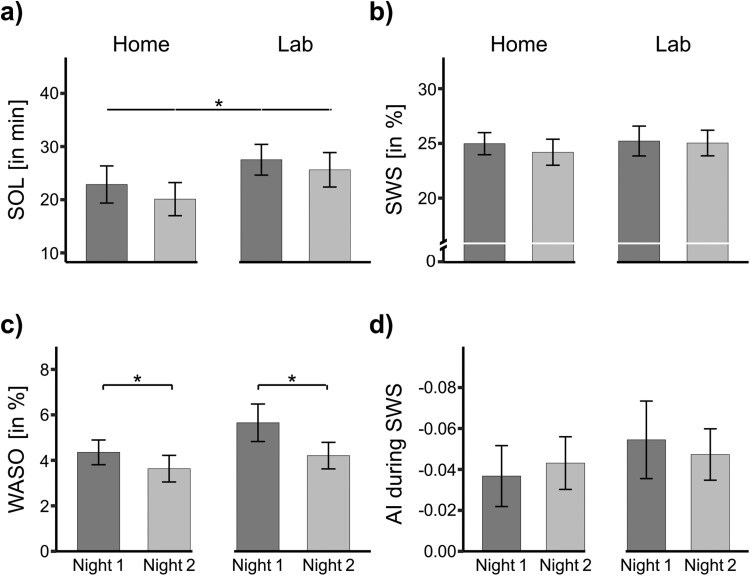
The first night in an unfamiliar environment is marked by reduced sleep quality and changes in sleep architecture. This so-called first-night effect (FNE) is well established for two consecutive nights and lays the foundation for including an adaptation night in sleep research to counteract FNEs. However, adaptation nights rarely happen immediately before experimental nights, which raises the question of how sleep adapts over nonconsecutive nights. Furthermore, it is yet unclear, how environmental familiarity and hemispheric asymmetry of slow-wave sleep (SWS) contribute to the explanation of FNEs. To address this gap, 45 healthy participants spent two weekly separated nights in the sleep laboratory. In a separate study, we investigated the influence of environmental familiarity on 30 participants who spent two nonconsecutive nights in the sleep laboratory and two nights at home. Sleep was recorded by polysomnography. Results of both studies show that FNEs also occur in nonconsecutive nights, particularly affecting wake after sleep onset, sleep onset latency, and total sleep time. Sleep disturbances in the first night happen in both familiar and unfamiliar environments. The degree of asymmetric SWS was not correlated with the FNE but rather tended to vary over the course of several nights. Our findings suggest that nonconsecutive adaptation nights are effective in controlling for FNEs, justifying the current practice in basic sleep research. Further research should focus on trait- and fluctuating state-like components explaining interhemispheric asymmetries.
在陌生环境中度过的第一晚,睡眠质量会下降,睡眠结构也会发生变化。这种所谓的第一晚效应(FNE)在连续两晚的研究中已经得到证实,这为在睡眠研究中纳入适应夜晚以抵消 FNE 奠定了基础。然而,适应夜晚很少在实验夜晚之前立即进行,这就提出了一个问题,即非连续夜晚的睡眠是如何适应的。此外,环境熟悉度和慢波睡眠(SWS)的半球不对称性如何有助于解释 FNE 仍不清楚。为了解决这一差距,45 名健康参与者在睡眠实验室中度过了两个每周分开的夜晚。在一项单独的研究中,我们调查了环境熟悉度对 30 名参与者的影响,他们在睡眠实验室度过了两个非连续的夜晚和两个晚上的家。通过多导睡眠图记录睡眠。两项研究的结果均表明,即使在非连续的夜晚,也会出现 FNE,特别是对睡眠后觉醒、入睡潜伏期和总睡眠时间有影响。第一晚的睡眠障碍发生在熟悉和不熟悉的环境中。SWS 的不对称程度与 FNE 无关,而是倾向于在几晚内发生变化。我们的发现表明,非连续的适应夜晚可以有效地控制 FNE,这证明了目前在基础睡眠研究中的实践是合理的。进一步的研究应集中在解释半球不对称性的特质和波动状态样成分上。