Lifschitz A, Nava S, Miró V, Canton C, Alvarez L, Lanusse C
Laboratorio de Farmacología, Centro de Investigación Veterinaria de Tandil (CIVETAN), UNCPBA-CICPBA-CONICET, Campus Universitario, Tandil, Buenos Aires, Argentina; Universidad Nacional del Centro de la Provincia de Buenos Aires (UNCPBA), Facultad de Ciencias Veterinarias, Campus Universitario, Tandil, Buenos Aires, Argentina.
Instituto de Investigación de la Cadena Láctea (IdICaL)(INTA-CONICET), Instituto Nacional de Tecnología Agropecuaria, INTA E.E.A, Rafaela, Santa Fe, Argentina.
Int J Parasitol Drugs Drug Resist. 2024 Dec;26:100559. doi: 10.1016/j.ijpddr.2024.100559. Epub 2024 Aug 8.
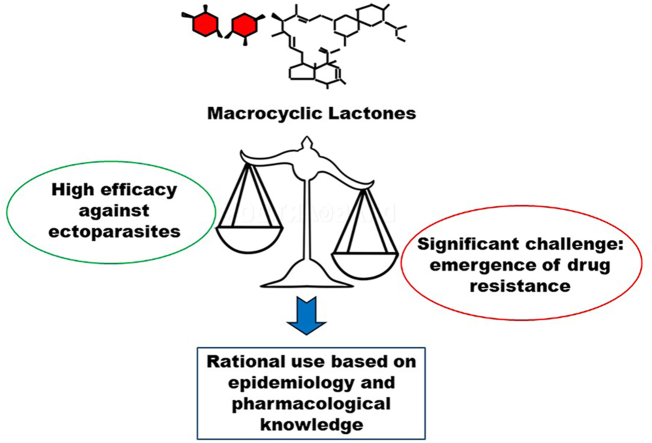
Macrocyclic lactones (MLs) are the cornerstone of parasite control in livestock due to their broad-spectrum activity against endo (nematodes) and ecto (lice, ticks, mites) parasites. These molecules, introduced into the veterinary pharmaceutical market 40 years ago, have substantially improved animal welfare and productivity by offering extended high efficacy, reducing treatment frequency, and displaying a favorable safety profile. However, their widespread and intensive use has led to a significant challenge nowadays: the development of parasite resistance. This review focuses on the critical link between drug pharmacokinetics (variation in concentration profiles and exposure over time) and pharmacodynamics (drug efficacy) and the ability of both avermectin and milbemycin MLs families to control livestock ectoparasites. This review discusses the integrated assessment of drug behavior in the host, its diffusion into target parasites, and the impact of different pharmaceutical formulations on enhancing drug delivery to infection sites. These are considered critical research/development areas to optimize the use of MLs, preventing treatment failures and finally extending the lifespan of these essential pharmaceutical ingredients. Finally, the importance of the rational use of MLs, guided by parasite epidemiology and pharmacological knowledge, is emphasized as a key strategy to preserve the antiparasitic efficacy of these still very useful molecules.
大环内酯类药物(MLs)是家畜寄生虫防治的基石,因为它们对体内寄生虫(线虫)和体外寄生虫(虱子、蜱虫、螨虫)具有广谱活性。这些分子于40年前进入兽医药市场,通过提供长效高效、减少治疗频率和良好的安全性,显著改善了动物福利和生产力。然而,它们的广泛和大量使用如今带来了一个重大挑战:寄生虫耐药性的产生。本综述重点关注药物药代动力学(浓度曲线变化和随时间的暴露情况)与药效学(药物疗效)之间的关键联系,以及阿维菌素和米尔贝霉素MLs家族控制家畜体外寄生虫的能力。本综述讨论了药物在宿主体内行为的综合评估、其向目标寄生虫的扩散以及不同药物制剂对增强药物向感染部位递送的影响。这些被认为是优化MLs使用、防止治疗失败并最终延长这些重要药物成分使用寿命的关键研发领域。最后,强调以寄生虫流行病学和药理学知识为指导合理使用MLs的重要性,这是保持这些仍然非常有用的分子抗寄生虫效力的关键策略。