Matthews Thomas, Salzberg Noah, Thayeswaran Trisheekeshan, Jacobs Nikhil, Colwell Niall S
Department of Medicine, Tipperary University Hospital, Clonmel, Ireland.
Eur J Case Rep Intern Med. 2024 Jul 2;11(8):004669. doi: 10.12890/2024_004669. eCollection 2024.
Arteriovenous malformations (AVMs) are abnormal direct connections between arterial and venous systems, without an interposed capillary bed. This permits high-flow arteriovenous shunting, which precipitates structural changes in the afferent and efferent vessels, namely arterial smooth muscle hyperplasia and thinning of venous walls. Patients with intracranial AVMs typically present with a haemorrhage, headache or seizure. Treatment is either via medical management aimed at control of seizures, headache and blood pressure, or interventional via surgical, radiation or radiologically guided embolisation.
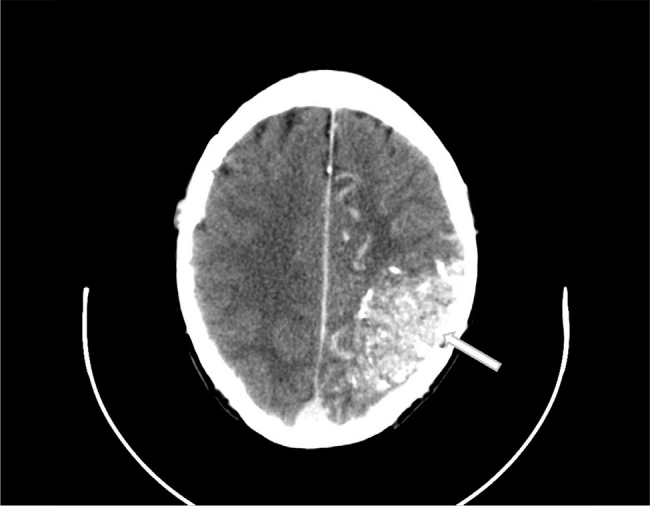
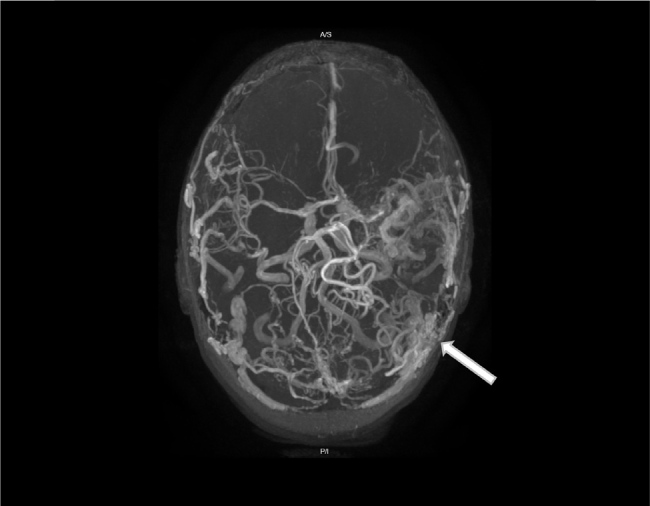
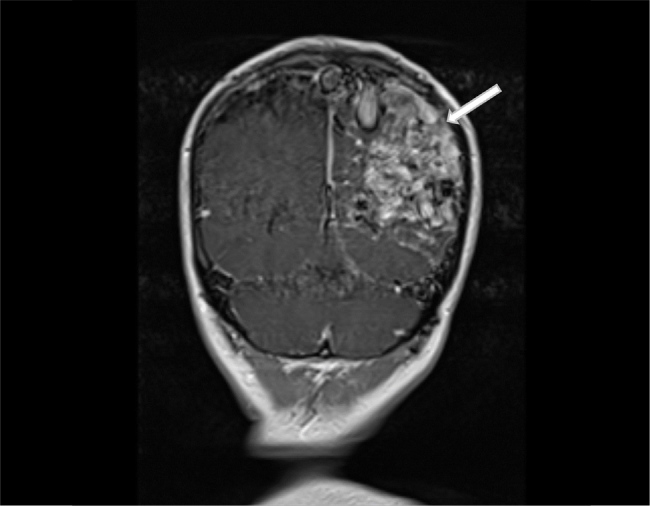
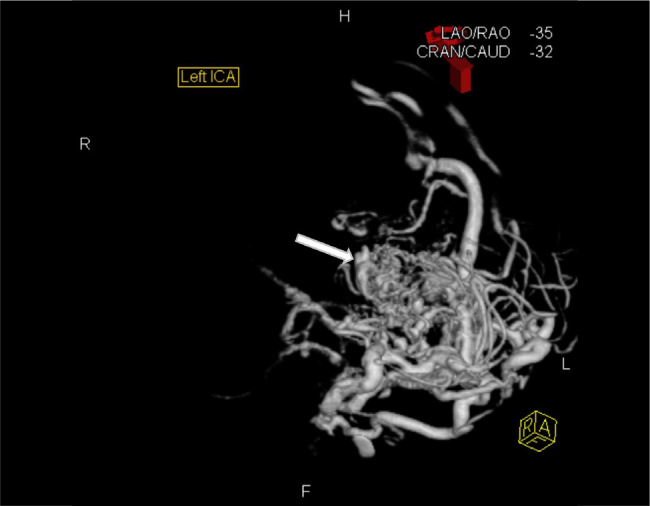
We report the case of a woman in her early 40s presenting with a tonic-clonic seizure against a background of a 31-year history of migraine and an 18-month history of tremors in her right arm. The clinical examination was remarkable for an extremely loud cranial bruit and a right homonymous hemianopia. Imaging diagnosed an 8 cm Martin-Spetzler grade V intracranial arteriovenous malformation in her left parietal lobe, which was deemed unsuitable for operative or radiotherapy-based intervention.
The patient was managed through observation and relatively good control of her breakthrough seizures was achieved through the addition of brivaracetam to her lamotrigine and carbamazepine-based therapy, six years after her initial presentation.
Arteriovenous malformations may go undetected for decades.The presence of a cranial bruit is an important sign and tool in diagnosing an intracranial arteriovenous malformation. The presence of a homonymous hemianopia, of which a patient may be unaware, helps to localise an intracranial lesion.The risks of operative or radiological intervention must be balanced with the risks of haemorrhage or refractory seizure when adopting a strategy for the treatment of an intracranial arteriovenous malformation. Good control of epileptic symptoms in those deemed not suitable for operative or radiological intervention can be achieved by careful titration of anti-seizure medications.
动静脉畸形(AVM)是动脉系统和静脉系统之间的异常直接连接,其间没有毛细血管床。这使得大量动静脉分流成为可能,从而导致输入和输出血管发生结构变化,即动脉平滑肌增生和静脉壁变薄。颅内动静脉畸形患者通常表现为出血、头痛或癫痫发作。治疗方法包括旨在控制癫痫发作、头痛和血压的药物治疗,或通过手术、放疗或放射引导栓塞进行介入治疗。
我们报告了一名40岁出头女性的病例,该患者在有31年偏头痛病史和右臂震颤18个月病史的背景下出现强直阵挛性发作。临床检查发现有极响亮的颅内杂音和右侧同向性偏盲。影像学检查诊断出她左侧顶叶有一个8厘米的Martin-Spetzler V级颅内动静脉畸形,认为不适合进行手术或基于放疗的干预。
患者通过观察进行管理,在初次就诊六年之后,通过在她基于拉莫三嗪和卡马西平的治疗方案中添加布瓦西坦,实现了对突破性癫痫发作的相对良好控制。
动静脉畸形可能几十年都未被发现。颅内杂音的存在是诊断颅内动静脉畸形的一个重要体征和工具。同向性偏盲的存在有助于颅内病变的定位,而患者可能并未意识到这一点。在采用颅内动静脉畸形治疗策略时,手术或放射干预的风险必须与出血或难治性癫痫发作的风险相平衡。对于那些被认为不适合手术或放射干预的患者,通过仔细调整抗癫痫药物的剂量,可以实现对癫痫症状的良好控制。