Hamidi Salim, Kahyaie-Aghdam Mina, Ebrahimi-Chaharom Mohammad-Esmaeel, Abed-Kahnamouei Mahdi, Dabaghi-Tabriz Fatemeh
Assistant professor, Department of Operative Dentistry, Faculty of Dentistry, Urmia University of Medical Sciences, Urmia, Iran.
Assistant professor, Department of Operative Dentistry, Faculty of Dentistry, Tabriz University of Medical Sciences, Tabriz, Iran.
J Clin Exp Dent. 2024 Jun 1;16(6):e685-e692. doi: 10.4317/jced.61493. eCollection 2024 Jun.
This study aimed to evaluate the effect of the Nd: YAG laser on the tensile bond strength of composite resin to dentin with hypersensitivity using different universal bonding systems.
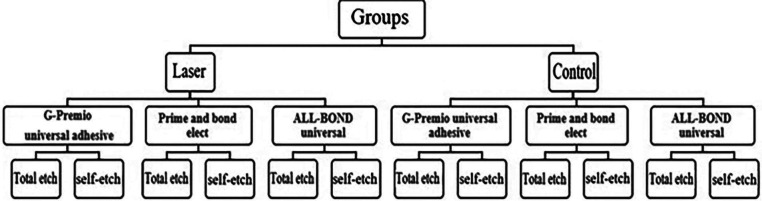
After cutting the crown of 252 molars, buccal cervical enamel was removed at a thickness of approximately 2 mm, and 252 smooth dentin surfaces were exposed. Then they were etched with 0.5 M ethylenediaminetetraacetic acid (pH = 7.4) to stimulate hypersensitivity. The specimens were then randomly divided into 12 groups (n= 21) according to the surface treatments performed. After etching and bonding according to the manufacturer's recommendations in each group, the entire dentin surface was restored with Valux Plus composite resin. The samples were thermocycled and a universal test machine was used to measure the microtensile bond strength. The failure mode for each sample was observed under a stereomicroscope. For data analysis, the Bonferroni test, the independent t-test and the three-way anova test were used.
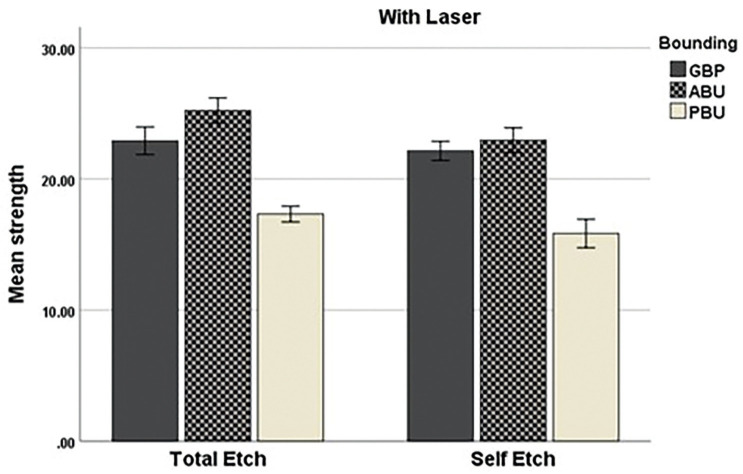
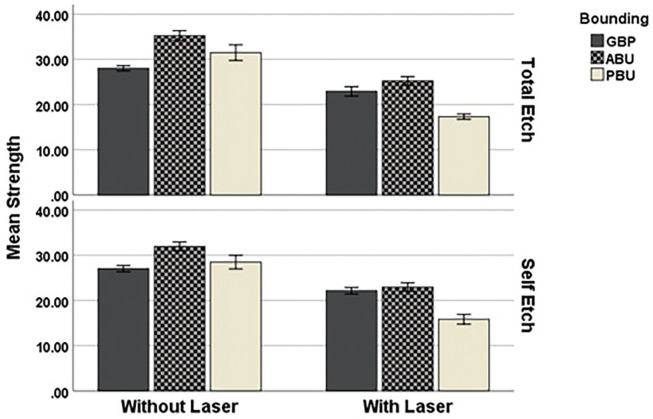
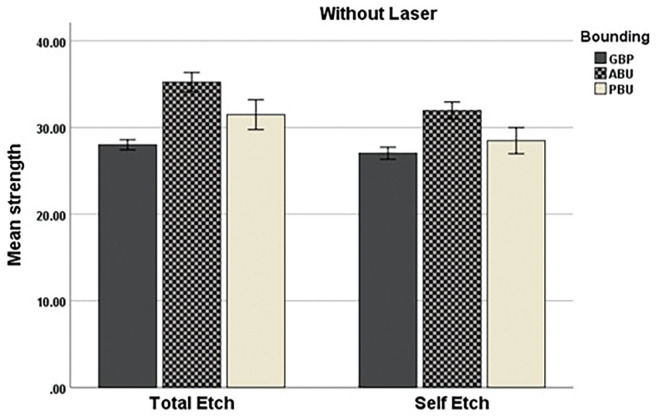
The average microtensile bond strength in non-laser samples was higher than the average in laser samples (<0.001). In comparison with the bonding agent type in both cases with and without laser, the highest average microtensile bond strength was related to ALL-BOND (<0.001), meanwhile the lowest average tensile strength in samples without laser was related to G-Premio universal adhesive (<0.001), and the lowest average microtensile strength in samples with laser belonged to Prime and Bond Elect group (<0.001).
Nd: YAG laser irradiation of the dentin surface before applying the adhesive significantly decreased the microtensile bond strength of the composite resin to the dentin surface. Nd:YAG laser, Bond strength, Dentin, hypersensitivity, Universal adhesives.
本研究旨在评估钕钇铝石榴石(Nd:YAG)激光对使用不同通用粘结系统的复合树脂与过敏牙本质之间拉伸粘结强度的影响。
在切割252颗磨牙的牙冠后,去除颊侧颈部约2mm厚的釉质,暴露252个光滑的牙本质表面。然后用0.5M乙二胺四乙酸(pH = 7.4)蚀刻以激发过敏反应。根据所进行的表面处理,将标本随机分为12组(n = 21)。按照每组制造商的建议进行蚀刻和粘结后,用Valux Plus复合树脂修复整个牙本质表面。对样品进行热循环处理,并用万能试验机测量微拉伸粘结强度。在立体显微镜下观察每个样品的失效模式。数据分析采用Bonferroni检验、独立t检验和三因素方差分析。
非激光处理样品的平均微拉伸粘结强度高于激光处理样品(<0.001)。在有激光和无激光的两种情况下,与粘结剂类型相比,最高的平均微拉伸粘结强度与ALL - BOND相关(<0.001),同时无激光样品中最低的平均拉伸强度与G - Premio通用粘结剂相关(<0.001),有激光样品中最低的平均微拉伸强度属于Prime and Bond Elect组(<0.001)。
在应用粘结剂之前对牙本质表面进行Nd:YAG激光照射会显著降低复合树脂与牙本质表面之间的微拉伸粘结强度。Nd:YAG激光、粘结强度、牙本质、过敏反应、通用粘结剂。