Maliyam Pattaravan, Laphookhieo Surat, Koedrith Preeyaporn, Puttarak Panupong
Department of Pharmacognosy and Pharmaceutical Botany, Faculty of Pharmaceutical Sciences, Prince of Songkla University, Hat-Yai District, Songkhla, 90112, Thailand.
Center of Chemical Innovation for Sustainability (CIS) and School of Science, Mae Fah Luang University, Chiang Rai, 57100, Thailand.
Heliyon. 2024 Jul 14;10(14):e34480. doi: 10.1016/j.heliyon.2024.e34480. eCollection 2024 Jul 30.
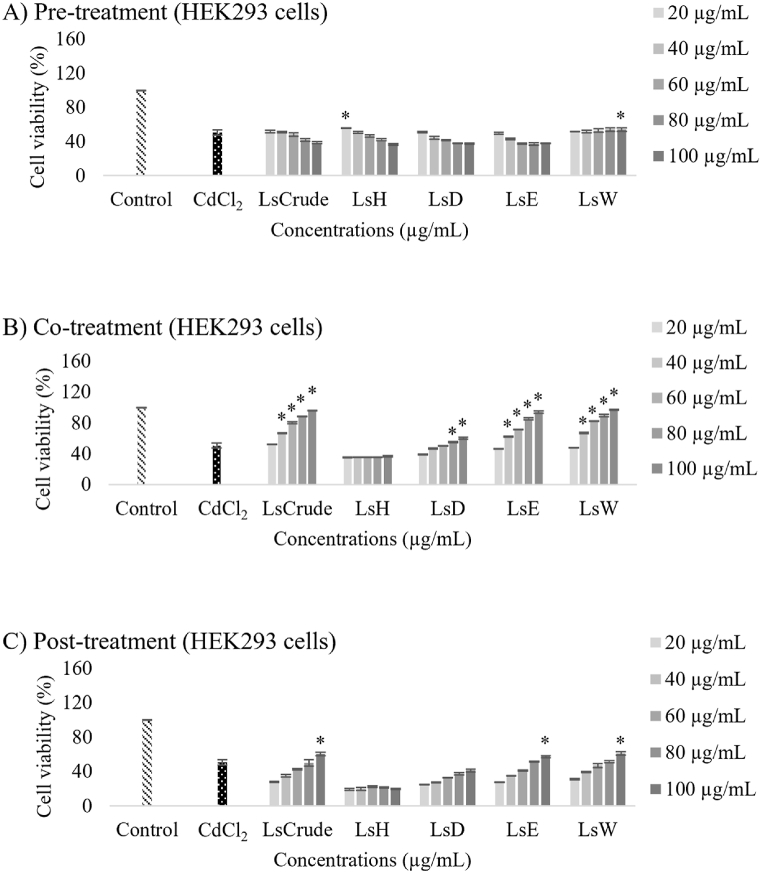
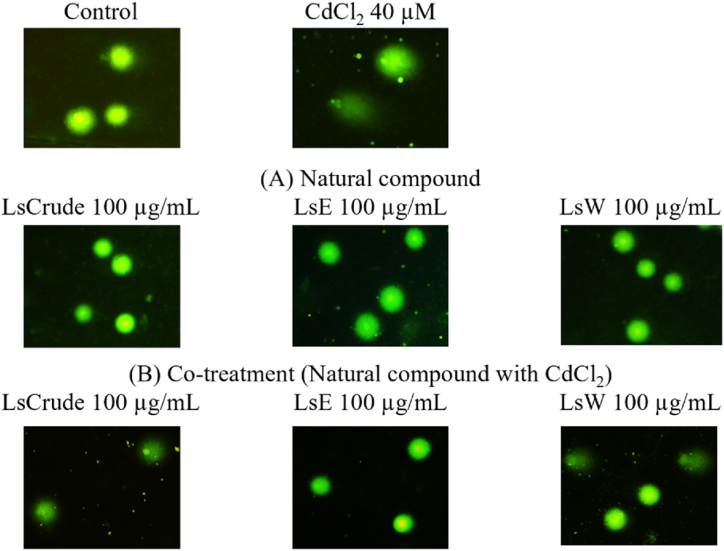
Exposure to cadmium (Cd) results in bioaccumulation and irreversible damage; this encourages an investigation of alternatives to address Cd toxicity, using natural compounds. , a well-known Thai medicinal plant, was investigated for its phytochemical compounds and corresponding bioactivities, including antioxidant and anti-cytogenotoxic effects against Cd toxicity in HEK293 renal and HDF dermal cell models. The crude extract of (LsCrude) was partitioned into four fractions, using sequential polarity solvents (hexane, dichloromethane, ethyl acetate, and water, denoted as LsH, LsD, LsE, and LsW, respectively). The extraction yields were 1.79 %, 5.08 %, 8.53 %, and 70.25 % (w/w), respectively. Phytochemical screening revealed the presence of tannins, alkaloids, and flavonoids in LsCrude and its fractions, except for LsH. LsE exhibited the highest concentrations of phenolics (286.83 ± 6.83 mg GAE/g extract) and flavonoids (86.36 ± 1.29 mg QE/g extract). Subsequent 2,2-diphenyl-1-picrylhydrazyl (DPPH) radical-scavenging and ferric-reducing ability of plasma (FRAP) reducing powder assays demonstrated the high antioxidant capacity of LsCrude and its fractions. The lowest IC value (9.11 ± 0.43 μg/mL) in the DPPH assay corresponded to LsW, whereas the highest total FRAP value (6.06 ± 0.70 mg QE Eq./g dry mass) corresponded to LsE. MTT and alkaline comet assays revealed the lack of toxicity of the extracts, which were considered safe. Upon exposure to Cd at the CC level, HEK293 cells treated with LsE suppressed Cd-induced damage. HDF cells treated with LsCrude, LsD, or LsE attenuated Cd-induced damage. In the pre-treatment, LsD protected the HDF cells against Cd-mediated cytogenotoxicity. These anti-cytogenotoxic potentials are likely due to the antioxidant properties of the phytochemicals. Our findings highlight the cyto-geno-protective properties of stem extracts against Cd toxicity in HEK293 and HDF cells, and provide a novel approach for combating oxidative stress and DNA damage caused by environmental pollutants.
接触镉(Cd)会导致生物累积和不可逆转的损害;这促使人们研究使用天然化合物来替代镉毒性的方法。对一种著名的泰国药用植物进行了研究,分析其植物化学成分及其相应的生物活性,包括在人胚肾293(HEK293)肾细胞模型和人皮肤成纤维细胞(HDF)模型中针对镉毒性的抗氧化和抗细胞遗传毒性作用。使用顺序极性溶剂(己烷、二氯甲烷、乙酸乙酯和水,分别表示为LsH、LsD、LsE和LsW)将该植物的粗提物分成四个部分。提取产率分别为1.79%、5.08%、8.53%和70.25%(w/w)。植物化学筛选显示,除LsH外,LsCrude及其各部分中均存在单宁、生物碱和黄酮类化合物。LsE中酚类(286.83±6.83毫克没食子酸当量/克提取物)和黄酮类(86.36±1.29毫克槲皮素当量/克提取物)的浓度最高。随后进行的2,2-二苯基-1-苦基肼基(DPPH)自由基清除和血浆铁还原能力(FRAP)还原粉末测定表明,LsCrude及其各部分具有较高的抗氧化能力。DPPH测定中最低的半数抑制浓度(IC)值(9.11±0.43微克/毫升)对应于LsW,而最高的总FRAP值(6.06±0.70毫克槲皮素当量/克干质量)对应于LsE。MTT和碱性彗星试验表明提取物无毒性,被认为是安全的。在CC水平暴露于镉时,用LsE处理的HEK293细胞抑制了镉诱导的损伤。用LsCrude、LsD或LsE处理的HDF细胞减轻了镉诱导的损伤。在预处理中,LsD保护HDF细胞免受镉介导的细胞遗传毒性。这些抗细胞遗传毒性潜力可能归因于植物化学物质的抗氧化特性。我们的研究结果突出了该植物茎提取物对HEK293和HDF细胞中镉毒性的细胞基因保护特性,并为对抗环境污染物引起的氧化应激和DNA损伤提供了一种新方法。