Lin Na, Dai Qiaoding, Zhang Yan, Xu Liping
Rheumatology and Immunology, The First Affiliated Hospital of Zhejiang Chinese Medical University (Zhejiang Provincial Hospital of Chinese Medicine), Hangzhou, Zhejiang, China.
Front Pharmacol. 2024 Jul 26;15:1388753. doi: 10.3389/fphar.2024.1388753. eCollection 2024.
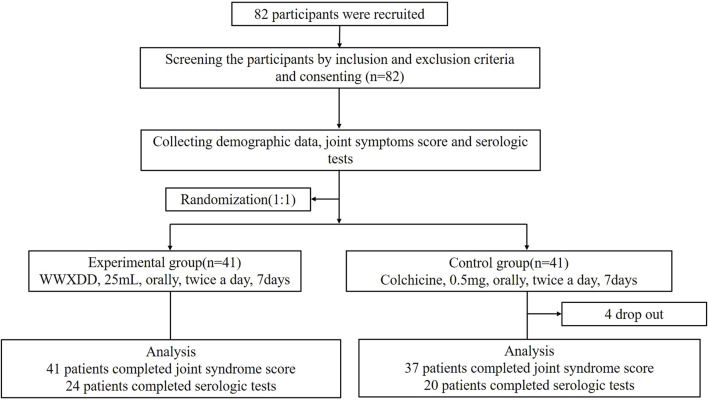
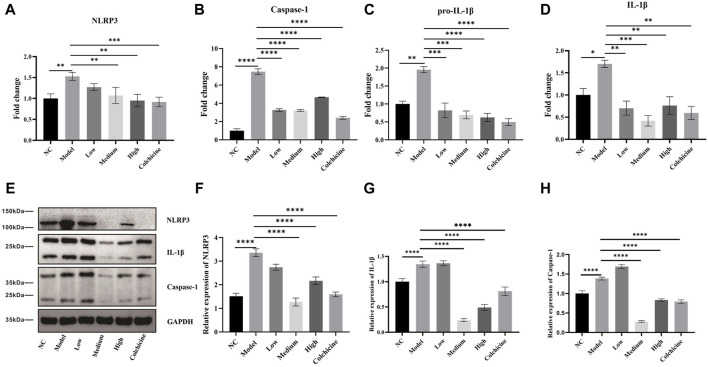
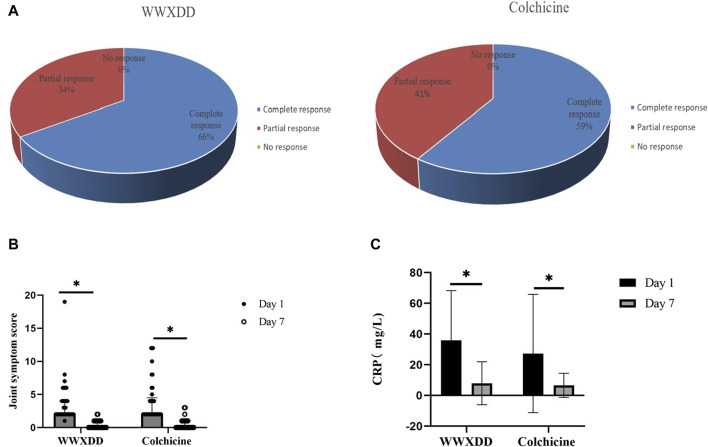
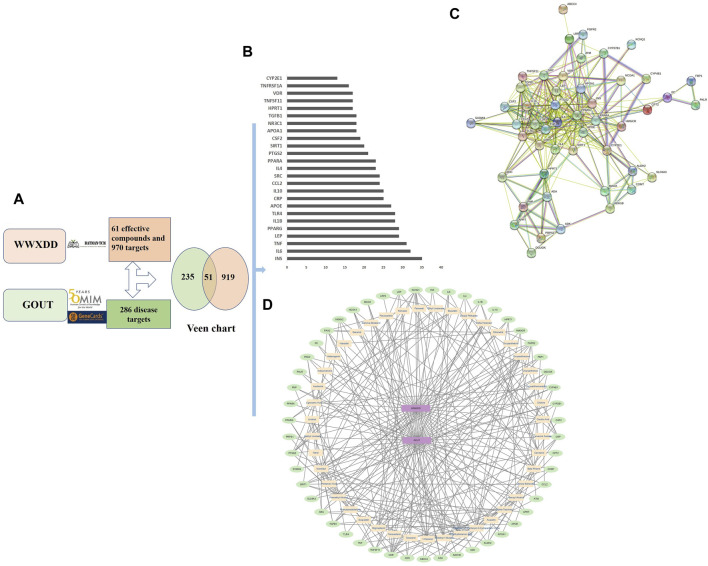
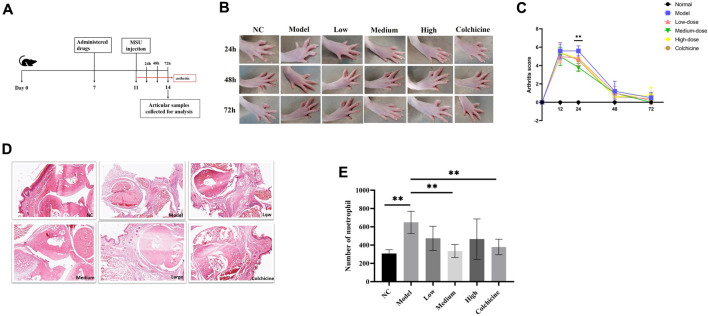
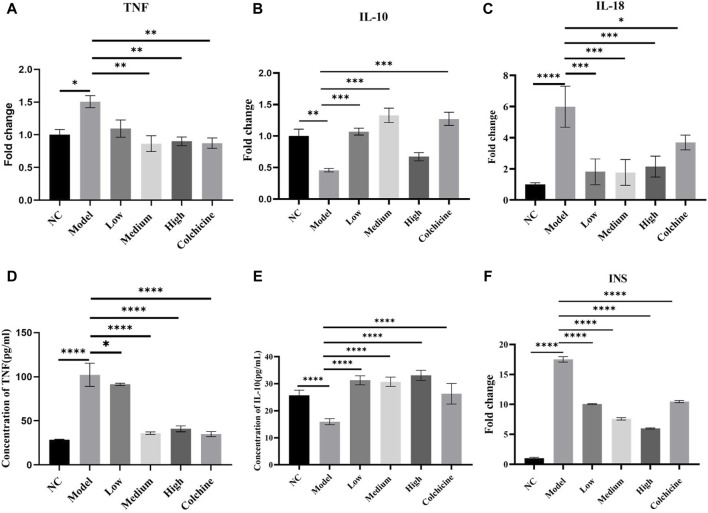
Wuwei Xiaodu Drink (WWXDD), a classical decoction of traditional Chinese medicine, has been clinically used for the treatment of gout in China for many years. This study aimed to demonstrate the efficacy of WWXDD in treating gout flares and elucidate its underlying therapeutic mechanism. A randomized control trial was conducted to compare the effectiveness of WWXDD with low-dose colchicine in gout arthritis. The primary outcome was the clinical response rate on the 7th day, and joint syndrome score and serological tests were secondary outcome measures and were compared in the two groups on the 1st and 7th day. Then we used a network pharmacology approach to investigate the possible mechanism of WWXDD in treating gout, and the effects of WWXDD on the MSU-induced rat model were observed. In the clinical trial, a total of 78 participants completed the study, and the results demonstrated comparable clinical complete response rates, joint symptom scores, and serological test outcomes between the two groups on the 7th day. Network pharmacology analysis identified 51 core genes that target gout and WWXDD interactions. Notably, strong significant correlations were observed with inflammation cytokine genes and metabolism-related genes. Furthermore, it was found that WWXDD reduced gene expression levels of inflammation cytokines including IL-1β, TNF, and IL-18 in an MSU-induced rat model while increasing IL-10 expression. Additionally, WWXDD decreased insulin gene expression in this model. Moreover, WWXDD exhibited a reduction in both gene and protein expressions associated with the NLRP3-mediated inflammatory pathway in inflamed joints of rats. The results of the present study suggested the anti-inflammatory effects of WWXDD in the treatment of gouty arthritis, partially through inhibiting NLRP3 inflammasome activation. ClinicalTrials.gov, identifier ChiCTR2100047807.
五味消毒饮(WWXDD)是一种经典的中药汤剂,在中国临床上用于治疗痛风已有多年。本研究旨在证明五味消毒饮治疗痛风发作的疗效,并阐明其潜在的治疗机制。进行了一项随机对照试验,比较五味消毒饮与低剂量秋水仙碱治疗痛风性关节炎的有效性。主要结局是第7天的临床反应率,关节综合征评分和血清学检查为次要结局指标,并在第1天和第7天对两组进行比较。然后,我们采用网络药理学方法研究五味消毒饮治疗痛风的可能机制,并观察五味消毒饮对尿酸钠(MSU)诱导的大鼠模型的影响。在临床试验中,共有78名参与者完成了研究,结果表明两组在第7天的临床完全缓解率、关节症状评分和血清学检查结果具有可比性。网络药理学分析确定了51个针对痛风和五味消毒饮相互作用的核心基因。值得注意的是,观察到与炎症细胞因子基因和代谢相关基因有很强的显著相关性。此外,发现在MSU诱导的大鼠模型中,五味消毒饮降低了包括IL-1β、TNF和IL-18在内的炎症细胞因子的基因表达水平,同时增加了IL-10的表达。此外,五味消毒饮降低了该模型中胰岛素基因的表达。此外,五味消毒饮在大鼠炎症关节中与NLRP3介导的炎症途径相关的基因和蛋白质表达均降低。本研究结果表明五味消毒饮在治疗痛风性关节炎中具有抗炎作用,部分是通过抑制NLRP3炎性小体激活实现的。ClinicalTrials.gov标识符:ChiCTR2100047807。