Girardi Nicholas G, Malin Sean, Zielenski Christopher, Lee Jessica H, Henry Kaleigh, Kraeutler Matthew J, Mei-Dan Omer
University of Colorado Anschutz Medical Campus, Aurora, Colorado, USA.
Boulder Valley Anesthesiology, Boulder, Colorado, USA.
Orthop J Sports Med. 2024 Aug 8;12(8):23259671241257260. doi: 10.1177/23259671241257260. eCollection 2024 Aug.
Previous studies have sought to determine the effect of inpatient ketamine therapy on postoperative pain in a variety of surgical specialties.
To determine the effects of postoperative ketamine analgesia after periacetabular osteotomy (PAO) and/or derotational femoral osteotomy (DFO) on opioid requirements, pain, and discharge time.
Cohort study; Level of evidence, 3.
Prospective data were collected on 145 patients who underwent PAO and/or DFO by the senior author between January 2021 and December 2022. Hip arthroscopy was performed 3 to 10 days before addressing any intra-articular pathology. In 2021, patients (n = 91 procedures; control group) received a traditional postoperative multimodal pain regimen. In 2022, postoperative low-dose ketamine (0.1-1 mg/kg/h) was added to the multimodal analgesic approach until 24 hours before discharge (n = 81 procedures; ketamine group). The ketamine and control groups were matched based on procedure type. Total opioid consumption was collected using milligram morphine equivalents (MMEs) for both groups. Postoperative pain was measured using the Defense and Veterans Pain Rating Scale (DVPRS), which was analyzed as the mean score per day. Data on the mean MME and DVPRS were analyzed for up to 7 days postoperatively. Linear mixed statistical analysis was performed to determine the significance of low-dose postoperative ketamine on postoperative pain and opioid utilization.
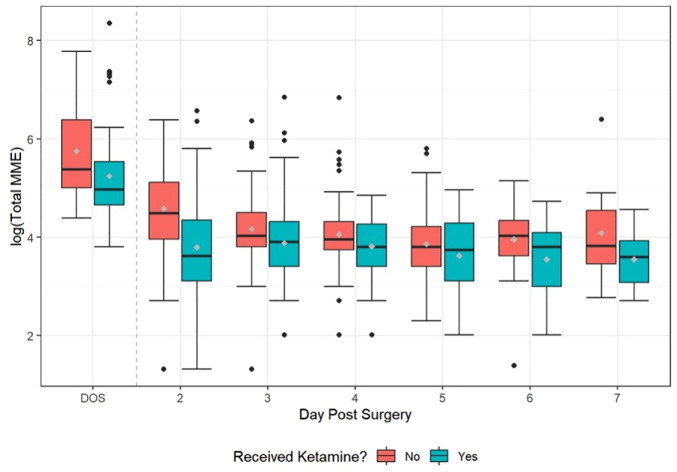
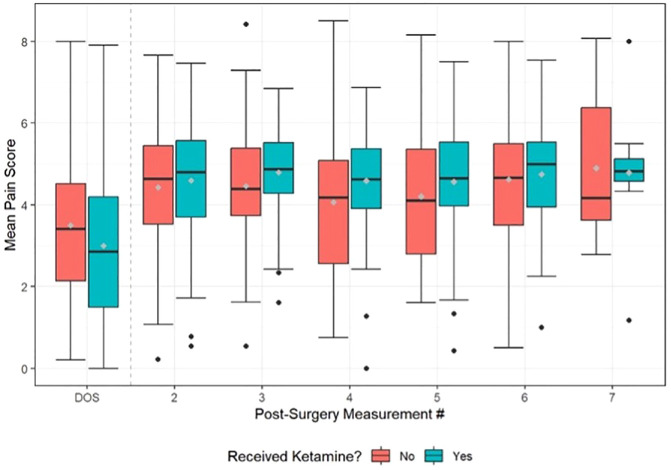
Patients who did not receive ketamine after PAO and/or DFO utilized a mean of 181 ± 335 MMEs and had a mean DVPRS score of 4.18 ± 1.63. Patients who received postoperative ketamine required a mean of 119 ± 291 MMEs and had a mean DVPRS score of 4.34 ± 1.61. The ketamine group was found to consume a significantly lower total MME dose per day ( < .001). No significant difference was found in the mean DVPRS score between the ketamine and control groups ( = .42). Also, no significant difference was found on the day of discharge ( = .79).
Patients who received postoperative ketamine after PAO and/or DFO had a significant decrease in MME dose when compared with a control group of patients who did not receive ketamine. Surgeons should consider adding ketamine to their postoperative multimodal pain control protocol to decrease opioid consumption while adequately addressing postoperative pain.
以往研究试图确定住院氯胺酮治疗对各种外科专业术后疼痛的影响。
确定髋臼周围截骨术(PAO)和/或股骨去旋转截骨术(DFO)后氯胺酮镇痛对阿片类药物需求、疼痛和出院时间的影响。
队列研究;证据等级,3级。
前瞻性收集了2021年1月至2022年12月期间资深作者为145例行PAO和/或DFO手术患者的数据。在处理任何关节内病变前3至10天进行髋关节镜检查。2021年,患者(n = 91例手术;对照组)接受传统的术后多模式镇痛方案。2022年,术后低剂量氯胺酮(0.1 - 1毫克/千克/小时)被添加到多模式镇痛方案中,直至出院前24小时(n = 81例手术;氯胺酮组)。氯胺酮组和对照组根据手术类型进行匹配。两组均使用毫克吗啡当量(MME)收集阿片类药物总消耗量。术后疼痛采用国防与退伍军人疼痛评定量表(DVPRS)进行测量,并分析为每日平均得分。对术后长达7天的平均MME和DVPRS数据进行分析。进行线性混合统计分析以确定术后低剂量氯胺酮对术后疼痛和阿片类药物使用的显著性。
PAO和/或DFO术后未接受氯胺酮治疗的患者平均使用181 ± 335 MMEs,平均DVPRS评分为4.18 ± 1.63。接受术后氯胺酮治疗的患者平均需要119 ± 291 MMEs,平均DVPRS评分为4.34 ± 1.61。发现氯胺酮组每天消耗的MME总剂量显著更低(P <.001)。氯胺酮组和对照组之间的平均DVPRS评分无显著差异(P =.42)。出院当天也未发现显著差异(P =.79)。
与未接受氯胺酮治疗的对照组患者相比,PAO和/或DFO术后接受氯胺酮治疗的患者MME剂量显著降低。外科医生应考虑在其术后多模式疼痛控制方案中添加氯胺酮,以减少阿片类药物消耗,同时充分处理术后疼痛。