Varghese Alan, Gusarov Ivan, Gamallo-Lana Begoña, Dolgonos Daria, Mankan Yatin, Shamovsky Ilya, Phan Mydia, Jones Rebecca, Gomez-Jenkins Maria, White Eileen, Wang Rui, Jones Drew, Papagiannakopoulos Thales, Pacold Michael E, Mar Adam C, Littman Dan R, Nudler Evgeny
Department of Cell Biology, NYU Grossman School of Medicine, New York, NY 10016, USA.
Department of Biochemistry and Molecular Pharmacology, NYU Grossman School of Medicine, New York, NY 10016, USA.
bioRxiv. 2024 Jul 31:2024.07.30.605703. doi: 10.1101/2024.07.30.605703.
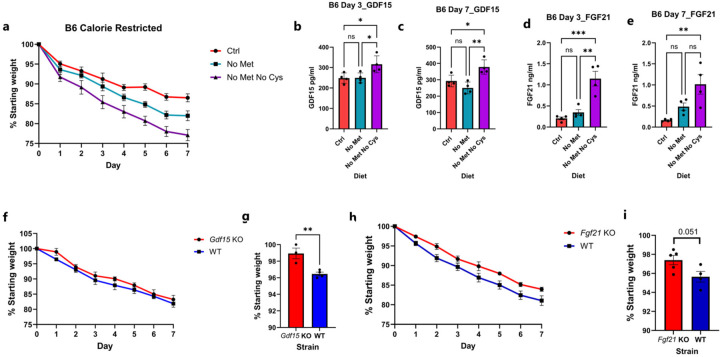
Forty percent of the US population and 1 in 6 individuals worldwide are obese, and the incidence of this disease is surging globally. Various dietary interventions, including carbohydrate and fat restriction, and more recently amino acid restriction, have been explored to combat this epidemic. We sought to investigate the impact of removing individual amino acids on the weight profiles of mice. Compared to essential amino acid restriction, induction of conditional cysteine restriction resulted in the most dramatic weight loss, amounting to 20% within 3 days and 30% within one week, which was readily reversed. This weight loss occurred despite the presence of substantial cysteine reserves stored in glutathione (GSH) across various tissues. Further analysis demonstrated that the weight reduction primarily stemmed from an increase in the utilization of fat mass, while locomotion, circadian rhythm and histological appearance of multiple other tissues remained largely unaffected. Cysteine deficiency activated the integrated stress response (ISR) and NRF2-mediated oxidative stress response (OSR), which amplify each other, leading to the induction of GDF15 and FGF21, hormones associated with increased lipolysis, energy homeostasis and food aversion. We additionally observed rapid tissue coenzyme A (CoA) depletion, resulting in energetically inefficient anaerobic glycolysis and TCA cycle, with sustained urinary excretion of pyruvate, orotate, citrate, α-ketoglutarate, nitrogen rich compounds and amino acids. In summary, our investigation highlights that cysteine restriction, by depleting GSH and CoA, exerts a maximal impact on weight loss, metabolism, and stress signaling compared to other amino acid restrictions. These findings may pave the way for innovative strategies for addressing a range of metabolic diseases and the growing obesity crisis.
美国40%的人口以及全球六分之一的人患有肥胖症,且这种疾病的发病率在全球范围内呈激增态势。人们已经探索了各种饮食干预措施,包括碳水化合物和脂肪限制,以及最近的氨基酸限制,以对抗这一流行病。我们试图研究去除单个氨基酸对小鼠体重的影响。与必需氨基酸限制相比,诱导条件性半胱氨酸限制导致了最显著的体重减轻,3天内体重减轻20%,一周内体重减轻30%,且这种体重减轻很容易逆转。尽管各种组织中存在大量储存在谷胱甘肽(GSH)中的半胱氨酸储备,但体重仍出现了减轻。进一步分析表明,体重减轻主要源于脂肪量利用率的增加,而运动、昼夜节律和其他多种组织的组织学外观基本未受影响。半胱氨酸缺乏激活了综合应激反应(ISR)和NRF2介导的氧化应激反应(OSR),这两种反应相互放大,导致生长分化因子15(GDF15)和成纤维细胞生长因子21(FGF21)的诱导,这两种激素与脂肪分解增加、能量稳态和食物厌恶有关。我们还观察到组织辅酶A(CoA)迅速耗尽,导致能量效率低下的无氧糖酵解和三羧酸循环,同时丙酮酸、乳清酸、柠檬酸、α-酮戊二酸、富氮化合物和氨基酸持续从尿液中排出。总之,我们的研究强调,与其他氨基酸限制相比,半胱氨酸限制通过消耗GSH和CoA,对体重减轻、新陈代谢和应激信号产生最大影响。这些发现可能为解决一系列代谢疾病和日益严重的肥胖危机的创新策略铺平道路。