Gillessen Anton, Angelico Francesco, Chen Jun, Lu Lungen, Lucena Maria Isabel, Fu Qingchun, Xie Qing, Andrade Raul J, Xie Wen, Xu Xiaoyuan, Yu Yanyan, Mao Yi-Min, Nan Yuemin
Department of Internal Medicine, Herz-Jesu-Hospital, Muenster, Germany.
Department of Public Health and Infectious Diseases, Sapienza University School of Medicine, Rome, Italy.
Gastro Hep Adv. 2022 May 14;1(5):882-893. doi: 10.1016/j.gastha.2022.05.006. eCollection 2022.
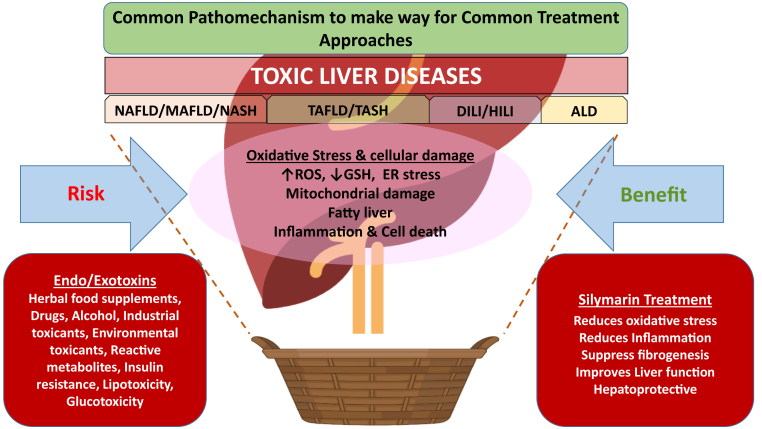
Chronic liver disease (CLD) is a leading health problem impacting the quality of life globally. China shares a major global burden of CLD-including alcoholic liver disease, nonalcoholic fatty liver disease/metabolic dysfunction-associated fatty liver disease, and drug-induced liver injury, except for chronic viral hepatitis. Several exogenous toxins or endogenous metabolic insults trigger hepatic pathology toward steatosis, inflammation, and fibrosis, which, if left untreated, may culminate in liver cirrhosis. Oxidative stress is a common pathomechanism underlying all phenotypes of toxic liver injury; thus, these may be brought under a unified entity, viz. toxic liver disease (TLD). Therefore, a common strategy to treat TLD is to use antioxidants as hepatoprotective agents. The cornerstone for treating fatty liver disease is lifestyle modification, diet, exercise, and behavioral therapy, along with the limited use of pharmacological agents. Available preclinical and clinical evidence indicates that silymarin is a hepatoprotective agent with established antioxidant, anti-inflammatory, antifibrotic effects. An international expert panel of clinicians was convened to discuss combining alcoholic liver disease, nonalcoholic fatty liver disease/metabolic dysfunction-associated fatty liver disease, drug-induced liver injury, and liver cirrhosis under the single definition of TLD, based on the shared pathologic mechanism of oxidative stress. The panel highlighted the significance of silymarin as an antioxidant treatment for TLD.
慢性肝病(CLD)是一个影响全球生活质量的主要健康问题。中国承担着全球慢性肝病的主要负担,包括酒精性肝病、非酒精性脂肪性肝病/代谢功能障碍相关脂肪性肝病以及药物性肝损伤,但不包括慢性病毒性肝炎。几种外源性毒素或内源性代谢损伤会引发肝脏病变,导致脂肪变性、炎症和纤维化,如果不加以治疗,可能最终发展为肝硬化。氧化应激是所有类型中毒性肝损伤的共同病理机制;因此,这些情况可归为一个统一的实体,即中毒性肝病(TLD)。所以,治疗TLD的一个常见策略是使用抗氧化剂作为肝保护剂。治疗脂肪性肝病的基石是生活方式改变、饮食、运动和行为疗法,同时有限度地使用药物。现有的临床前和临床证据表明,水飞蓟宾是一种具有明确抗氧化、抗炎、抗纤维化作用的肝保护剂。一个由临床医生组成的国际专家小组召开会议,基于氧化应激这一共同病理机制,讨论将酒精性肝病、非酒精性脂肪性肝病/代谢功能障碍相关脂肪性肝病、药物性肝损伤和肝硬化合并在TLD这一单一定义之下。该小组强调了水飞蓟宾作为TLD抗氧化治疗药物的重要性。