Siddiqui Saman Asad, Kazemian Sina, Gupta Tanush, Patel Nilay K, Sakhuja Rahul, Inglessis Ignacio, Jassar Arminder, Langer Nathaniel, Passeri Jonathan J, Dauerman Harold L, Elmariah Sammy, Kolte Dhaval
Harvard Medical School, Boston, Massachusetts.
Cardiovascular Diseases Research Institute, Tehran University of Medical Sciences, Tehran, Iran.
J Soc Cardiovasc Angiogr Interv. 2024 May 22;3(7):102146. doi: 10.1016/j.jscai.2024.102146. eCollection 2024 Jul.
The choice of transcatheter aortic valve replacement (TAVR) prosthesis is crucial in optimizing short- and long-term outcomes. The objective of this study was to conduct a meta-analysis comparing outcomes of third-generation balloon-expandable valves (BEV) vs self-expanding valves (SEV).
Electronic databases were searched from inception to June 2023 for studies comparing third-generation BEV vs SEV. Primary outcome was all-cause mortality. Secondary outcomes included clinical and hemodynamic end points. Random-effects models were used to calculate pooled odds ratios (ORs) or weighted mean differences (WMDs).
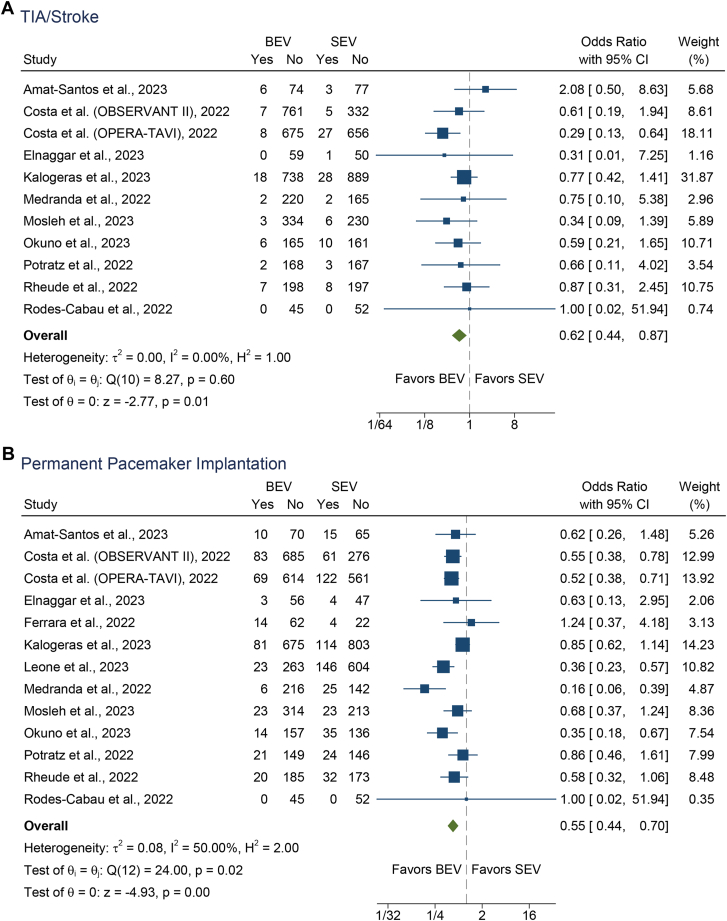
The meta-analysis included 16 studies and 10,174 patients (BEV, 5753 and SEV, 4421). There were no significant differences in 1-year all-cause mortality (OR, 1.15; 95% CI, 0.89-1.48) between third-generation BEV vs SEV. TAVR with third generation BEV was associated with a significantly lower risk of TIA/stroke (OR, 0.62; 95% CI, 0.44-0.87), permanent pacemaker implantation (OR, 0.55; 95% CI, 0.44-0.70), and ≥moderate paravalvular leak (PVL, OR, 0.43; 95% CI, 0.25-0.75), and higher risk of ≥moderate patient-prosthesis mismatch (OR, 3.76; 95% CI, 2.33-6.05), higher mean gradient (WMD, 4.35; 95% CI, 3.63-5.08), and smaller effective orifice area (WMD, -0.30; 95% CI, -0.37 to -0.23), compared with SEV.
In this meta-analysis, TAVR with third-generation BEV vs SEV was associated with similar all-cause mortality, lower risk of TIA/stroke, permanent pacemaker implantation, and ≥moderate PVL, but higher risk of ≥moderate patient-prosthesis mismatch, higher mean gradient, and smaller effective orifice area. Large, adequately powered randomized trials are needed to evaluate long-term outcomes of TAVR with latest generations of BEV vs SEV.
经导管主动脉瓣置换术(TAVR)假体的选择对于优化短期和长期疗效至关重要。本研究的目的是进行一项荟萃分析,比较第三代球囊扩张瓣膜(BEV)与自膨胀瓣膜(SEV)的疗效。
检索电子数据库,从建库至2023年6月,查找比较第三代BEV与SEV的研究。主要结局是全因死亡率。次要结局包括临床和血流动力学终点。采用随机效应模型计算合并比值比(OR)或加权平均差(WMD)。
该荟萃分析纳入了16项研究和10174例患者(BEV组5753例,SEV组4421例)。第三代BEV与SEV在1年全因死亡率方面无显著差异(OR,1.15;95%CI,0.89 - 1.48)。与SEV相比,使用第三代BEV进行TAVR与短暂性脑缺血发作/中风风险显著降低(OR,0.62;95%CI,0.4