Herweijer Eva, Schwamborn Klaus, Bollaerts Kaatje, Spillmann Adrian, Cattaert Tom, Verstraeten Thomas, Hoogstraate Janet
P95 Epidemiology and Pharmacovigilance, Heverlee, Belgium.
Global Scientific Alliance & innovation, Valneva SE, Saint-Herblain, France.
Gastro Hep Adv. 2022 Apr 29;1(4):531-537. doi: 10.1016/j.gastha.2022.02.013. eCollection 2022.
Recently, cholera vaccine use was shown to be associated with a reduced risk of death in patients with colorectal cancer (CRC). However, evidence on heterologous effects of travel vaccines is limited. The aim of this study was to study heterologous effects of travel vaccines in patients with CRC.
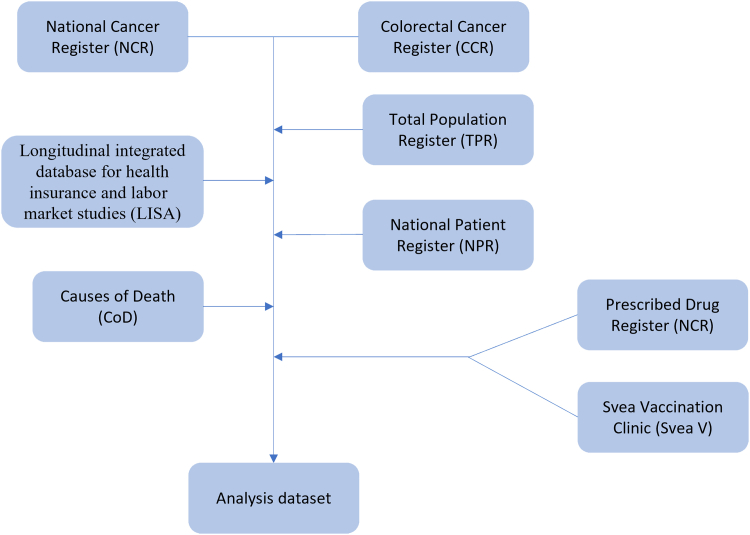
We performed a retrospective database study on a cohort of CRC patients in Sweden and their postdiagnostic use of travel medications between July 2005 and December 2017. We obtained data from national registries on number of CRC diagnosis, death from CRC or other causes, age at diagnosis, and postdiagnostic use of travel vaccines and malaria prophylaxis. The Cox regression model was used to calculate incidence rate and incidence rate ratios of CRC-related and all-cause mortality by postdiagnostic travel medication status.
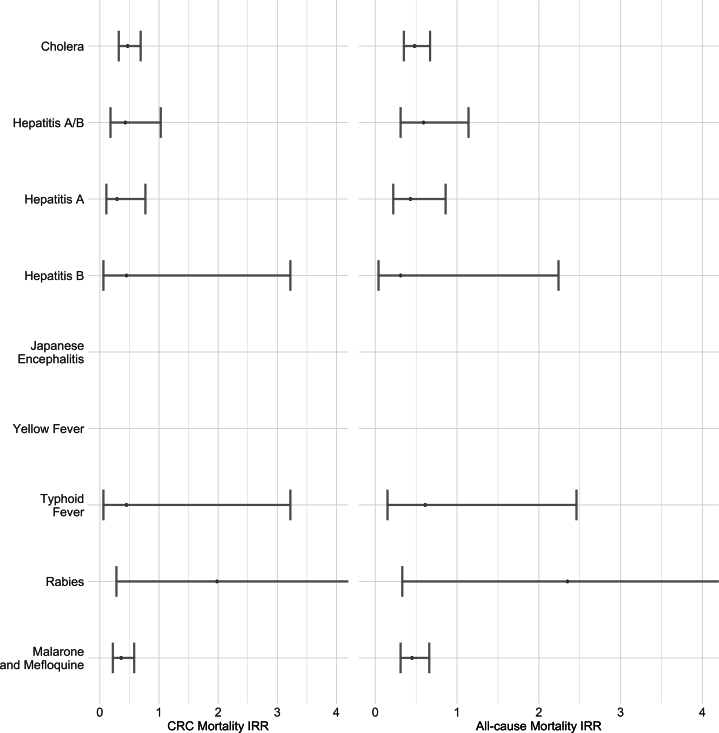
Two hundred ninety-five patients exposed to travel vaccines and malaria prophylaxis and 73,466 patients not exposed to travel medications were identified. CRC-related mortality was lowered in the exposed patients compared to the unexposed patients, irrespective of the travel medications used. The incidence rate ratios for CRC-related mortality and overall mortality were comparable.
We postulated that patients in better health were likely to travel more frequently than patients with poor health, leading to a healthy user bias. The results suggested the same, as similar reduced mortality risks were found for all the investigated travel medications, lowering the biological plausibility of truly protective effect from post-therapeutic use of any of the travel medication studied. We advocate the use of multiple negative exposure controls and to exercise caution while drawing conclusions from travel vaccine research.
最近研究表明,霍乱疫苗的使用与降低结直肠癌(CRC)患者的死亡风险有关。然而,关于旅行疫苗异源效应的证据有限。本研究的目的是探讨旅行疫苗在CRC患者中的异源效应。
我们对瑞典一组CRC患者及其在2005年7月至2017年12月期间诊断后使用旅行药物的情况进行了回顾性数据库研究。我们从国家登记处获取了CRC诊断数量、CRC或其他原因导致的死亡、诊断时的年龄以及诊断后旅行疫苗和疟疾预防药物使用的数据。采用Cox回归模型计算诊断后旅行用药状态下CRC相关死亡率和全因死亡率的发病率及发病率比。
确定了295名接触旅行疫苗和疟疾预防药物的患者以及73466名未接触旅行药物的患者。与未接触的患者相比,接触的患者CRC相关死亡率降低,无论使用何种旅行药物。CRC相关死亡率和总死亡率的发病率比相当。
我们推测健康状况较好的患者可能比健康状况较差的患者旅行更频繁,从而导致健康使用者偏差。结果表明情况相同,因为所有研究的旅行药物都发现了类似的降低死亡风险的情况,这降低了所研究的任何一种旅行药物治疗后真正具有保护作用的生物学合理性。我们提倡使用多个阴性暴露对照,并在从旅行疫苗研究中得出结论时谨慎行事。